
Managing patient referrals across healthcare facilities often becomes bogged down by slow intake processes and inconsistent insurance verification that delay admissions and revenue capture. Many solutions demand complex EHR integration, lack clear customization options, or hide enterprise pricing behind bespoke contracts, leaving clinical teams without a transparent or rapid path to deployment. This comparison details features, integrations, and pricing models for leading patient referral management software so you can select one that fits your technical resources, workflow needs, and budget.
Table of Contents
Smart Admissions
At a Glance
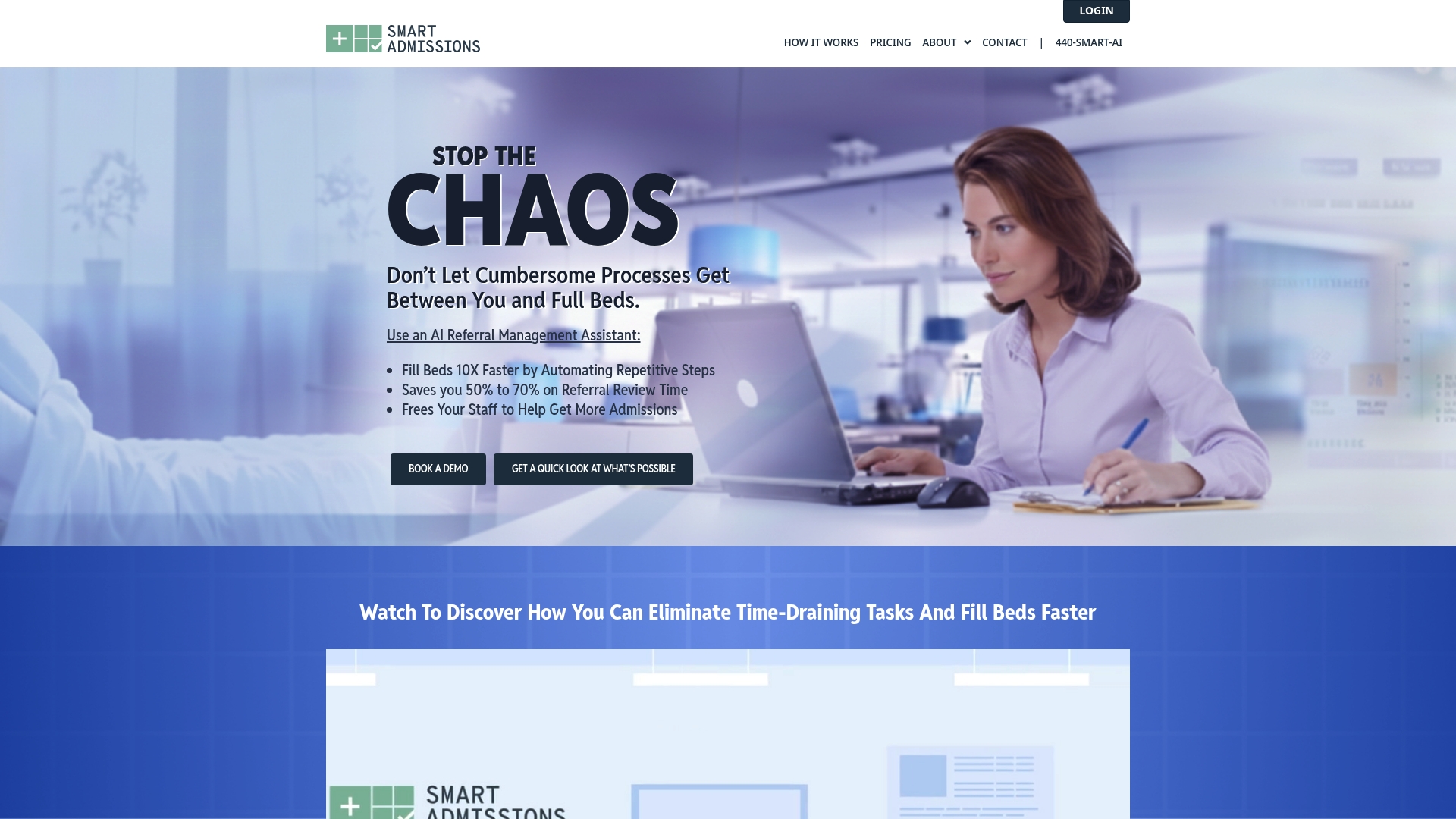
The vendor reports reducing referral review time from up to 45 minutes to under 15 minutes, a claim used to illustrate faster bed placement and revenue capture. Smart Admissions pairs that speed with automated insurance checks and a rules engine tailored to skilled nursing facilities.
Core Features
Centralized referral intake and pipeline tracking lets your team see every referral stage in one view.
Real-time insurance eligibility verification cuts manual phone calls and payer lookups.
Bidirectional EHR integration moves clinical and demographic data both ways and keeps records consistent.
A facility-specific decision engine offers accept or deny recommendations using your admission criteria, plus automated routing, notifications, and referral analytics.
Key Differentiator
The platform’s defining capability is its facility-specific decision engine that applies your SNF admission criteria in real time and combines that with eligibility verification and EHR data. That mix turns raw referrals into prioritized work items your admissions team can act on immediately.
Pros
The figure above about reduced review time gives a concrete baseline for ROI discussions during procurement and budgeting.
Automated insurance verification eliminates repetitive lookups, freeing staff to focus on clinical review rather than paperwork.
Bi-directional EHR integration preserves clinical context and reduces transcription errors that delay acceptance decisions.
Audit trails and centralized referral records simplify compliance reviews and internal audits.
Quick onboarding and high-touch support lower administrative friction when you go live.
Cons
- Requires existing EHR integration which can add setup cost and project time, making the initial implementation heavier for facilities without IT resources.
Notable Integrations
- EHR systems such as PointClickCare are listed as supported integrations.
Who It’s For
Administrators and admissions teams at skilled nursing, rehabilitation, and post-acute care facilities that want to reduce manual referral work and increase bed fill velocity. Best for organizations that have or can provision EHR integration support.
Unique Value Proposition
The platform applies facility rules to each incoming referral so your admissions staff receive a ranked, clinically informed queue rather than an undifferentiated inbox. That change shifts effort from triage to placement, which can shorten time to bed occupancy and improve capture of competitive referrals.
Real World Use Case
A skilled nursing facility used Smart Admissions and reported the time reduction noted above; that change let them place higher-priority patients faster and recover revenue that would otherwise have been lost during referral delays. The figure above is the vendor’s reported outcome from a deployment example.
Pricing
Monthly pricing starts at $597. Annual billing is available at $6,447 and covers referral management, eligibility checks, EHR integration, automation, analytics, and compliance features.
Website: https://smartadmissions.ai
SkyPoint AI Platform
At a Glance
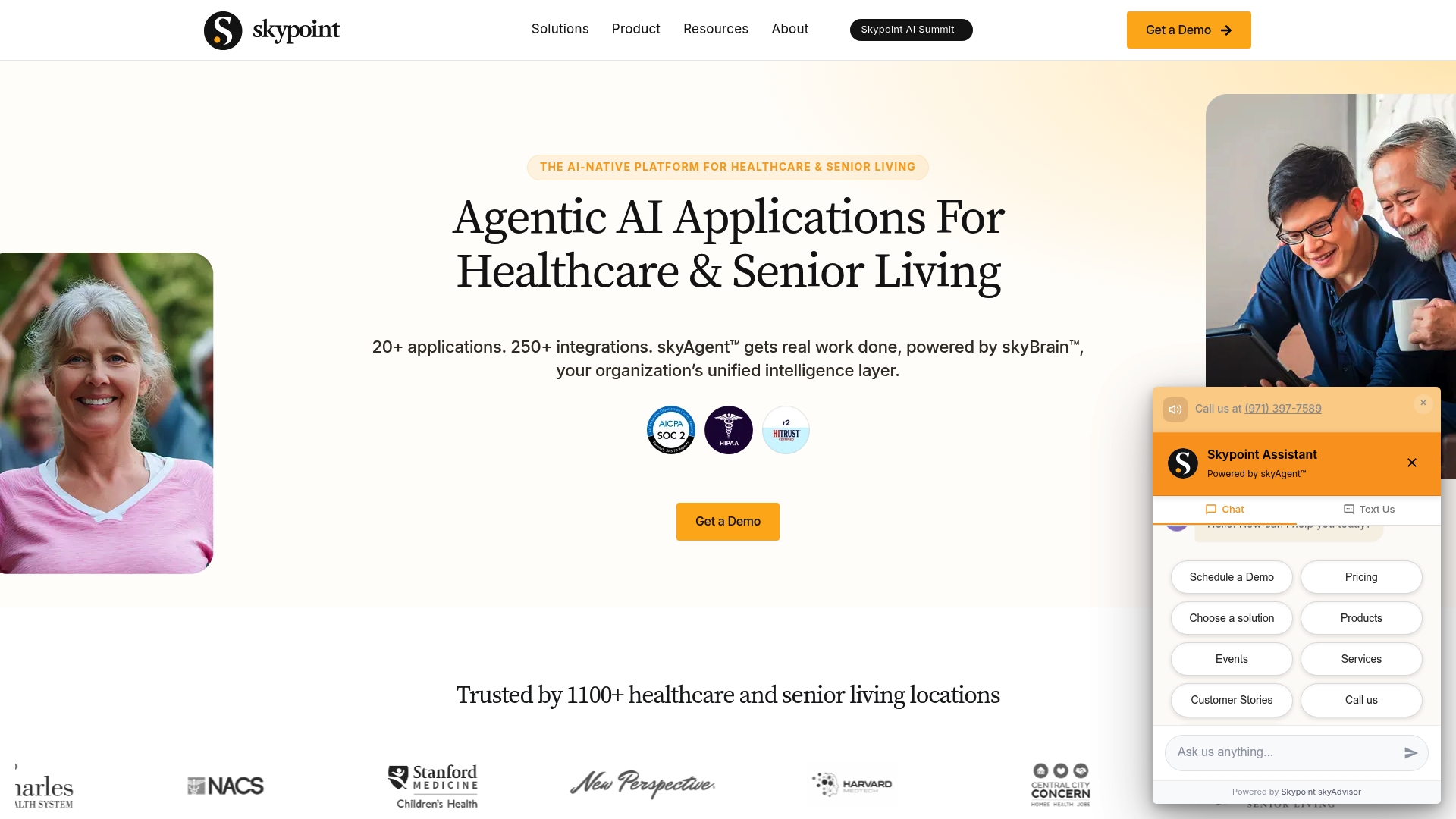
SkyPoint’s marketing materials state 250+ integrations with enterprise healthcare systems, a concrete signal of its connector-first approach. The vendor also advertises implementations delivering measurable results in weeks rather than months, a timing claim you should verify against your internal rollout plan.
SkyPoint carries HITRUST r2 certification and other compliance controls aimed at healthcare privacy and security. That combination of connectors and certification is why many health systems evaluate it first.
Core Features
SkyPoint consolidates clinical and financial data into a single analytics layer. It exposes ready-made AI applications focused on workflow automation, revenue cycle, and clinical reporting.
- Unifies data from EHRs, claims feeds, and resident records for a single view.
- Library of more than 20 AI applications targeted at healthcare and senior living workflows.
- Real-time analytics and reporting for both clinical and financial teams.
Key Differentiator
The platform’s selling point is its healthcare-specific compliance posture paired with fast deployments. The combination of HITRUST r2 certification and prebuilt healthcare models shortens vendor validation cycles and can accelerate operational use compared with generic AI platforms.
Pros
- Industry focus reduces the need to rework clinical models. For admissions and care coordination teams, workflows map to common healthcare patterns out of the box.
- Compliance stack supports HIPAA and CCPA requirements stated in the product data, easing security reviews for enterprise buyers.
- The vendor reports that onboarding can produce usable dashboards and automated workflows in weeks, which helps justify executive approvals for pilot projects.
- Large integration footprint means fewer custom adapters; that typically lowers initial engineering cost when connecting EHRs and billing systems.
- Dedicated support and tailored deployment approach are offered, which matters for organizations with tight change control windows.
Cons
- Initial integration setup can be complex, especially if your data environment is fragmented across older systems.
- The product’s focus on healthcare and senior living makes it less applicable to non-healthcare teams needing general-purpose AI tooling.
- Platform complexity may require specialized training for clinical analysts and IT staff to extract full value.
When It May Not Fit
If your organization lacks a baseline healthcare data architecture, the vendor’s integration assumptions will add time and cost. Also avoid SkyPoint when you need a lightweight point solution for a single clinical app; this platform is optimized for cross-system unification and broader operational use.
Notable Integrations
- EHR systems
- Power BI
- Medicare and Medicaid data sources
- Patient and resident records systems
Who It’s For
Health system administrators, senior living operators, and revenue cycle leaders who need secure, enterprise-grade AI that connects to many existing systems. Ideal when your priority is consolidated reporting, compliance, and operational automation across care and finance.
Real World Use Case
Cascadia Senior Living used SkyPoint to automate operational dashboards and reduce manual reporting. The deployment freed clinical staff from repetitive data pulls and surfaced utilization and cost signals to operators more quickly.
Pricing
No public pricing is provided in the product data. Expect an enterprise licensing model and custom quotes based on scope, connectors, and deployment services. Budget for implementation and training alongside license fees.
Website: https://skypoint.ai
Hippocratic AI
At a Glance
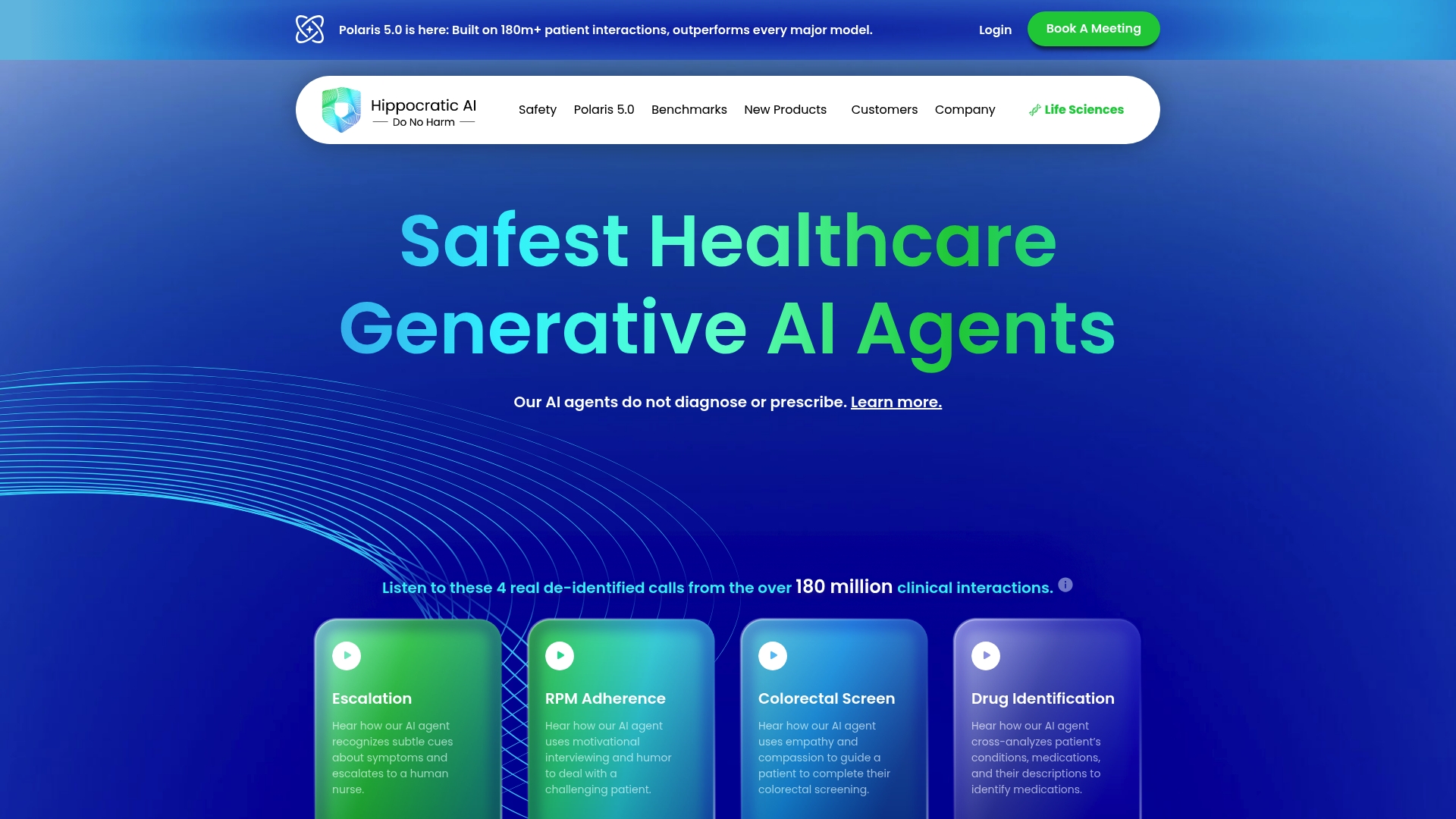
The vendor advertises a 4.1T+ parameter architecture trained on more than 180 million patient interactions and reports over 725,000 test calls from US clinicians to support its safety and accuracy focus. That marketing claim frames the product as a clinically oriented AI agent suite rather than a general chatbot.
The platform positions its agents to assist with care management, outreach, and clinical support without diagnosing or prescribing medications. The emphasis is on safety validation and equitable access.
Core Features
Autonomous healthcare agents built on large parameter architectures designed to support clinical workflows without providing diagnoses or prescriptions.
Specialized model variants focused on safety, accuracy, and empirical validation across patient outreach, care management, and escalation workflows.
Clinical testing reported by the vendor includes thousands of clinicians and millions of interactions used to refine safety behaviors and response patterns.
Key Differentiator
Hippocratic AI’s distinct claim is the combination of a very large parameter model and an explicit safety validation program. The vendor advertises extensive clinician testing and task-specific validation that aim to restrict the agent to support functions rather than clinical decision making.
That validation emphasis separates it from generic LLM vendors that repurpose conversational models without clinical test records.
Pros
Clinically oriented testing. The vendor advertises thousands of clinician interactions and a large number of test calls, which supports a defensible safety narrative for procurement teams.
Designed for non-diagnostic tasks. Agents handle outreach, monitoring, triage escalation, and administrative clinical support while avoiding diagnosis or prescriptions.
Broad task coverage. Use cases include care management, population screening, and rapid response scenarios across outpatient and inpatient settings.
Focus on equity and patient-first outcomes. The product data stresses accessibility and tailored behavior for diverse patient groups.
Large parameter backbone. The 4.1T+ architecture is intended to improve nuance and context handling in clinical conversations.
Cons
Integration details are sparse. The product data contains no explicit statements about EHR or middleware connectors, which raises technical risk for deployment teams.
Limited customization guidance. There is little information about training or tuning on a hospital’s own data, which may limit fit for institution-specific protocols.
Enterprise posture with no published pricing. No subscription or licensing details are provided, suggesting procurement is bespoke and potentially slow.
When It May Not Fit
If your hospital needs an AI that can document, diagnose, and prescribe within existing clinician workflows this is not the right choice. The vendor explicitly avoids diagnostic and prescriptive capabilities.
If you require out-of-the-box EHR integration details or a fixed per-seat SaaS contract the sparse integration and pricing information will hinder procurement and technical planning.
Who It’s For
Health systems, payors, and clinical operations teams seeking an AI assistant focused on safety validated support tasks rather than clinical decision making. Best for organizations that plan an enterprise evaluation and can run clinical validation pilots.
This is less suited to small clinics that need fast, low-friction point solutions with transparent pricing.
Real World Use Case
A hospital care management team uses Hippocratic AI agents to automate post-discharge outreach for pneumonia and diabetes cohorts. The agents run scheduled check-ins, surface red-flag responses for clinician review, and reduce unnecessary phone chasing while preserving clinician oversight.
Clinical staff review escalations and retain final decision authority, using the agent to triage rather than replace clinical judgment.
Pricing
Pricing information is not provided in the product data and is listed as not applicable for public reference. That typically indicates enterprise licensing with custom quotes and pilot arrangements rather than a standard per-seat or tiered SaaS plan.
Budget teams should expect a procurement process that includes technical validation, security review, and a pilot phase before contract negotiation.
Website: https://hippocraticai.com
Patient Referral Management Software Comparison
When deciding on patient referral management software, consider features, integrations, and fit for your organization’s operational priorities.
| Product Name | Core Feature | Key Differentiator | Best For | Pricing | Notable Limitation |
|---|---|---|---|---|---|
| Smart Admissions | Centralized referral intake and tracking with EHR integration | Facility-specific decision engine and real-time insurance verification | Skilled nursing and rehabilitation facilities | $597/month | Requires EHR integration setup efforts |
| SkyPoint AI Platform | Unified data analytics with 250+ enterprise integrations | HITRUST r2 certification and fast deployment | Health systems requiring secure enterprise-grade AI | Not disclosed | Complex initial setup for fragmented data environments |
| Hippocratic AI | Autonomous agents for care management and patient outreach | Large parameter architecture with safety validation focus | Health systems needing validated AI for non-clinical decision tasks | Not disclosed | Sparse integration and customization details |
Discover a Smarter Alternative to SkyPoint.ai for Healthcare Admissions
Choosing the right platform to manage patient referrals and admissions can feel overwhelming, especially when seeking faster bed occupancy and reduced manual workloads. Smartadmissions tackles these challenges head-on by automating referral reviews and real-time insurance eligibility checks tailored for skilled nursing and post-acute care facilities. Unlike some complex enterprise solutions, Smartadmissions delivers a focused, easy-to-onboard platform that frees your team from repetitive tasks while improving revenue capture.
Experience how Smartadmissions transforms your referral process with its AI-powered assistant and bi-directional EHR integration. Visit Smartadmissions to explore features, see client success stories, and schedule a demo that shows you how to reduce referral review times and increase bed fill rates effectively.
Frequently Asked Questions
How does Smartadmissions automate referral reviews?
Smartadmissions reduces referral review time from up to 45 minutes to under 15 minutes through its facility-specific decision engine. This engine combines eligibility verification and EHR data to prioritize referrals effectively. You can expect faster bed placements and improved revenue capture with this efficient system.
What is the difference between Smartadmissions and SkyPoint AI for patient referral management?
SkyPoint AI has over 250 integrations with enterprise healthcare systems, offering a strong connector-first approach for data unification. In contrast, Smartadmissions provides a centralized referral intake process and automated insurance eligibility verification, which is ideal for actively managing patient admissions. Consider Smartadmissions if your main focus is on streamlining referral workflows and improving bed fill velocity.
Which platform offers easier onboarding for healthcare facilities?
Smartadmissions is designed for quick onboarding, reducing administrative friction when going live. It includes high-touch support, which is critical for organizations new to patient referral management software. Opt for Smartadmissions if you prioritize a smoother implementation experience.
Can I use Smartadmissions without existing EHR integration?
Smartadmissions requires existing EHR integration, which may add setup costs and time for facilities without IT resources. This factor is crucial if your organization has limited technical support, as you may need additional planning for implementation.
What pricing tiers does Smartadmissions offer?
Smartadmissions starts at a monthly price of $597, with annual billing available at $6,447, covering features like referral management and EHR integration. This pricing allows reasonable budgeting for facilities looking to enhance their patient referral management capabilities.