
Value-based referrals are the leads most likely to convert into a fast, confirmed, revenue-positive admission: clean payer coverage, clear clinical fit, and realistic length-of-stay potential. A crucial improvement for any admissions team is to shift from reviewing referrals in order of arrival to using a decision-first triage checklist that assesses payer, clinical, and bed-fit data simultaneously rather than sequentially.
TL;DR:
- More facilities are stabilizing referral volumes and increasing admission rates by using predictive analytics and parallel review workflows.
- High-value referrals are identified by confirmed payer coverage, appropriate clinical need, proper documentation, bed fit, and discharge timing within hours.
- Automated, parallel checks for eligibility, documentation gaps, and bed availability reduce referral response times by up to 19 hours compared to sequential review.
- Key KPIs include time to first response, acceptance rate, admission conversion, referral leakage, and revenue per admission to measure triage effectiveness.
- Successful triage programs require clear escalation rules, ownership of exception cases, and ongoing rule tuning, with automation supporting clinical judgment.
Table of Contents
- What Value-Based Referrals Mean for Admissions Teams
- Which Referral Criteria Signal High Value?
- How Should the Triage Workflow Actually Run?
- What KPIs Prove a Triage Program Is Working?
- What I’ve Learned Watching Triage Rollouts Succeed and Stall
- How Smart Admissions Puts This Triage Method to Work
- Sources
- FAQ
What Value-Based Referrals Mean for Admissions Teams
Value-based referrals, in this context, have nothing to do with value-based payment models between providers and payers. That term describes reimbursement arrangements tied to quality metrics and shared savings. Here, “value” means something more immediate: which referrals are worth your admissions team’s limited hours today.
Every facility deals with referral packets that arrive incomplete, get stuck in sequential review, or turn into bad-fit admits that strain staffing within 48 hours. That drag shows up as census gaps, rushed documentation, and burned-out coordinators chasing missing authorization numbers at 6 p.m.
The fix isn’t reviewing faster. It’s reviewing smarter. Research into skilled nursing facility (SNF) admissions workflows shows that fragmented, sequential handoffs are the primary cause of referral delay, and that first-pass summaries paired with parallel review cut both errors and decision time. Industry reporting also shows referral volumes to SNFs have stabilized while admission rates are actually rising among facilities using predictive analytics to sort referrals faster. The opportunity isn’t more referrals. It’s converting the good ones before a competing facility does.

Which Referral Criteria Signal High Value?
A high-value referral checks out on five dimensions at once, not one at a time. Build your triage checklist around these fields and score each referral the moment it lands, before anyone reads the full chart.
- Payer and authorization status: Is coverage confirmed, pending, or unclear? A pending Medicare Advantage authorization is not automatically a no-go, but it changes your response timeline.
- Expected length of stay: Short-stay rehab cases and long-term skilled cases carry different revenue and staffing implications; know which one you’re looking at before you accept.
- Skilled need intensity: Wound care, IV therapy, and complex medication management demand specific staff coverage. Match acuity to your actual staffing that week, not your staffing on paper.
- Therapy plan and frequency: PT, OT, and speech therapy volume drives both reimbursement and staffing load.
- Documentation completeness: Missing history and physical notes, incomplete medication lists, or absent discharge summaries all slow acceptance and increase clinical risk.
- Bed and room fit: Isolation needs, bariatric equipment, or private-room requirements narrow your available inventory fast.
- Discharge timing: A same-day discharge needs an answer in hours, not by tomorrow’s stand-up meeting.
Sort each referral into one of three buckets: automatic fit (clear payer, clear clinical match, bed available), operator review (one or two flags that need a human judgment call), or automatic no-go (acuity or coverage mismatch your facility cannot safely absorb). Borderline cases, like a pending authorization with a strong clinical match, belong in operator review, not in the reject pile.
How Should the Triage Workflow Actually Run?
The workflow that works runs checks in parallel, not in a line. Sequential handoffs, where one coordinator finishes the clinical read before another starts the payer check, are exactly what stalls referral packets for hours. Run the clinical extract, the payer and authorization lookup, and the bed and staffing check simultaneously the moment a referral arrives.
Automate what’s repetitive and keep judgment calls human:
- Automate data extraction from referral documents and EMR feeds so no coordinator retypes a diagnosis code by hand.
- Automate eligibility and authorization lookups against insurance portals in real time, not via a phone queue.
- Automate missing-document alerts so gaps get flagged to the referral source before your team even opens the chart.
- Route automatically based on facility-specific rules (bed type, acuity ceiling, payer mix targets).
- Reserve human review for clinical judgment calls and the final acceptance decision. Automation should hand your staff a decision-ready packet, not make the decision for them.
Integration matters here. Your workflow needs live EMR connectivity, insurance portal access, timestamped audit trails for every step, and routing rules your team actually wrote, not generic defaults — much like how specialized Healthcare SEO Services build trust and visibility in healthcare networks to increase referrals. Facilities that centralized referral coordination with real-time availability and authorization data saw response times improve by 13 to 19 hours in one documented case study.
Pro Tip: Write your escalation rule before you need it. Decide now who owns a referral that’s flagged “operator review” after 4 p.m. on a Friday, so no packet sits untouched over a weekend.
What KPIs Prove a Triage Program Is Working?
Track a small set of numbers, and track them from day one of any pilot. These are the ones that actually tell you whether triage is improving revenue and reducing wasted staff time:
- Time to first response: how fast a referral gets any acknowledgment.
- Time to acceptance: how fast it gets a real yes or no.
- Acceptance rate: the share of referrals your facility accepts.
- Admission conversion: accepted referrals that actually admit.
- Referral leakage: qualified referrals lost to slower response or incomplete follow-up.
- Revenue per admission: the financial payoff per completed case.
- Staff-hours per referral: the labor cost of processing each one.
One health system that standardized referral workflows and added real-time bed visibility reduced length of stay by 0.3 days for post-acute transfers and opened additional beds daily.
For a quick pilot ROI estimate, use: (staff-hours saved × hourly cost) + (additional admissions × margin per admission). Collect baseline hours-per-referral and current acceptance rate before you start, so the comparison means something.
What I’ve Learned Watching Triage Rollouts Succeed and Stall
The first four weeks of any triage rollout look messy, and that’s normal. Staff are still second-guessing the automated flags, and your decision rules are incomplete. Teams that persist with the process often see acceptance decisions moving much faster within a few months, and over time, the checklist becomes an integral part of the workflow.
The rollouts that stall almost always share one root cause: nobody owns the exception queue. When “operator review” referrals sit because three people assume someone else is watching, the whole system reverts to the old chaos. The second most common failure is writing decision rules too loosely, so half of every batch lands in manual review anyway. Tighten the rules as real data comes in. Treat the first quarter as calibration, not failure.
— Harry
How Smart Admissions Puts This Triage Method to Work
Everything covered above, the checklist, the parallel checks, the automated alerts, is exactly what Smartadmissions is built to run, without your team building it from scratch in a spreadsheet. An AI referral assistant can connect to EMR and insurance portals to verify eligibility, flag missing documentation, and route referrals against a facility’s acceptance rules, while a coordinator handles the actual judgment call.
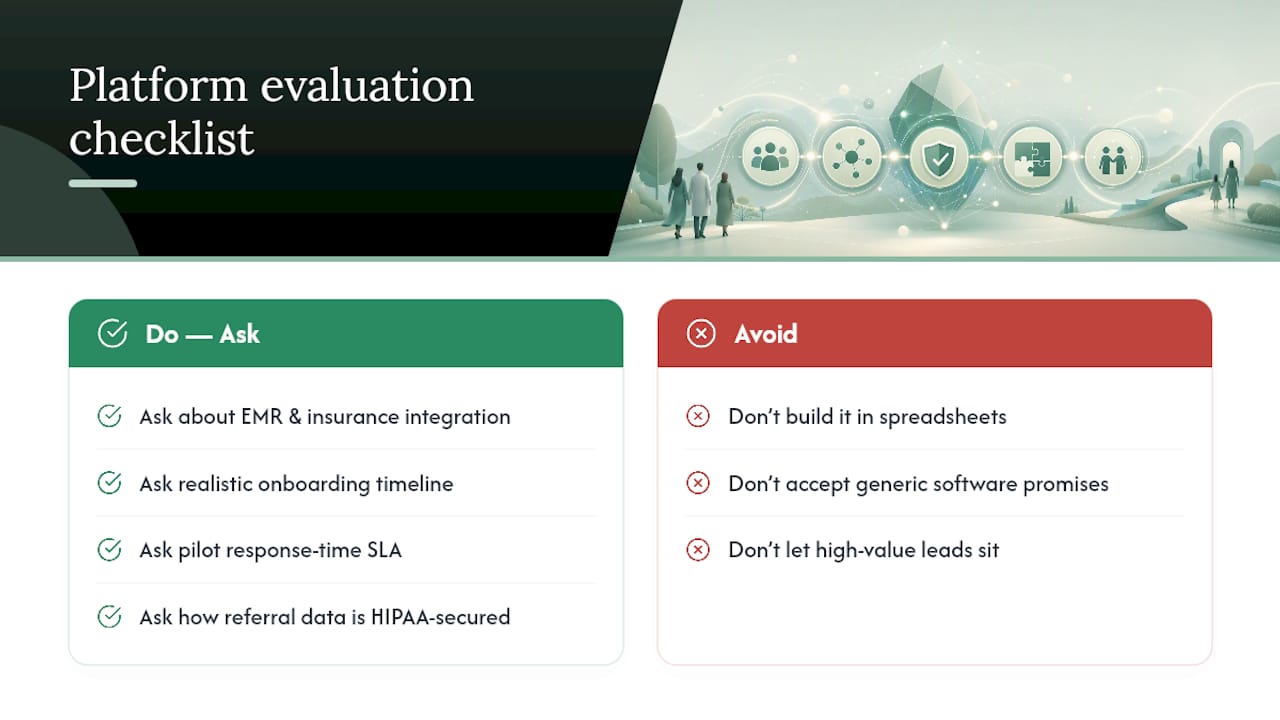
If you’re evaluating a platform, ask pointed questions before signing anything: How deep is the EMR and insurance portal integration? What’s the realistic onboarding timeline for your facility size? What response-time SLA does the platform commit to during a pilot? How is referral data secured and handled for HIPAA compliance? Some referral management platforms are built around these operational questions rather than generic software promises.
See how the workflow maps to real features in 7 Examples of Referral Management Systems for Efficiency, and request a walkthrough of your own referral volume before your next high-value lead lands and sits too long.
Sources
For deeper research, review the electronic case summary study on post-acute referral decisions, the Carilion Clinic referral center case study, and Smartadmissions’s own guide on data-driven admissions decisions.
- Post-Acute Referral Center Case Study – Carilion Clinic – TeleTracking
- Case and referral management technology gets big results for St. Luke’s | Healthcare IT News
- Hospital-to-skilled-nursing-facility referral rate stable; admission rate rises | Skilled Nursing News
FAQ
What Are Value-Based Referrals in Skilled Nursing?
Value-based referrals are referral leads prioritized by their likely admission conversion, confirmed payer coverage, and revenue potential, not by arrival order or referral source alone.
How Long Should Referral Triage Take?
Decision-ready triage should produce an accept or decline answer within hours, not days; facilities using centralized coordination and real-time data have cut response time by 13 to 19 hours compared to manual review.
Which KPIs Matter Most for Referral Triage?
Time to first response, acceptance rate, admission conversion, referral leakage, and revenue per admission together give the clearest picture of whether triage is working.
Can Automation Replace Clinical Judgment in Referral Review?
No. Automation should handle data extraction, eligibility lookups, and document flagging, while clinical judgment and final acceptance decisions stay with trained staff.