
Managing admissions at skilled nursing facilities across America often means balancing complex workflows and stretched staff resources. The growing demand for efficient patient intake makes this challenge even more pressing. By adopting artificial intelligence tools, directors gain a practical solution that reduces manual tasks, improves data accuracy, and ensures timely patient placement. This article shows how AI technologies empower admissions teams to work more efficiently and address staffing concerns without compromising care quality.
Table of Contents
- Defining AI Admission Tools In Healthcare
- Key Features And Core Functions Explained
- Types Of AI Tools For Admissions Workflow
- How AI Enhances Intake Efficiency And Accuracy
- Financial, Compliance, And Staffing Impacts
- Risks, Barriers, And Common Challenges
Key Takeaways
| Point | Details |
|---|---|
| AI Admission Tools Transform Healthcare | These tools enhance patient intake processes by automating administrative tasks and providing actionable insights for better resource management. |
| Significant Operational Improvements | Healthcare facilities can expect increased efficiency and reduced waiting times with the implementation of AI technologies. |
| Focus on Human Augmentation | AI tools augment the capabilities of healthcare professionals by handling repetitive tasks while allowing staff to concentrate on patient care. |
| Comprehensive Integration Strategy Required | A phased approach to integration, alongside thorough workflow analysis, ensures effective deployment of AI admission tools tailored to specific facility needs. |
Defining AI Admission Tools in Healthcare
AI admission tools represent an advanced technological solution transforming patient intake processes in healthcare settings. These sophisticated software platforms leverage artificial intelligence to optimize and streamline administrative workflows, enabling healthcare facilities to manage patient referrals more efficiently. AI technologies in healthcare encompass machine learning and natural language processing designed to enhance operational effectiveness.
At their core, AI admission tools perform several critical functions that revolutionize traditional intake procedures:
- Predictive patient flow modeling
- Automated scheduling and bed management
- Real-time eligibility verification
- Intelligent data processing and record management
- Streamlined insurance and documentation workflows
These tools integrate advanced algorithms that analyze complex healthcare data rapidly, providing actionable insights for admissions teams. By processing information from multiple sources simultaneously, AI admission tools can identify potential bottlenecks, forecast patient volumes, and recommend optimal resource allocation strategies.
AI admission tools are not replacing human professionals but augmenting their capabilities by handling repetitive administrative tasks with unprecedented speed and accuracy.
Healthcare facilities utilizing these tools can expect significant improvements in operational efficiency. Artificial intelligence technologies enable more precise patient intake processes, reducing manual errors and accelerating admission timelines. The ability to quickly assess patient information, verify insurance details, and match clinical requirements allows healthcare administrators to make faster, more informed decisions.
Pro tip: Start by conducting a comprehensive workflow analysis of your current admissions process to identify specific areas where AI tools can deliver the most immediate and impactful improvements.
Key Features and Core Functions Explained
AI admission tools represent sophisticated technological platforms with a comprehensive set of advanced features designed to transform healthcare administrative processes. Core AI functions enable healthcare facilities to streamline patient intake, optimize resource allocation, and enhance overall operational efficiency.
The primary features of AI admission tools include:
- Predictive patient demand forecasting
- Automated administrative workflow management
- Real-time electronic health record (EHR) integration
- Intelligent patient triage and prioritization
- Dynamic bed management and scheduling optimization
- Comprehensive insurance verification processes
- Automated compliance and risk assessment
These sophisticated systems leverage complex algorithms to analyze vast amounts of healthcare data instantaneously. By processing multiple information streams simultaneously, AI admission tools can identify potential operational bottlenecks, predict patient volumes, and generate strategic recommendations for resource deployment.
AI admission technologies transform administrative tasks from manual, time-consuming processes into seamless, intelligent workflows that dramatically improve healthcare facility efficiency.
Lifecycle management of AI applications emphasizes continuous system improvement, ensuring that these tools become increasingly precise and effective over time. The tools incorporate advanced machine learning techniques that allow them to adapt and refine their decision-making capabilities based on ongoing operational data and emerging healthcare trends.
Healthcare administrators can leverage these intelligent systems to make more informed, data-driven decisions. By reducing manual data entry, minimizing human error, and providing real-time insights, AI admission tools enable medical staff to focus more on patient care and less on administrative overhead.

Pro tip: Implement a phased rollout strategy when integrating AI admission tools, starting with non-critical workflows to build staff confidence and systematically demonstrate tangible operational improvements.
Types of AI Tools for Admissions Workflow
Healthcare facilities are increasingly adopting various AI-powered technologies to transform their admissions processes. Predictive modeling algorithms enable healthcare administrators to streamline complex intake workflows with unprecedented precision and efficiency.
The primary types of AI tools for admissions workflows include:
- Predictive Modeling Systems
- Patient arrival forecasting
- Severity estimation algorithms
- Resource allocation optimization
- Natural Language Processing (NLP) Tools
- Automated patient record extraction
- Unstructured data interpretation
- Clinical documentation analysis
- Decision Support Systems
- Patient triage prioritization
- Clinical risk assessment
- Admission urgency classification
- Robotic Process Automation
- Administrative workflow streamlining
- Automated scheduling
- Billing and insurance verification
AI admission tools are not about replacing human judgment, but about augmenting healthcare professionals’ capabilities with intelligent, data-driven insights.
Clinical decision support technologies play a crucial role in transforming administrative processes. These intelligent systems can rapidly analyze complex patient data, providing healthcare teams with actionable recommendations that enhance both operational efficiency and patient care quality.
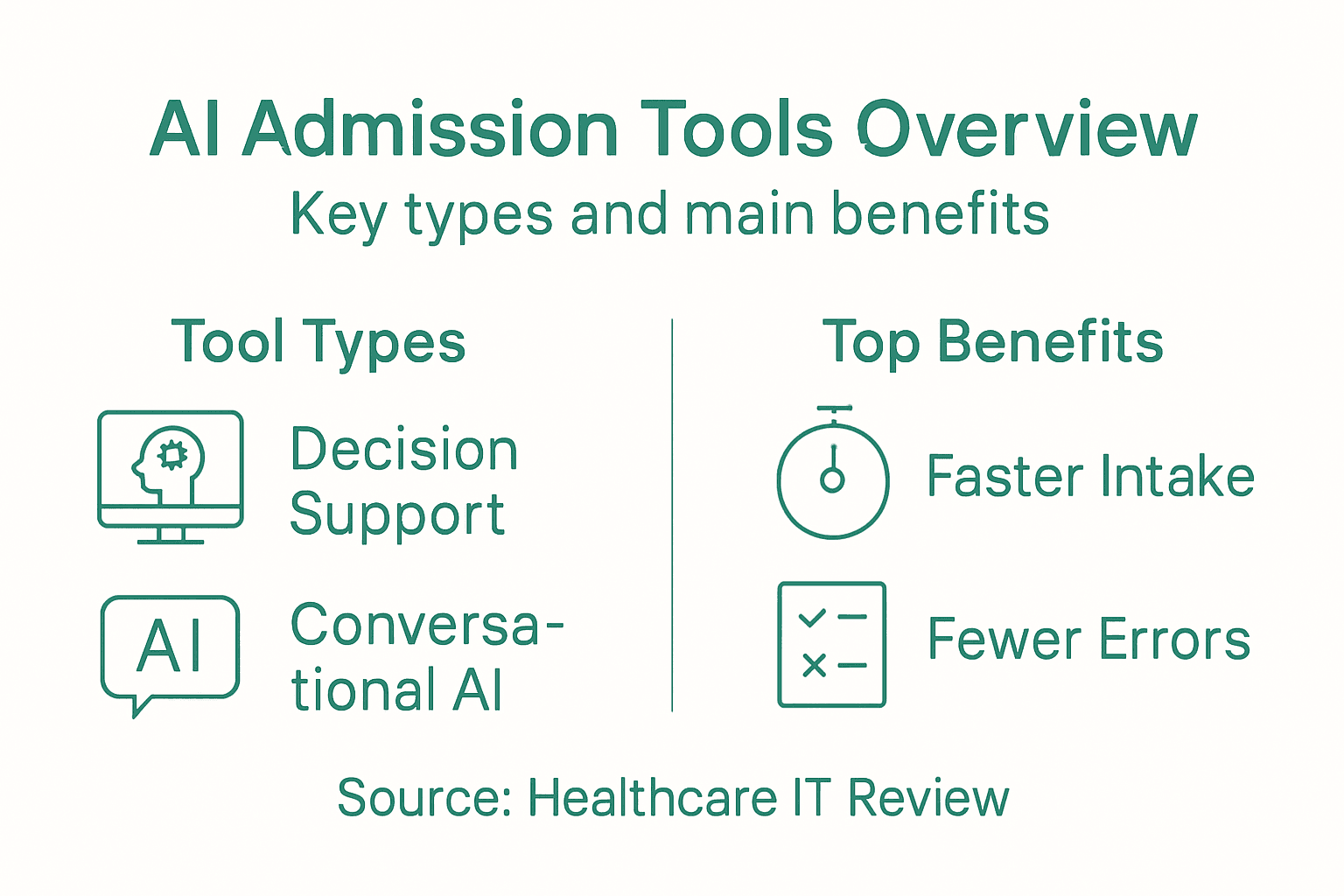
Conversational AI represents another innovative frontier in admissions workflow management. These sophisticated tools can conduct preliminary patient intake, gather essential information, and create structured patient profiles, significantly reducing manual data entry and streamlining initial assessment processes.
The following table summarizes how different AI admission tool types uniquely impact healthcare admissions:
| Tool Type | Primary Use Case | Distinctive Advantage | Example Outcome |
|---|---|---|---|
| Predictive Modeling Systems | Forecast patient flow and resource needs | Proactive capacity management | Reduced overcrowding |
| Natural Language Processing | Interpret and extract medical records | Automates unstructured data tasks | Faster data retrieval |
| Decision Support Systems | Guide triage and clinical decision | Real-time prioritization | Faster critical care assignment |
| Robotic Process Automation | Streamline repetitive admin tasks | Systematic process acceleration | Shorter admission timelines |
Pro tip: Conduct a comprehensive workflow audit before implementing AI tools to identify specific operational bottlenecks and select the most appropriate AI solutions for your healthcare facility’s unique needs.
How AI Enhances Intake Efficiency and Accuracy
AI technologies are revolutionizing patient intake processes by dramatically improving both operational efficiency and data accuracy. Predictive intake algorithms enable healthcare facilities to transform traditional administrative workflows into intelligent, streamlined systems that reduce manual errors and accelerate patient processing.
The key mechanisms of AI-driven intake enhancement include:
- Automated Data Processing
- Instant patient information extraction
- Reduced manual data entry errors
- Rapid record verification
- Intelligent Triage Systems
- Risk level assessment
- Priority patient identification
- Real-time resource allocation
- Predictive Patient Flow Management
- Forecasting patient arrival patterns
- Optimizing bed management
- Reducing waiting times
- Advanced Error Detection
- Identifying potential information gaps
- Cross-referencing multiple data sources
- Flagging inconsistent patient records
AI intake tools transform administrative complexity into seamless, intelligent workflow optimization.
Real-time data analytics play a crucial role in enhancing intake precision. These sophisticated systems can rapidly process complex patient information, identifying potential risks and opportunities for intervention far more quickly than traditional manual review processes.
The most significant benefit of AI in healthcare admissions is the ability to create a more responsive, adaptive intake system. By continuously learning from each interaction, AI tools can progressively improve their accuracy, reducing administrative burdens and allowing healthcare professionals to focus more on direct patient care.
Pro tip: Implement a phased AI integration strategy, starting with low-risk administrative tasks to build institutional confidence and demonstrate tangible efficiency gains.
Financial, Compliance, and Staffing Impacts
Healthcare facilities increasingly recognize AI admission tools as strategic investments with multifaceted organizational impacts. Regulatory considerations for AI deployment have become critical in understanding the comprehensive transformation these technologies introduce across financial, compliance, and staffing dimensions.
The primary financial implications include:
- Cost Reduction Strategies
- Decreased administrative overhead
- Minimized patient wait times
- Reduced staff overtime expenses
- Optimized resource allocation
- Revenue Enhancement
- Improved bed occupancy rates
- More accurate insurance billing
- Faster patient processing
- Reduced claim rejection rates
- Compliance Management
- Automated regulatory documentation
- Enhanced data privacy protocols
- Standardized decision-making processes
- Transparent AI governance
- Workforce Transformation
- Reallocation of staff to clinical roles
- Development of AI technical skills
- Reduced administrative burnout
- New technology management positions
AI technologies are not replacing healthcare workers but empowering them to deliver more strategic, patient-centered care.
Healthcare workforce adaptations reveal significant shifts in professional roles, with staff increasingly focusing on AI system oversight and complex patient interactions rather than repetitive administrative tasks.
Compliance remains a nuanced challenge, requiring robust frameworks that balance technological innovation with ethical considerations. Healthcare organizations must develop comprehensive training programs and governance structures that ensure responsible AI implementation, maintain patient trust, and meet evolving regulatory standards.
Here’s a comparison of benefits and challenges associated with AI admission tools:
| Aspect | Key Benefit | Top Challenge |
|---|---|---|
| Efficiency | Shorter patient wait times | Integrating with legacy systems |
| Accuracy | Reduced data-entry mistakes | Algorithmic or data biases |
| Compliance | Improved documentation and audit trails | Adapting to evolving regulations |
| Workforce | Reduced burnout, focus on patient care | Staff training and culture shift |
Pro tip: Create a cross-functional AI implementation team that includes clinical, administrative, and technical stakeholders to ensure comprehensive strategy development and smooth organizational adoption.
Risks, Barriers, and Common Challenges
Healthcare organizations must carefully navigate the complex landscape of AI implementation challenges when adopting admission tools. Data bias and algorithmic risks represent significant hurdles that require proactive management and continuous monitoring to ensure fair and accurate patient processing.
Key risks and barriers in AI admission tools include:
- Technological Barriers
- Legacy system integration challenges
- Interoperability limitations
- Complex data migration processes
- Technical infrastructure requirements
- Ethical Concerns
- Algorithmic bias detection
- Patient privacy protection
- Transparent decision-making processes
- Accountability frameworks
- Organizational Resistance
- Staff technological hesitation
- Cultural adaptation challenges
- Training and skill development needs
- Change management complexities
- Regulatory Compliance
- Evolving legal frameworks
- Data security standards
- Continuous auditing requirements
- Ethical AI governance
Successful AI adoption requires a holistic approach that balances technological innovation with human-centered considerations.
Cybersecurity and technical barriers remain critical challenges in AI admission tool implementation. Healthcare facilities must develop robust security protocols that protect sensitive patient information while enabling technological advancement.
Mitigating risks involves creating comprehensive validation processes, implementing ongoing monitoring systems, and establishing clear accountability mechanisms. Organizations must prioritize transparency, continually audit AI performance, and develop adaptive strategies that can quickly address emerging technological and ethical challenges.
Pro tip: Develop a multidisciplinary AI governance committee with representatives from clinical, technical, legal, and ethical domains to provide comprehensive oversight and strategic guidance.
Transform Your Healthcare Admission Process with Smart AI Solutions
The article highlights the common challenges healthcare facilities face when managing complex patient intake workflows such as administrative bottlenecks, data inaccuracies, and inefficient resource allocation. If your team struggles with lengthy referral reviews, manual insurance verification, or slow bed occupancy rates, these pain points can lead to staff burnout and lost revenue opportunities. Smart Admissions directly addresses these issues by offering an AI-powered referral management assistant that automates repetitive tasks, performs real-time patient eligibility verification, and streamlines documentation—all while integrating smoothly with existing Electronic Medical Records and insurance portals.
Improve your operational efficiency, reduce manual errors, and accelerate patient intake with Smart Admissions. Our platform is designed to enhance decision making through actionable insights and analytics, helping you fill beds faster and optimize revenue without overwhelming your staff. Discover how cutting-edge AI technologies can turn your admissions into a seamless workflow.
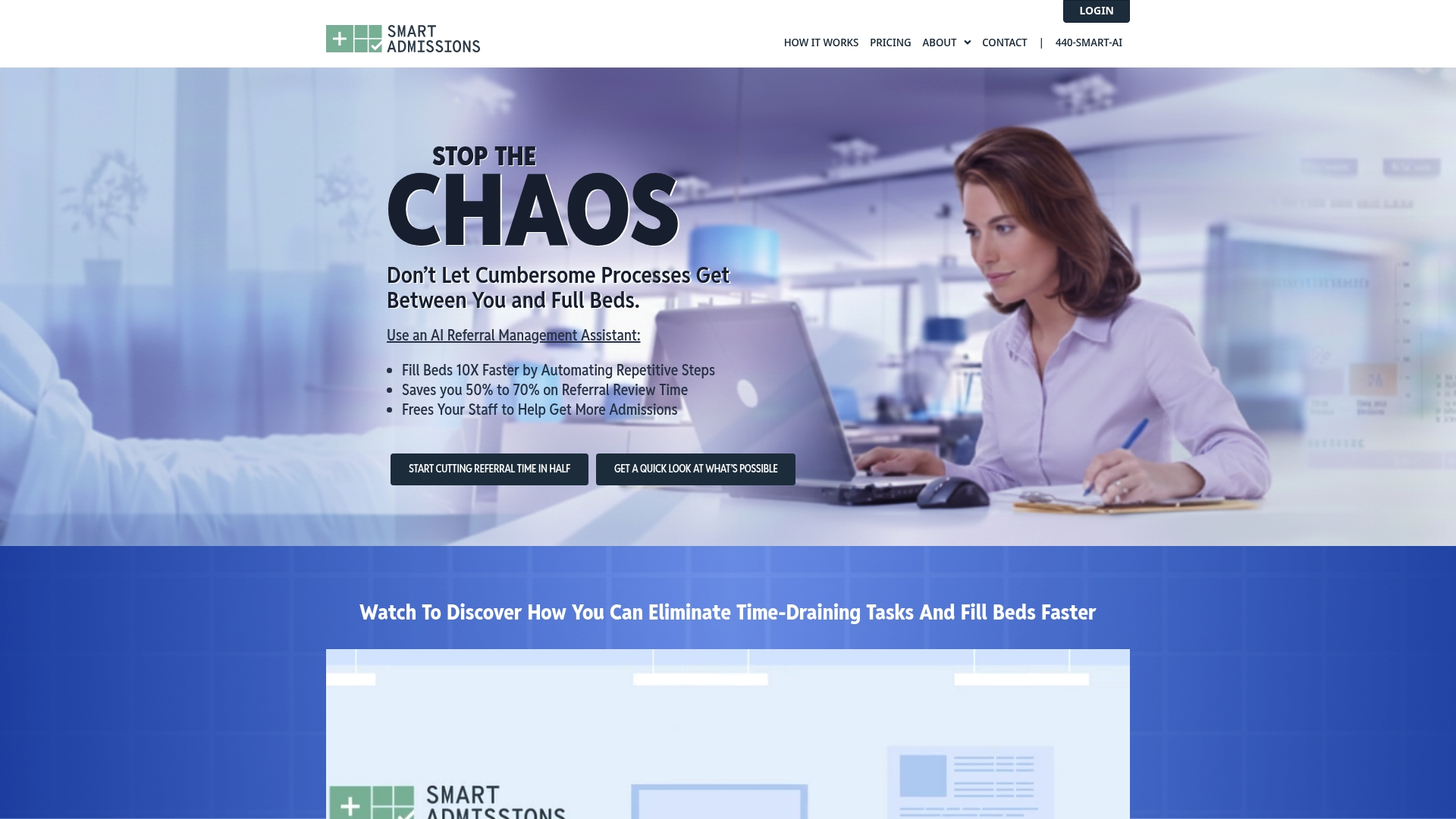
Ready to see how AI admission tools can revolutionize your healthcare facility’s intake process? Visit Smart Admissions today to learn more and schedule a demo. Streamline your patient referrals, reduce administrative burden, and start experiencing faster, smarter admissions now.
Frequently Asked Questions
What are AI admission tools in healthcare?
AI admission tools are advanced software platforms that leverage artificial intelligence to optimize patient intake processes, streamline administrative workflows, and improve operational efficiency in healthcare facilities.
How do AI admission tools enhance patient intake efficiency?
AI admission tools enhance efficiency by automating data processing, improving triage systems, predicting patient flow, and reducing manual errors, which all contribute to shorter wait times and faster admissions.
What are the core functions of AI admission tools?
Core functions of AI admission tools include predictive patient flow modeling, automated scheduling and bed management, real-time eligibility verification, intelligent data processing, and streamlined insurance workflows.
What risks and challenges are associated with AI admission tools?
Common risks and challenges include technological barriers such as legacy system integration, ethical concerns like algorithmic bias, organizational resistance to change, and compliance with evolving regulations.