
TL;DR:
- Manual admissions workflows drain resources and cause delays in SNFs.
- Automation reduces referral processing times, improves bed occupancy, and decreases staff burnout.
- Effective implementation depends on proper customization, staff involvement, and continuous monitoring.
Manual admissions workflows are quietly draining your facility’s resources. Staff spend hours reviewing referrals, chasing insurance authorizations, and manually entering patient data, all while beds sit empty and referral sources grow impatient. Referral processing can drop from 45 to 90 minutes down to just 5 minutes with the right automation. This article breaks down the top admissions workflow automation solutions for skilled nursing facilities (SNFs), compares their real-world outcomes, and gives your team the criteria and best practices needed to make a confident, informed decision.
Table of Contents
- What makes admissions workflow optimization essential?
- Top admissions workflow automation solutions for SNFs
- How leading solutions compare: Efficiency, outcomes, and usability
- Tailoring your admissions workflow: Best practices and common pitfalls
- Our take: Why workflow optimization is the SNF advantage that isn’t just tech
- Ready to modernize your admissions workflow?
- Frequently asked questions
Key Takeaways
| Point | Details |
|---|---|
| Automation saves time | Automated admissions workflows reduce referral processing times by as much as 90%. |
| Higher occupancy rates | Optimized workflows lead to significantly faster bed occupancy and better financial performance for SNFs. |
| Staff burnout drops | Automation supports admissions teams, lowering burnout and enabling more patient-focused care. |
| Informed solution selection | Choosing the right tool depends on evidence-backed outcomes, integration, and ongoing support for staff. |
What makes admissions workflow optimization essential?
The pressure on SNF admissions teams is not slowing down. Facilities are fielding more referrals than ever, and the complexity of each case is increasing. SNF admission rates have risen 43% since 2019, with an average of 6.6 referrals per admitted patient and only a 32% acceptance rate. Meanwhile, the 23.5% 30-day readmission rate costs the industry $4.34 billion annually. These numbers are not abstract. They represent real operational strain on your admissions coordinators, clinical staff, and bottom line.
Inefficient workflows create a cascade of problems. When your team spends hours on manual data entry and phone-based insurance verification, response times slow, referral sources lose confidence, and your facility misses bed-fill opportunities. Staff burnout follows, and turnover compounds the problem. The facilities that are pulling ahead are the ones investing in streamlining administrative tasks to free up clinical judgment for where it matters most.
When evaluating admissions automation solutions, your team should prioritize the following criteria:
- Speed: How quickly can the system process a referral from receipt to decision?
- Integration: Does it connect with your existing EHR systems using FHIR and HL7 standards?
- Error reduction: Does it flag incomplete documentation and reduce manual entry mistakes?
- Scalability: Can it handle volume spikes without degrading performance?
- Regulatory compliance: Is it HIPAA-compliant, with audit trails and role-based access controls?
These criteria are not optional checkboxes. They are the foundation of a sustainable, high-performing admissions operation. A solution that scores well on speed but fails on integration will create new bottlenecks rather than eliminating existing ones.
Statistic spotlight: Facilities with automated admissions workflows report response times dropping from an average of 6 hours to just 1.5 hours, a 75% improvement that directly impacts referral source satisfaction and repeat business.
Pro Tip: Before evaluating any vendor, audit your current average referral-to-decision time and document your top three workflow pain points. This baseline data will help you measure ROI after implementation and negotiate more effectively with vendors.
Top admissions workflow automation solutions for SNFs
Several platforms have emerged as measurable performers in SNF admissions automation. Understanding what each one does well, and where it fits best, will help your team narrow the field quickly.
ExaCare AI is built for high-volume referral environments. In one documented case, Creative Solutions processed 1,500 referrals in 48 hours with 62% auto-approved on first use. That kind of throughput is only possible when the system can pull clinical data, run eligibility checks, and apply your facility’s admission criteria automatically. ExaCare AI is best suited for multi-site operators managing large referral pipelines.
Clinware AI focuses on placement speed and care coordination. It integrates directly with hospital discharge systems to accelerate the handoff between acute and post-acute care. Clinware recently secured $4.25 million in funding to expand its platform capabilities, signaling strong market confidence in its approach. It is a strong fit for SNFs that want to strengthen referral relationships with hospital partners.
Sparkco emphasizes adaptive triage. Its system cut response times by 75% and reduced staff time on admissions tasks by 40%, according to published case data. Sparkco’s strength is its ability to route complex cases to the right reviewer automatically, reducing the cognitive load on your admissions coordinators.
You can explore how workflow automation for admissions and AI for patient intake are reshaping the intake process across post-acute care settings.
| Solution | Auto-approval rate | Response time reduction | Staff time saved | Best fit |
|---|---|---|---|---|
| ExaCare AI | 62% | Up to 90% | 50-75% | High-volume, multi-site |
| Clinware AI | Not published | Significant | Moderate | Hospital-aligned SNFs |
| Sparkco | Not published | 75% | 40% | Complex case triage |
Pro Tip: Request a sandbox demo using your own referral data. Generic demos rarely reveal how a platform handles your specific payer mix, clinical criteria, or EHR environment. Real data surfaces real gaps.
How leading solutions compare: Efficiency, outcomes, and usability
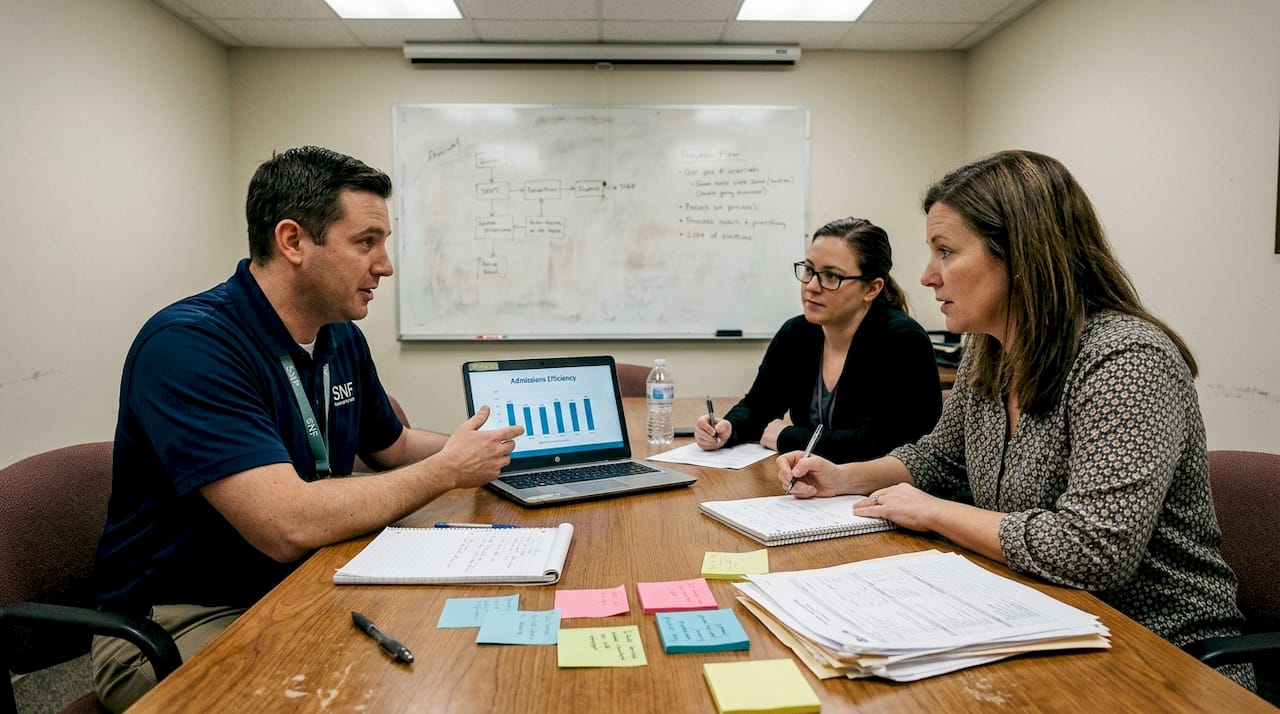
Choosing between platforms requires more than reviewing marketing materials. Your team needs a clear picture of how each solution performs across the metrics that matter most to your facility.
| Metric | ExaCare AI | Clinware AI | Sparkco |
|---|---|---|---|
| Referral processing time | 5 min avg | Reduced significantly | 75% faster |
| Bed occupancy improvement | 10-20% | Reported gains | Reported gains |
| Staff time savings | 50-75% | Moderate | 40% |
| EHR integration | Yes | Yes | Yes |
| Auto-approval capability | 62% first use | Available | Available |
The empirical benchmarks across leading platforms show bed occupancy improvements of 10 to 20% and staff time savings of 50 to 75%. These are not theoretical projections. They reflect live deployments in SNF environments comparable to yours.
“Automation does not replace the clinical judgment of your admissions team. It removes the administrative friction that prevents that judgment from being applied quickly and consistently.”
Implementing any of these solutions successfully requires a structured approach. Follow these steps to reduce risk and accelerate adoption:
- Map your current workflow before selecting a platform. Document every handoff, approval step, and data entry point.
- Confirm EHR integration with your IT team before signing a contract. Incompatible systems create costly workarounds.
- Run a pilot program with a defined referral volume and a 30-day measurement window.
- Train your team in phases, starting with admissions coordinators before expanding to clinical reviewers.
- Monitor key metrics weekly during the first 90 days: response time, auto-approval rate, and staff satisfaction.
The most common pitfall is underestimating change management. Technology adoption fails when staff feel excluded from the process. Involve your admissions coordinators in vendor selection and pilot design. Their buy-in is not a soft consideration. It is a hard operational requirement. You can review admissions workflow benefits to build the internal business case for your leadership team.
Tailoring your admissions workflow: Best practices and common pitfalls
Even the best automation platform will underperform if it is not configured to match your facility’s specific clinical criteria, payer mix, and staffing model. Customization is not a luxury. It is what separates a tool that transforms your operation from one that adds complexity.
Here are the most effective steps for tailoring your admissions automation:
- Secure leadership buy-in early. Present data on referral volume growth, current response times, and readmission costs to your executive team before selecting a vendor.
- Define your admission criteria in the system. Work with your clinical team to translate your acceptance standards into logic the platform can apply automatically.
- Blend automation with expert review. Set auto-approval thresholds for straightforward cases and route complex or borderline referrals to your senior admissions staff.
- Establish data quality standards. Automation is only as accurate as the data it processes. Incomplete referral packets will still require manual follow-up if your intake process does not enforce completeness upfront.
- Plan for post-live support. Assign an internal champion who owns the platform relationship and escalates issues to your vendor’s support team promptly.
A critical insight from current research is that automation reduces burnout by 30% and allows staff to focus on patient-centered activities rather than paperwork. This is especially relevant given ongoing staffing shortages across post-acute care. Facilities that position automation as a staff support tool rather than a replacement strategy see faster adoption and better long-term outcomes.
Common pitfalls to avoid include rushing the rollout to meet an arbitrary go-live date, skipping staff training to save time, and failing to monitor performance data after launch. Each of these shortcuts creates problems that are harder to fix after the fact. Review admissions automation best practices to build a rollout plan that accounts for these risks.
Pro Tip: Schedule a 60-day post-launch review with your vendor. Use it to recalibrate auto-approval thresholds, address staff feedback, and set targets for the next quarter. Continuous improvement is built into the process, not bolted on later.
Our take: Why workflow optimization is the SNF advantage that isn’t just tech
Here is what most technology vendors will not tell you: the facilities that see the biggest gains from admissions automation are not the ones with the most sophisticated software. They are the ones that treated the implementation as a cultural shift, not a software installation.
Automation is transformative only when your team understands that it is there to support their expertise, not sideline it. The admissions coordinator who once spent four hours chasing insurance authorizations now has time to build referral relationships and conduct thorough clinical assessments. That shift in how staff spend their time is the real competitive advantage.
SNFs that lead their markets in 2026 will not do so because they adopted AI first. They will lead because they used AI to make their people more effective. The facilities still relying on manual workflows are not just slower. They are losing referral sources, burning out staff, and leaving revenue on the table. Investing in streamlining admin tasks is not a technology decision. It is a people decision.
Ready to modernize your admissions workflow?
If your facility is ready to reduce referral review times, improve bed fill rates, and give your admissions team the tools they need to work efficiently, Smart Admissions is built for exactly that.
Explore how faster bed occupancy is achievable with the right automation strategy, or review referral management systems that are already delivering measurable results in post-acute care settings. When you are ready to see how it works for your specific facility, visit the Smart Admissions platform to schedule a personalized demo. Your team deserves tools that match the complexity of the work they do every day.
Frequently asked questions
How much time can SNFs save with admissions automation?
Referral processing drops from 45 to 90 minutes down to as little as 5 minutes with automation, representing a 50 to 90% reduction in processing time per referral.
Does automation replace admissions staff or just support them?
Automation reduces burnout by 30% and shifts staff focus to high-value, patient-centered activities, making it a support tool rather than a replacement for your admissions team.
What impact does workflow optimization have on bed occupancy rates?
SNFs that automate admissions consistently report bed occupancy gains of 10 to 20% due to faster response times and streamlined approval processes.
How do SNFs choose the right admissions automation tool?
Prioritize ease of EHR integration, documented speed improvements, HIPAA compliance, vendor support responsiveness, and verifiable outcome data from comparable SNF deployments.
Can workflow automation reduce SNF readmission costs?
More accurate admissions decisions, supported by automated clinical assessments, improve patient-facility fit and care transitions, directly addressing the 23.5% readmission rate that costs the industry $4.34 billion annually.