
TL;DR:
- Manual intake processes cause delays costing approximately $450 per bed per day.
- Mapping and analyzing bottlenecks helps identify targeted improvements to accelerate admissions.
- Automating with AI-driven tools reduces processing time and enhances workflow consistency.
Every day a bed sits empty because paperwork stalled, your facility loses revenue and a patient loses timely care. Each 24-hour delay costs roughly $450 per bed, and manual processes are a leading driver of those gaps. For skilled nursing homes and rehabilitation centers, the admissions workflow is not just an administrative function. It is a direct lever on occupancy, staff morale, and patient outcomes. This guide walks your team through a practical, step-by-step process to assess, redesign, and continuously improve your intake workflow so that admissions move faster, errors drop, and your facility captures the revenue it has earned.
Table of Contents
- Assess your current intake workflow
- Set clear goals and map your future state
- Select and integrate the right technology
- Standardize, monitor, and refine your workflow
- What most facilities miss when customizing intake workflows
- Take the next step with advanced intake automation
- Frequently asked questions
Key Takeaways
| Point | Details |
|---|---|
| Map and assess bottlenecks | Start by deeply analyzing intake challenges like manual entry and delays to target improvements. |
| Set goals and KPIs | Define measurable goals and align stakeholders to guide and justify workflow changes. |
| Leverage automation | Digital and AI tools can cut intake times by up to 90% and drastically reduce errors. |
| Standardize and iterate | Standardize steps, monitor outcomes, and refine regularly to lock in sustainable gains. |
Assess your current intake workflow
Before you can fix what is broken, you need to see it clearly. Mapping your admission process uncovers bottlenecks like manual data entry, incomplete documentation, and delays that quietly drain time and revenue. This first phase is not about blame. It is about building an honest picture of how referrals move from first contact to final bed assignment.
Start by walking through each stage of your step-by-step intake process with the staff who actually perform the work. Nurses, coordinators, and billing specialists often hold the clearest view of where things slow down. Collect their observations alongside data from your EMR system, such as average time from referral receipt to decision, and the percentage of referrals returned for missing information.
The most common bottlenecks your team will likely surface include:
- Manual data entry across multiple systems that do not communicate with each other
- Incomplete referral packets that require follow-up calls and fax exchanges before a clinical decision can be made
- Insurance verification delays caused by manual eligibility checks
- Compliance documentation gaps that create risk and slow final approval
- Poor handoff communication between clinical, financial, and admissions teams
Once you have gathered input, organize your findings in a summary table for leadership review. A clear visual of where time is lost makes the case for change far more persuasive than anecdotal evidence alone.
| Intake stage | Average time spent | Key bottleneck identified |
|---|---|---|
| Referral receipt and triage | 45 to 90 minutes | Incomplete clinical documentation |
| Insurance eligibility verification | 2 to 4 hours | Manual portal checks |
| Clinical assessment and decision | 1 to 3 hours | Waiting on physician notes |
| Admission paperwork and signatures | 1 to 2 hours | Paper forms and manual filing |
| Bed assignment and notification | 30 to 60 minutes | Siloed communication channels |
Pro Tip: Time-stamp every handoff in your current process for at least two weeks. Even a simple spreadsheet log will reveal patterns that feel invisible in day-to-day operations. You may find that one stage accounts for 60% of total delay, which immediately tells you where to focus first.
With this data in hand, explore intake optimization strategies that match the specific gaps your facility has identified. Generic fixes rarely hold. Targeted ones do.
Set clear goals and map your future state
With a clear understanding of your intake bottlenecks, you can focus on what a successful future process should achieve. Vague goals like “improve efficiency” produce vague results. Your team needs specific, measurable targets that everyone from the admissions coordinator to the CFO can rally around.
Define metrics such as processing time, acceptance rate, and error reduction to measure improvements accurately and hold your initiative accountable over time. These become your key performance indicators, or KPIs, and they give you an objective way to know whether changes are working.
Useful KPIs for intake workflow improvement include:
- Time to admission decision (target: under 2 hours for standard referrals)
- Referral acceptance rate (track weekly to spot trends)
- Documentation error rate (aim for less than 5% of packets requiring correction)
- Staff time per admission (measure before and after automation)
- Patient and referral source satisfaction scores (collected via brief surveys)
Next, draft a process map that places your current state alongside your desired future state. This comparison helps your team see the gap concretely and builds alignment before any technology is purchased or process changed.
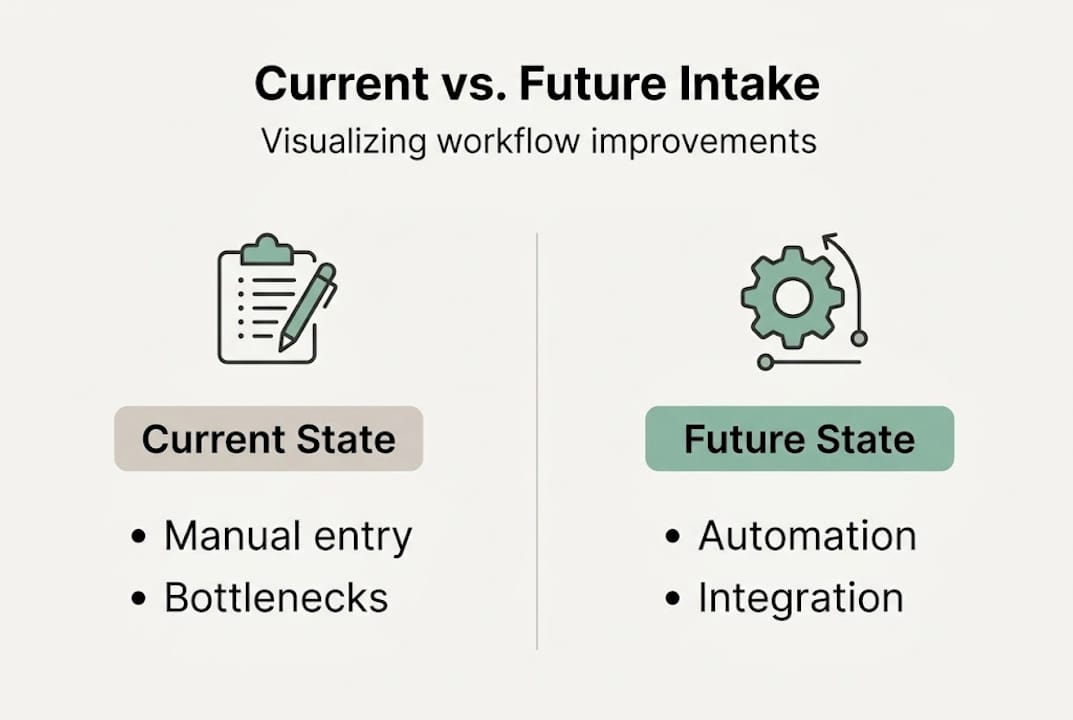
| Process element | Current state | Future state goal |
|---|---|---|
| Referral intake method | Fax and phone | Digital portal with auto-parsing |
| Insurance verification | Manual, same-day | Real-time automated check |
| Clinical review turnaround | 3 to 5 hours | Under 90 minutes |
| Documentation completion rate | 78% on first submission | 95% or higher |
| EMR data entry | Manual re-entry | Automated EMR integration |
To move from plan to action, follow these steps to engage stakeholders and secure the resources you need:
- Present the bottleneck data and proposed KPIs to senior leadership with a projected ROI.
- Identify a cross-functional project team including clinical, IT, billing, and admissions staff.
- Assign ownership of each KPI to a specific role or team member.
- Confirm budget and timeline before selecting any technology.
- Schedule a kickoff meeting to align all stakeholders on goals and responsibilities.
EMR and insurance portal integration is not optional at this stage. Any future-state design that requires staff to re-enter data across systems will recreate the bottlenecks you are trying to eliminate. Build integration as a non-negotiable requirement from the start.
Select and integrate the right technology
With goals and an ideal workflow mapped, it is time to identify and implement technology that can deliver the promised improvements. The right tools do not just speed things up. They reduce errors, standardize documentation, and free your team to focus on clinical judgment rather than administrative tasks.
Digital forms with conditional logic and AI data extraction now enable real-time insurance verification and automated intake handoffs, removing the manual steps that create the longest delays. When evaluating platforms, prioritize these features:
- Conditional logic in digital intake forms so that only relevant fields appear based on patient type or payor
- AI-powered data extraction that reads referral documents and populates EMR fields automatically
- Real-time insurance eligibility verification integrated directly with payor portals
- Automated notifications to clinical and billing teams when a referral is ready for review
- FHIR and HL7 standards compliance to ensure seamless data exchange with existing EMR systems
- Audit trails and role-based access controls for HIPAA compliance
The efficiency gains from these tools are substantial. Automation can reduce intake processing from up to 12 hours to just an hour in many facilities, which directly translates to faster bed fill and reduced revenue loss.
Pro Tip: Always request a HIPAA compliance attestation and a Business Associate Agreement from any vendor before sharing patient data. This protects your facility legally and ensures the vendor meets federal privacy standards.
Learn more about workflow automation in admissions and how AI for patient intake is reshaping the speed and accuracy of referral decisions. Understanding the full range of AI benefits for admissions will help you build a stronger business case internally.
Once you select a platform, do not roll it out facility-wide on day one. Pilot the technology with a defined subset of referrals, such as Medicare short-stay admissions, for the first 30 days. Collect data, gather staff feedback, and resolve configuration issues before scaling. A controlled pilot reduces risk and builds staff confidence at the same time.
Standardize, monitor, and refine your workflow
With technology and automation in place, standardizing processes and refining them over time ensures the gains are lasting and scalable. Automation alone does not sustain improvement. The human side of the workflow, including how staff follow procedures and how leadership tracks outcomes, determines whether your facility maintains its gains or drifts back to old habits.
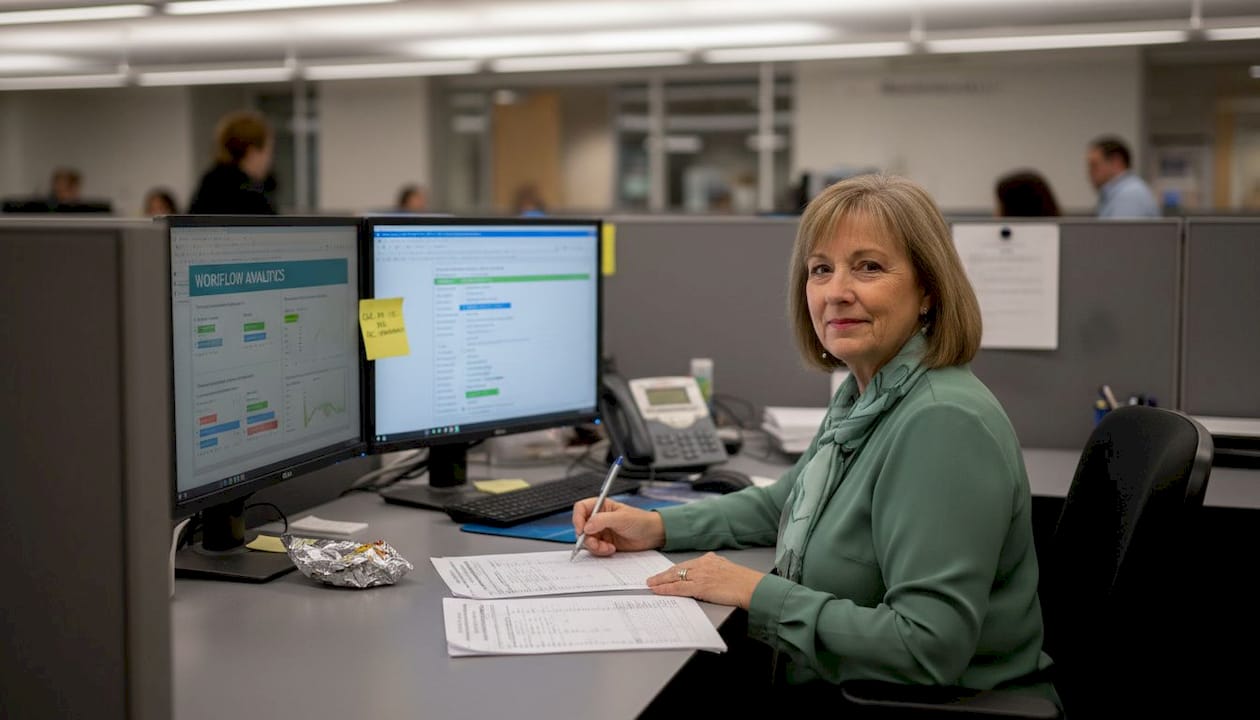
Best practice is to standardize admissions with checklists and run analytics for ongoing improvement. Create a master checklist for each referral type, covering every required document, every verification step, and every handoff point. Store these in your intake platform so staff access them automatically during the workflow rather than relying on memory.
Review intake documentation best practices to ensure your templates align with current Medicare documentation compliance requirements, which change periodically and can create compliance risk if your checklists fall out of date.
Follow these steps to build a sustainable monitoring cycle:
- Pull KPI reports weekly for the first 90 days after go-live, then shift to monthly once performance stabilizes.
- Hold a 30-minute team debrief each month to review trends and surface front-line concerns.
- Log every compliance-related error in a dedicated tracker and review root causes quarterly.
- Update workflow templates whenever payor rules, regulatory requirements, or EMR configurations change.
- Conduct an annual full workflow audit to identify new bottlenecks introduced by volume growth or staff turnover.
Facilities that implement continuous monitoring and rapid iteration report cutting bottleneck-related delays by up to 75%, compared to those that treat workflow improvement as a one-time project.
Monitor errors, processing time, and staff feedback; update workflows as payor rules and technologies evolve. This is not a set-and-forget process. The facilities that sustain the strongest admissions performance are those that treat workflow refinement as an ongoing operational discipline, not a project with a finish line. Explore workflow optimization for skilled nursing to find additional frameworks your team can adapt.
What most facilities miss when customizing intake workflows
Even with the best plans and tools, there are deeper reasons why many intake improvement projects stall. The most common one is underinvesting in staff training after go-live. Technology does not run itself. If your team does not understand why the new process works the way it does, they will find workarounds that reintroduce the inefficiencies you eliminated.
Centralized intake enables consistent screening for multi-facility organizations, but requires strong change management to succeed. Centralization can drive standardization and reduce variation across sites, but it often meets resistance from staff who feel ownership of local processes. That cultural shift requires deliberate communication, not just a new software login.
The other failure point is analysis paralysis. Facilities that wait for a perfect workflow design before acting often lose months of potential improvement. Start with the highest-impact bottleneck, implement a fix, measure the result, and iterate. The data will guide your next step better than any planning document. Understanding automation in healthcare admissions as an evolving practice, rather than a finished product, is the mindset that separates facilities that improve from those that stagnate.
Take the next step with advanced intake automation
Now that you understand how to optimize your workflow, the right partners and platforms can accelerate your progress. Smart Admissions is built specifically for skilled nursing homes and rehabilitation centers that need to move faster without adding administrative burden.
Our AI-powered platform integrates with your existing EMR and insurance portals to automate eligibility verification, documentation management, and referral routing from day one. Whether you are ready to boost admissions efficiency across your facility or want to explore intake automation solutions tailored to your referral volume, Smart Admissions gives your team the tools to reduce intake time, improve bed fill rates, and support your staff with less manual work.
Frequently asked questions
What are the main causes of delays in patient admissions?
Manual data entry, incomplete referrals, and missing documentation are the leading causes of intake delays in skilled nursing and rehab settings. Manual processes are error-prone and can take up to 12 hours per admission without automation.
How much money do admission delays really cost?
Facilities lose about $450 per bed for every 24-hour delay, making efficient intake a direct financial priority rather than just an operational preference.
What KPIs should we track when customizing intake workflows?
Track admission processing time, acceptance rates, error rates, and staff satisfaction to measure workflow improvements. Full-funnel KPI tracking from referral to admit gives you the clearest picture of ROI.
Is intake workflow automation difficult to implement?
Automation requires upfront effort and training, but adoption is easier with clear steps, pilot programs, and end-user involvement early on. Staff training is critical for successful automation adoption and long-term sustainability.
What is the best way to handle high-acuity referrals?
Use automation with parallel processing and customizable intake pathways to ensure rapid and compliant admissions for complex cases. High-acuity referrals need parallel processing built into the automation design to avoid sequential delays that slow bed assignment.