
TL;DR:
- Delays in skilled nursing admissions stem from systemic communication and responsibility-sharing issues among teams. Implementing structured frameworks, clear roles, and AI tools can streamline workflows, reduce delays, and improve bed occupancy. Leadership support, continuous measurement, and fostering team empathy are essential for sustainable collaboration and operational success.
When a referral arrives and no one on the team knows who reviews it first, hours pass. Beds stay empty. Census targets slip. These delays are not random — they reflect a systemic breakdown in how admissions teams communicate, assign responsibility, and share information. The good news is that structured collaboration frameworks, clearly defined roles, and AI-powered intake tools can resolve these bottlenecks directly. This guide walks your admissions team through practical strategies, proven communication tools, and measurable outcomes that will help you fill beds faster and reduce the operational friction that slows your facility down.
Table of Contents
- Understanding collaboration barriers in admissions teams
- Building your toolkit: proven frameworks and tech for collaboration
- Step-by-step: Planning and executing collaborative patient intake
- Measuring success: Metrics, compliance, and verification
- Our perspective: Building trust and efficiency in admissions collaboration
- Enhance your admissions collaboration with expert solutions
- Frequently asked questions
Key Takeaways
| Point | Details |
|---|---|
| Collaboration impacts efficiency | Effective teamwork and structured communication are proven to accelerate patient intake and boost census. |
| AI and frameworks streamline intake | Combining tech tools with best-practice frameworks delivers faster, more reliable admissions workflows. |
| Measurement drives improvement | Tracking metrics and compliance ensures sustained success and regulatory alignment for admissions teams. |
| Hybrid human-tech approach works best | Balancing automated processes with empathetic human review builds trust and resilience in admissions workflows. |
Understanding collaboration barriers in admissions teams
After establishing the importance of collaboration, let’s identify the core barriers admissions teams must overcome.
Siloed communication is the most common and most damaging barrier in skilled nursing admissions. When your admissions coordinator, director of nursing, social worker, and billing staff each operate in separate systems with no shared visibility, critical referral data gets duplicated, lost, or delayed. A referral can sit unanswered simply because no one was sure whose responsibility it was to respond.
Unclear accountability compounds this problem. Without defined role ownership for each step of the intake process, tasks fall through the gaps. Your team may be working hard, but parallel efforts and redundant follow-ups waste time that could be directed toward completing the admission.
Interprofessional collaboration in nursing homes depends on investing in each other, shaped by roles, policies, structured meetings, and organizational design. This finding points to something most admissions leaders already know intuitively: collaboration is not just about tools. It is about culture, structure, and the investment your facility makes in enabling team members to work across roles effectively.
Key barriers your team should assess and address include:
- Siloed information systems that prevent real-time visibility across nursing, admissions, and billing
- Absence of feedback channels where frontline staff can flag problems with the intake process
- Unclear role boundaries, particularly during high-volume referral periods
- Infrequent or unstructured team meetings that fail to align priorities across departments
- Lack of cross-role empathy, where admissions staff may not understand the clinical constraints nursing faces when accepting a new resident
“Effective interprofessional collaboration in skilled nursing does not happen by default. It requires deliberate organizational investment — in roles, relationships, and processes — to become sustainable.”
Strong intake process optimization starts with acknowledging these barriers openly. Once your leadership team names the specific gaps, you can begin closing them with frameworks and technology designed for exactly this environment.
Leadership investment matters enormously here. Directors and administrators who model collaborative behavior, participate in intake huddles, and actively support cross-department communication set the standard that cascades through the entire admissions team. Policies that formalize this collaboration — such as mandatory handoff protocols and documented escalation paths — create structural reliability that does not depend solely on individual effort.
Building your toolkit: proven frameworks and tech for collaboration
Now that we have identified the barriers, let’s look at practical collaboration frameworks and technologies that admissions teams can leverage.
Structured communication tools like ISBARR, handoff reports, closed-loop communication, and TeamSTEPPS promote effective interprofessional collaboration in healthcare teams. These frameworks give your team a common language and a repeatable process structure that reduces the risk of miscommunication during high-stakes intake moments.
Here is a practical comparison of these frameworks to help you choose the right one for your team:
| Framework | Best use case | Core benefit | Implementation complexity |
|---|---|---|---|
| ISBARR | Verbal and written handoffs | Standardizes information transfer | Low |
| TeamSTEPPS | Full team training programs | Builds situational awareness | Moderate |
| Closed-loop communication | Real-time task confirmation | Confirms message receipt and action | Low |
| Structured handoff reports | Shift changes and transfers | Prevents information gaps at transitions | Low to moderate |
ISBARR stands for Identify, Situation, Background, Assessment, Recommendation, and Read-back. It is particularly useful when your admissions coordinator calls the director of nursing to discuss a complex referral. Instead of an unstructured conversation, ISBARR ensures that every key data point gets covered and confirmed in the right order.
TeamSTEPPS, developed by the Agency for Healthcare Research and Quality, is a more expansive training model that builds team skills across four domains: leadership, situation monitoring, mutual support, and communication. It is especially valuable when your facility is growing and needs to standardize collaboration across a larger admissions team.
On the technology side, the AI role in patient intake has expanded significantly. AI-driven intake tools now handle eligibility verification, clinical document review, and payer authorization checks automatically, freeing your team to focus on the decisions that require human judgment.
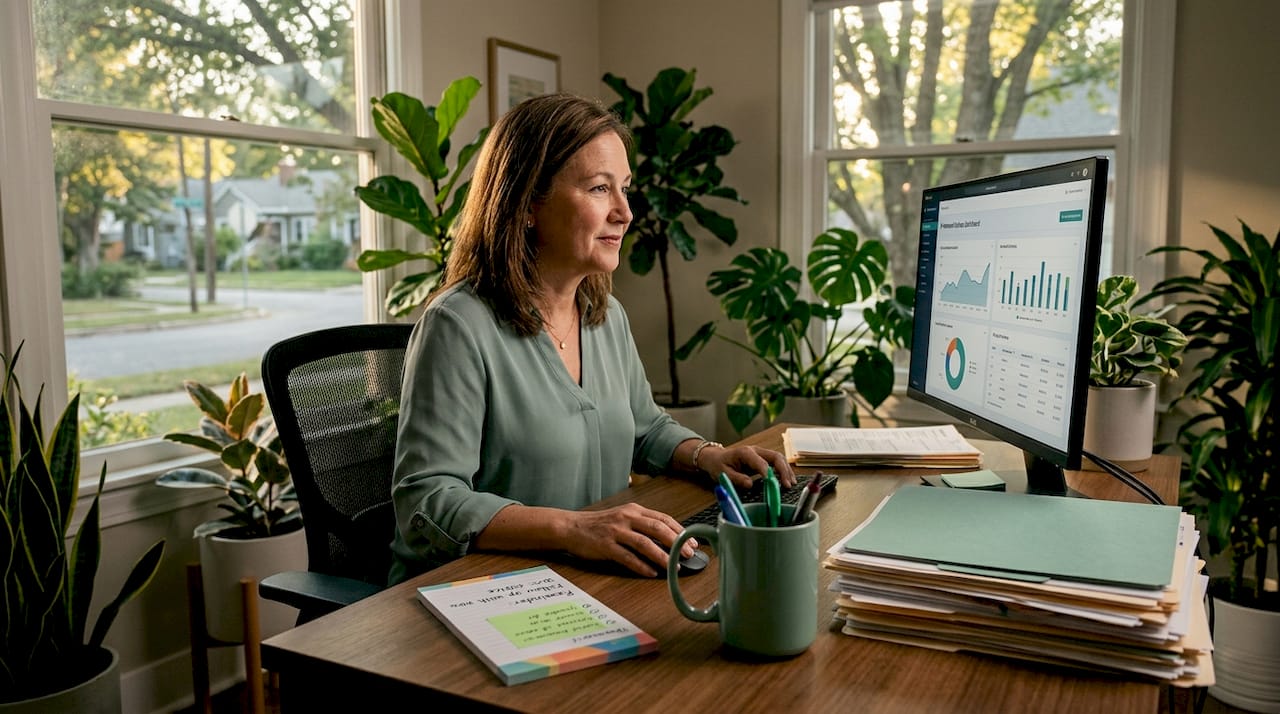
Shared real-time dashboards give every team member, from the admissions coordinator to the DON to the billing specialist, a unified view of each referral’s status. This eliminates the “I didn’t know that was already done” problem and keeps the team coordinated without requiring constant status-update meetings.
Automated scheduling tools reduce the manual back-and-forth of coordinating care planning meetings, physician reviews, and family consults. When these steps happen automatically based on intake milestones, your team moves faster and with less administrative burden. More intake workflow improvement ideas can help your team evaluate which tools align with your current capacity.
Pro Tip: Before launching any new technology or communication framework, map out every role involved in your intake process and assign clear ownership for each step. Establish a feedback loop from day one so staff can report friction points early. Technology adoption succeeds when people understand their place in the new workflow.
Step-by-step: Planning and executing collaborative patient intake
With frameworks and technology in place, here is how to put collaboration into practice step by step.
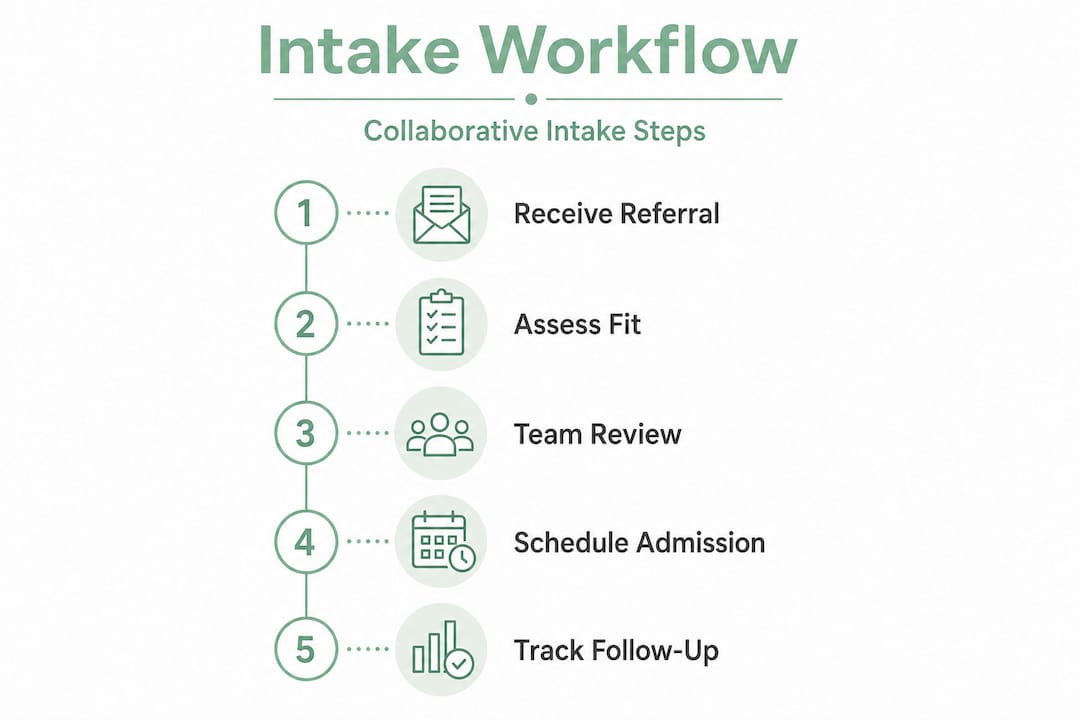
Effective collaborative intake is not a single moment. It is a sequence of coordinated actions across multiple roles, each one building on the previous step. Here is a structured approach your team can follow:
- Align the team and assign roles. Before the first referral of the day arrives, confirm who owns each phase of intake: who receives and logs referrals, who performs clinical review, who handles payer verification, and who communicates the admission decision.
- Receive and triage the referral. Log the incoming referral immediately into your shared platform. Flag clinical complexity, payer type, and anticipated bed type so the right team members are notified at once.
- Conduct a rapid clinical eligibility assessment. Your clinical reviewer should assess the referral against your facility’s admission criteria, checking diagnosis, functional status, required equipment, and staffing capacity. Use standardized clinical checklists to keep this step consistent and fast.
- Verify insurance eligibility in real time. Integrate your intake platform with payer portals to run automated eligibility checks. This eliminates the time lost to manual phone calls and reduces the risk of admitting a patient whose coverage does not match your service level.
- Track progress collaboratively. Use your shared dashboard to update status in real time. Every team member should see where the referral stands without needing to ask. This removes the need for disruptive status-check interruptions during the review process.
- Confirm the admission decision and communicate across departments. Once the admission is approved, notify nursing, dietary, housekeeping, and therapy simultaneously. A coordinated notification prevents the scenario where a bed is unprepared when the patient arrives.
- Validate documentation and complete handoff. Cross-check all required documents — consent forms, physician orders, clinical records, and insurance authorizations — before the patient arrives. A structured handoff checklist ensures nothing is missing at the point of admission.
The scale of impact when these steps are executed with AI support is notable. AI systems have processed 1,500 referrals in the first 48 hours with 62% automatically approved, enabling unified information for nursing, admissions, and operations teams. This speed would be impossible with manual workflows, and it demonstrates how automation creates the capacity for teams to handle higher referral volumes without adding staff.
| Intake step | Responsible role | Technology support |
|---|---|---|
| Referral receipt and logging | Admissions coordinator | Intake platform with auto-logging |
| Clinical eligibility review | Director of nursing or clinical reviewer | AI-assisted clinical assessment tools |
| Insurance verification | Billing or admissions coordinator | Payer portal integration |
| Admission decision | Admissions director | Shared dashboard with decision tracking |
| Department notification | Admissions coordinator | Automated alerts to relevant teams |
| Documentation validation | Admissions and clinical staff | Document management module |
Improving decision-making in admissions requires giving your team access to the right data at the right moment. When clinical flags, payer restrictions, and bed availability data all appear in one view, your team makes faster, better-informed decisions. And streamlining administrative tasks across each of these steps reduces the manual load that slows down your most experienced staff.
Pro Tip: Build a 24-hour follow-up checkpoint into your intake workflow. After each admission, have the admissions coordinator confirm with nursing that the handoff was complete and that no documentation gaps were found. This simple step prevents compliance issues and builds cross-departmental trust over time.
Measuring success: Metrics, compliance, and verification
Having reviewed the intake steps, know that ongoing measurement and regulatory compliance are critical for long-term collaboration improvement.
Your collaboration strategies are only as strong as your ability to measure and verify their impact. Without clear metrics, your team has no feedback on what is working and what still needs adjustment. Establishing a core set of intake performance indicators gives you a foundation for continuous improvement.
Key metrics your admissions team should track:
- Average referral-to-decision time: The time from referral receipt to admission approval or decline. Target reductions here translate directly into faster bed fill rates.
- Auto-approval rate: The percentage of referrals processed and approved without manual intervention. A rate above 50% indicates strong integration between your intake tools and clinical criteria.
- Census growth rate: Month-over-month change in occupied beds, which reflects the cumulative impact of your intake efficiency improvements.
- Readmission rate: Tracking hospital returns within 30 days helps your team identify whether intake decisions are clinically appropriate and well-coordinated with discharge planning.
- Staff workload per intake: Measuring the hours your team spends per admission helps identify bottlenecks that new tools or process changes could address.
Interdisciplinary teams that align with CMS QRP metrics reduce readmissions through structured meetings and data tracking for mobility and therapy utilization. This connection between team collaboration and regulatory compliance is direct. When your admissions and clinical teams coordinate through standardized processes, you are simultaneously building the documentation and care coordination practices that CMS quality reporting programs require.
Compliance is not a separate workstream. It is the output of a well-run collaborative intake process. Your admissions process optimization strategy should therefore include regulatory checkpoints at key intake milestones, not just at the end of the admission.
Conduct post-intake reviews at least monthly. Bring together representatives from admissions, nursing, billing, and therapy to review what worked, where delays occurred, and whether any compliance gaps were identified. Use these sessions to update your workflows, retrain on communication frameworks, and recognize team members who drove improvements. This feedback loop is what turns a one-time process improvement into a lasting organizational capability.
Our perspective: Building trust and efficiency in admissions collaboration
As we wrap up, here is our candid take on what is changing — and what will not — in admissions collaboration.
There is a real tension that admissions leaders need to navigate. AI tools are delivering measurable results. The 62% auto-approval rate and greater than 50% reduction in intake times are not projections. They are benchmarks from facilities that have implemented AI-powered intake systems. That performance is compelling, and it makes the case for automation clearly.
But here is what we believe: automation at that scale only succeeds when your team’s human judgment stays central to the process. The referrals that fall outside the auto-approval criteria — the complex wound care cases, the behavioral health admits, the patients with non-standard payer combinations — require experienced clinical and admissions staff who can weigh nuance that an algorithm cannot fully assess.
The facilities that do best are those that treat AI as a capacity multiplier rather than a replacement for skilled review. They use automation to handle the straightforward cases quickly and efficiently, and they direct their best staff toward the decisions that genuinely require expertise and judgment. That division of labor is what builds both speed and trust.
Cross-role empathy is undervalued in most admissions improvement conversations. When your admissions coordinator understands the staffing pressure the DON faces before approving a high-acuity admit, and when the DON understands the census pressure driving rapid intake decisions, both roles make better choices. Technology that streamlines patient intake with AI is most effective inside a team culture where people genuinely understand each other’s constraints.
Our recommendation is to invest in both dimensions equally. Implement the frameworks, adopt the tools, and measure the metrics. And invest just as seriously in the team relationships, communication practices, and leadership behaviors that make technology adoption sustainable. Neither alone delivers the outcomes your facility needs.
Enhance your admissions collaboration with expert solutions
If you are ready to put these collaboration strategies into action, explore specialized solutions designed for skilled nursing admissions teams.
Smart Admissions provides an AI-powered platform built specifically for skilled nursing facilities, rehabilitation centers, and post-acute providers. From automated referral processing and real-time eligibility verification to shared dashboards and document management, the platform addresses every stage of the collaborative intake process covered in this guide.
Explore the SaaS benefits for admissions teams that are scaling their intake capacity without adding headcount. Review the step-by-step intake process resources to see how Smart Admissions maps to your facility’s workflow and supports every role from coordinator to administrator. The platform is designed for fast onboarding and supported by a responsive customer success team, so your team can start seeing improvements quickly.
Frequently asked questions
What is the most effective communication framework for admissions teams?
Structured tools like ISBARR and TeamSTEPPS deliver clear, reliable handoffs and foster interprofessional collaboration by giving teams a shared language and consistent process structure for every intake interaction.
How does AI impact patient intake collaboration?
AI systems can process referrals at high volume and unify clinical, admissions, and operations data in one view, enabling teams to coordinate efficiently without manual status-checking or duplicate data entry.
Why are structured meetings important for collaboration?
Interdisciplinary meetings aligned with CMS QRP help teams track mobility, therapy utilization, and care coordination data that directly supports readmission reduction and regulatory compliance goals.
What’s a key tip for launching new technology with admissions teams?
Define clear role ownership and establish a structured feedback process before rollout, because interprofessional collaboration in skilled nursing depends on how well roles, policies, and organizational support are aligned before any new tool goes live.