
TL;DR:
- Missed referrals and delays in skilled nursing facilities stem from incomplete data, manual verification, and inconsistent decision criteria. Building structured workflows, instrumenting the admissions funnel, and applying predictive models enable data-driven decisions that improve bed occupancy rates. Continuous process optimization and reliable measurement practices are essential for effective, proactive admissions management.
Missed referrals and delayed admissions are not random occurrences in skilled nursing facilities. They are symptoms of a deeper problem: admissions workflows that rely on incomplete data, manual verification, and inconsistent decision criteria. When your team lacks visibility into referral status, patient eligibility, or clinical acuity at the right moment, opportunities to fill beds disappear quickly. This guide walks your team through a structured, step-by-step approach to building data-driven admissions decisions, from understanding the admissions funnel to applying predictive models and optimizing intake workflows for measurable results.
Table of Contents
- Understanding the admissions funnel and key data points
- Instrumenting the admissions workflow for actionable insights
- Applying predictive models to admissions decisions
- Optimizing eligibility verification and intake workflows
- Why most SNFs miss the mark on data-driven decisions
- Take your admissions to the next level with data-driven tools
- Frequently asked questions
Key Takeaways
| Point | Details |
|---|---|
| Map your admissions funnel | Identify key data points and instrument every step from referral to intake for actionable insights. |
| Leverage predictive models | Use machine learning to assess readmission risks but recalibrate frequently as performance may vary. |
| Optimize eligibility verification | Speed up admissions and minimize delays by standardizing eligibility and intake workflows. |
| Don’t over-rely on single metrics | Combine data-driven approaches with ongoing expert review for best results. |
Understanding the admissions funnel and key data points
Now that you understand the core admissions challenge, it is essential to break down the funnel and pinpoint exactly which data elements drive decisions at each stage.
The admissions funnel in a skilled nursing facility follows a predictable sequence: referral receipt, packet review, eligibility verification, prior authorization, and intake completion. Each stage introduces potential delays and decision points where incomplete or missing data can stall the entire process. Your team needs clear visibility across all five stages to make consistent, informed admissions decisions.
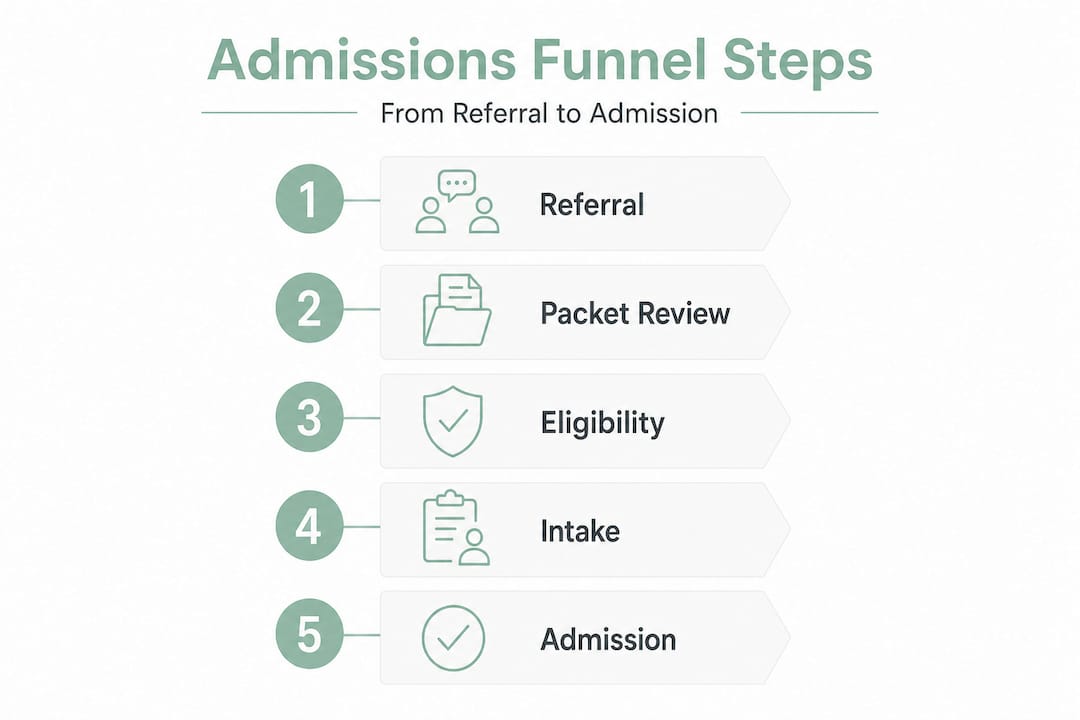
The data points that matter most fall into several categories. Demographics and insurance coverage establish baseline eligibility. Medical acuity scores and comorbidity profiles help your clinical team assess care complexity and resource requirements. Intake packet completeness determines whether authorization can move forward without rework. Understanding how these referral management advantages connect to operational outcomes gives your team a measurable framework for improvement.
Research confirms that standardizing referral protocols improves timely and efficient admissions decisions across care settings. When data collection is inconsistent or left to individual staff interpretation, decision quality suffers and referral conversion rates decline.
SNF admissions data requirements vs. operational role
| Data element | Admissions stage | Operational role |
|---|---|---|
| Patient demographics | Referral receipt | Identifies payer type and basic eligibility |
| Medical acuity score | Packet review | Guides clinical fit assessment |
| Comorbidity profile | Packet review | Determines resource and staffing needs |
| Insurance eligibility status | Eligibility verification | Confirms coverage and benefit period |
| Prior authorization status | Authorization | Gates the admission decision |
| Intake packet completeness | Intake | Triggers final bed assignment |
Common pitfalls in data collection include:
- Receiving referral packets with missing clinical documentation, requiring follow-up calls that delay decision timelines
- Failing to verify insurance eligibility before clinical review, resulting in wasted clinical team time on ineligible patients
- Inconsistent comorbidity documentation across referring hospitals, making acuity comparisons unreliable
- Incomplete medication lists that create medication reconciliation gaps at intake
- Missing contact information for authorization specialists at the payer level, causing authorization delays
Facilities that take time to optimize patient experience at the admissions stage also benefit from cleaner data collection, since structured intake processes naturally reduce errors and omissions. Investing in intake process optimization is one of the highest-leverage actions your team can take to reduce downstream bottlenecks.
Instrumenting the admissions workflow for actionable insights
Once you have identified key data points, the next task is to instrument your workflow to capture actionable metrics at every stage.
Instrumentation simply means building measurement into your process so that your team can see where time is lost, where data is incomplete, and where decisions slow down. Most facilities have the raw activity data available inside their EHR systems and referral portals but have never structured that data into a meaningful performance view.
Instrumenting the referral-to-admission funnel is the first step in building reliable, data-driven workflows. Without this foundation, even the most sophisticated predictive model will produce outputs that your team cannot act on confidently.
Follow these steps to instrument your admissions workflow:
- Map your current process in writing. Document every step from referral receipt to bed assignment, including who owns each step, what data they need, and what system they use to record it.
- Identify your key timing metrics. Measure referral-to-response time, packet review duration, eligibility verification turnaround, and authorization-to-admission lag separately for each payer type.
- Create a completeness score for incoming packets. Assign a numeric score to each referral packet based on how many required fields are populated, and track average completeness by referring hospital or agency.
- Set baseline benchmarks. Use four to six weeks of historical data to establish your current average performance at each stage before making process changes.
- Assign ownership for each metric. Every measurement needs a named owner on your team who monitors it, investigates outliers, and reports findings in weekly admissions reviews.
- Review and adjust weekly. Instrumentation only works when your team uses the data actively. Schedule a brief weekly review of your funnel metrics to catch emerging bottlenecks before they compound.
Manual vs. digital workflow instrumentation
| Capability | Manual tracking | Digital workflow tools |
|---|---|---|
| Response time measurement | Estimated, often inaccurate | Automated, timestamp-based |
| Packet completeness scoring | Subjective, inconsistent | Structured, rule-based |
| Eligibility verification speed | Days, dependent on phone calls | Hours or minutes, integrated with payer portals |
| Audit trail | Paper logs, fragmented | Centralized, searchable |
| Bottleneck visibility | Reactive, after delays occur | Proactive, real-time alerts |
You can also use streamline admissions tasks resources to understand which administrative tasks are the strongest candidates for automation once your instrumentation is in place.
Pro Tip: Track referral response time as your leading indicator for process health. If your average response time increases week over week, it typically signals a bottleneck in packet review or eligibility verification before it becomes a measurable drop in bed fill rate.
Applying predictive models to admissions decisions
With workflow metrics in place, your facility can begin applying predictive models to improve admissions decisions and manage clinical risk more effectively.
Predictive models in SNF admissions take structured data inputs, such as demographics, diagnosis codes, medication lists, and prior hospitalization history, and produce a risk score or probability estimate for a defined outcome. The most common outcomes modeled in post-acute care include 30-day readmission risk, length of stay prediction, and discharge destination likelihood.
Machine-learning models can predict 30-day readmission with an AUROC of up to 0.7484, meaningful accuracy for a high-complexity clinical population. AUROC, or Area Under the Receiver Operating Characteristic curve, measures a model’s ability to distinguish between patients who will and will not experience the outcome. A score of 0.50 is equivalent to random chance, while 1.0 represents perfect prediction.
However, it is important to recognize that model performance varies with dataset and feature window, meaning recalibration is not optional. A model trained on data from one patient population or time period will drift in accuracy when applied to a different group or after significant changes in your facility’s payer mix or referral sources.
Core predictors used in SNF admission models typically include:
- Age and gender, which correlate with care complexity and payer type
- Primary diagnosis and secondary comorbidities, which drive resource utilization
- Prior hospitalization frequency, a strong signal for readmission risk
- Medication count and specific drug classes, including anticoagulants, insulin, and psychotropics
- Functional status scores, such as Activities of Daily Living ratings
- Insurance type and benefit status, which affect authorization timelines
- Cognitive status indicators, which influence staffing and care planning
Statistic to watch: Models deployed in real-world SNF cohorts typically report AUROC scores between 0.62 and 0.64 for readmission prediction, lower than research benchmarks because of missing data and population variability. Your team should set realistic performance expectations and treat model scores as decision support, not as definitive admission criteria.
The decision-making guide for healthcare admissions covers how to integrate these predictive outputs into your existing clinical review process without creating alert fatigue or over-reliance on model scores. The most effective facilities use predictive scores as one input alongside clinical judgment, not as a replacement for it.
Recalibration should occur at minimum every six months, or whenever your referral volume, payer mix, or patient population shifts meaningfully. Assign a clinical informatics lead or partner with your software vendor to schedule model validation reviews on a consistent cycle.
Optimizing eligibility verification and intake workflows
After refining decision models, the next frontier is real-time eligibility and intake process optimization, where speed and accuracy directly affect referral conversion.

Eligibility verification is consistently one of the highest-friction stages in the SNF admissions funnel. When verification depends on manual phone calls to payer representatives or delayed portal access, your team loses hours or days that referring hospitals simply cannot wait for. Delays in eligibility verification and incomplete intake packets slow admissions and directly reduce referral conversion rates, particularly for Medicare Advantage patients with complex prior authorization requirements.
Common pitfalls in eligibility verification include:
- Verifying eligibility only once at intake rather than confirming active coverage at admission
- Failing to check benefit period exhaustion for Medicare Part A patients before clinical review
- Missing secondary insurance information that affects cost-sharing and authorization pathways
- Relying on the referring hospital’s insurance information without independent verification
- Not tracking which payers require concurrent review versus retrospective authorization
“The slower discharge of Medicare Advantage patients from hospitals is reshaping how SNFs approach their intake and admissions practices, putting pressure on facilities to resolve authorization barriers faster than ever before.”
Coordinating authorization specialists directly with payers helps facilities manage common barriers to SNF admission, including prior authorization criteria gaps and documentation requirements that vary by plan.
Pro Tip: Standardize your intake packet requirements into a structured checklist that maps directly to each payer’s authorization criteria. When your admissions coordinators know exactly which documents each payer requires before they even open the referral packet, verification timelines shrink significantly.
Your team can reference the intake documentation guide for a detailed breakdown of required documentation by payer type. Reviewing referral management system examples can also help you evaluate whether your current tools support real-time verification or still rely on manual lookups that slow the process.
Why most SNFs miss the mark on data-driven decisions
Having reviewed best practices and operational tactics, it is worth addressing where real-world skilled nursing facilities most commonly fall short, because the gap between knowing and doing is where facilities lose the most ground.
The most common failure is treating data-driven admissions as a one-time project rather than an ongoing operational discipline. A facility installs a new platform, runs reports for a few weeks, and then gradually reverts to informal decision-making when the initial enthusiasm fades. Data-driven admissions is not a tool you deploy once. It is a practice your team builds into every daily huddle, every referral review, and every weekly performance meeting.
The second failure is over-reliance on a single metric. Bed fill rate is the most visible number in any admissions discussion, but it tells you nothing about why conversion is declining. Facilities that watch only fill rate miss the upstream signals: rising referral response times, increasing packet incompleteness scores, or a specific payer type generating authorization delays. By the time the fill rate drops, the underlying problem has already been compounding for weeks.
The third failure involves predictive models specifically. Many facilities implement a readmission risk score or acuity model and then treat the output as a fixed rule rather than a calibrated estimate. They reject patients above a certain score threshold without reviewing whether the model is still performing accurately for their current patient population. Model drift is real, and it is underappreciated. A model calibrated on pre-2024 data may be systematically miscalibrated for today’s Medicare Advantage patient mix.
The actionable lesson is straightforward: build recalibration reviews into your calendar, assign ownership to a specific team member, and use model scores alongside clinical judgment. Your admissions coordinators bring contextual knowledge that no algorithm captures, and the strongest outcomes come from pairing that expertise with structured data.
Finally, too many facilities use data to justify existing decisions rather than to challenge them. The goal is not to confirm what you already believe about which referrals to accept. It is to surface patterns you would not see otherwise, identify referral sources with high conversion rates, flag documentation gaps before they delay authorization, and find the eligibility issues that your team is currently catching too late. Resources like streamline admissions tasks can help your team shift from reactive to proactive workflow management.
Take your admissions to the next level with data-driven tools
Your facility now has a clear framework for building data-driven admissions decisions, from funnel instrumentation through predictive modeling and eligibility optimization. The next step is applying proven tools that put these capabilities directly into your admissions team’s hands.
Smart Admissions is built specifically for skilled nursing facilities, rehabilitation centers, and post-acute care providers that want to move faster without adding administrative burden. The platform automates referral review, integrates with your existing EHR and insurance portals for real-time eligibility verification, and delivers actionable analytics so your team can make confident decisions at every stage of the admissions funnel. Facilities using Smart Admissions report measurable gains in bed fill rates and significant reductions in manual administrative work. Explore how to automate admissions for faster bed occupancy, review referral management system examples to compare your current setup, and learn about the different patient referral types your team should be tracking.
Frequently asked questions
What data should be prioritized in SNF admissions decisions?
The most important data includes demographics, medical acuity, comorbidities, eligibility status, and intake packet completeness. Research confirms that 23 predictors including demographics, medications, acuity, and comorbidities shape SNF admissions risk models most reliably.
How accurate are predictive models for SNF admissions decisions?
Most models achieve moderate accuracy, with AUROC scores between 0.62 and 0.75 for readmission risk predictions. Machine-learning models in SNFs report an AUROC of up to 0.7484, with best-model real-world performance typically ranging from 0.62 to 0.64 depending on dataset and feature selection.
How can facilities overcome common bottlenecks in admissions?
Facilities should standardize referral protocols, coordinate eligibility verification, and streamline intake documentation processes. Standardizing referral criteria and optimizing communication reduces inefficiencies and improves referral speed across care settings.
What’s the first step in building a data-driven admissions strategy?
Instrument the referral-to-admission funnel by tracking response time, packet completeness, and eligibility status before implementing predictive models. Instrumenting the funnel is step one in building the reliable measurement foundation that makes all downstream data-driven decisions possible.