
Swing bed admissions run best on a standardized pre-admission checklist that verifies Medicare eligibility, confirms clinical skilled need, and matches the referral to your facility’s actual capabilities. Getting this sequence right cuts referral review time and lifts conversion rates. The immediate next step for your team is simple: adopt the nine-step pre-admission checklist below and start timestamping every referral that comes through the door.
TL;DR:
- Ensuring Medicare Part A eligibility and confirming remaining benefit days is essential within 30 days of hospital discharge to prevent claim denials.
- A 1 to 4 hour response time for referral decisions relies on a streamlined team of nurse, therapy, insurance reviewers, and a physician for final approval.
- Accurate daily skilled documentation, including history, physical, medication reconciliation, and skilled notes, is critical to avoid Medicare audit rejections.
- Publishing a capability matrix upfront reduces inappropriate referrals by clearly stating what clinical and operational services the facility can safely provide.
- Implementing an AI-based referral management system can automate eligibility verification and streamline tracking, improving response times and decision accuracy.
Table of Contents
- Pre-Admission Checklist: The 9 Steps Every Swing Bed Referral Must Pass
- A Lean Review Team That Hits the 1-4 Hour Response Target
- What Medicare and CMS Require You to Document
- Define What You Accept, Publicly, Before Referrals Arrive
- Keeping Beds Full: Outreach That Doesn’t Feel Like Sales
- The Full Workflow: Forms, Owners, and Deadlines at Each Stage
- Closing the Gap Between Hospital Discharge Planners and Your Team
- Training Your Staff So Every Admission Follows the Same Process
- Planning the Discharge Before the Patient Even Arrives
- A 30-Day Snapshot: What Early Implementation Actually Looks Like
- How Smart Admissions Fits Into This Workflow
- Sources
- FAQ
Pre-Admission Checklist: The 9 Steps Every Swing Bed Referral Must Pass
A reliable swing bed program treats every referral in the same way, every time. That consistency is what separates facilities with strong conversion rates from those losing beds to slow decisions or preventable denials. Here is the sequence your admissions team should run on every case.
- Timestamp the referral the moment it arrives, and capture required fields immediately: diagnosis, current level of care, anticipated discharge date, insurance information, and physician contact.
- Verify Medicare Part A eligibility. This means confirming the 3-day qualifying inpatient stay, remaining Part A benefit days, and whether admission will occur within the 30-day window following hospital discharge.
- Confirm clinical skilled need using a daily skilled services checklist. Wound care, IV therapy, complex medication management, or daily therapy needs all qualify differently and should be documented distinctly.
- Check operational readiness. Confirm equipment availability, therapy staffing coverage, and bed assignment before you commit to acceptance.
- Run insurance and prior authorization tasks. Note payer-specific quirks. Some Medicare Advantage plans require prior authorization even when traditional Medicare would not.
- Document patient choice and deliver required notices before admission, not after.
- Notify the referral source with a clear acceptance or denial, timestamped for your records.
- Complete admission orders, including the discharge order from acute care and a separate admission order to swing bed status.
- Finalize documentation: history and physical, medication reconciliation, and certification of skilled need.
This sequence mirrors the WHA Swing Bed Optimization Playbook’s five-step framework of eligibility screening, clinical review, patient and family education, authorization, and final documentation, expanded into the granular tasks your staff actually execute.
A Lean Review Team That Hits the 1-4 Hour Response Target
Speed in swing bed admissions comes from limiting who touches a referral before a decision gets made. The WHA playbook recommends a streamlined, multidisciplinary review team rather than a long approval chain, and that structure is what makes a 1 to 4 hour response time realistic.
Four roles typically cover it:
- Initial nurse reviewer screens for basic eligibility and obvious red flags within the first 30 to 60 minutes.
- Therapy triage assesses rehab potential and staffing fit.
- Utilization or insurance reviewer confirms benefit days, authorization requirements, and payer-specific rules.
- Physician gives final sign-off, but only after the first three checks clear.
That ordering matters. Elevating every referral straight to a physician wastes the scarcest resource on cases that could have been screened out or approved at the nursing level. Reserve physician time for clinically marginal cases where medical judgment genuinely changes the outcome.
Each step needs a logged status in your EHR or referral tracker: received, screening, clinical review, authorization pending, accepted, or denied, each with a timestamp. Without that data trail, you cannot measure where referrals actually stall.
Statistic Callout: Facilities pursuing high-performance referral management target a response window of 1 to 4 hours from referral receipt to decision, a benchmark that directly affects whether a hospital discharge planner sends you the next case.
Pro Tip: Review referral response time and conversion rate weekly at the operational level, then step back monthly for a strategic look at length of stay and readmissions. The weekly cadence catches bottlenecks before they become a pattern; the monthly view tells you whether the pattern is actually costing you occupancy.
What Medicare and CMS Require You to Document
Swing bed care sits inside a specific set of federal rules, and your documentation needs to prove you followed them, not just that you provided good care. Three Medicare basics anchor everything else: a 3-day qualifying inpatient stay, available Part A benefit days, and admission generally within 30 days of hospital discharge.
Beyond eligibility, CMS’s discharge planning rule requires that patients be given a genuine choice of post-acute providers, and that this choice, along with the quality and resource-use data shared with the patient, be recorded in the medical record. Skipping this step is one of the more common and entirely avoidable compliance gaps in swing bed programs.
| Documentation item | When it’s required | Why it matters |
|---|---|---|
| Discharge order from acute care | At transition | Confirms hospital course ended appropriately |
| Swing bed admission order | At admission | Establishes the new level of care |
| Certification of skilled need | At admission, recertified periodically | Supports Medicare billing |
| History and physical | 1 to 4 hours | Baseline for skilled care plan |
| Medication reconciliation | At admission | Prevents adverse drug events |
| Daily skilled service note | Every day of stay | Defends against audit or denial |
Daily documentation of skilled need is what auditors look for first. A gap of even one or two days without a clear skilled service note is a common trigger for denial. Keep swing bed records clearly flagged as separate from the preceding acute stay so reviewers, and your own staff, never confuse the two episodes of care.
Define What You Accept, Publicly, Before Referrals Arrive
Every swing bed program has a capability ceiling, and stating it clearly upfront saves your team from reviewing referrals you were always going to decline. A readiness assessment should cover clinical, operational, administrative, and regulatory readiness, including staffing, equipment, documentation, and payer authorization, before you commit to a capability publicly.
A reasonable capability list to publish includes:
- Wound vac management
- IV antibiotic therapy
- CPAP or BiPAP support
- Tube feeding
- Tracheostomy care
- Bariatric accommodations, where equipment supports it
Common exclusions worth stating plainly: ventilator dependence, active chemotherapy or radiation requiring daily oncology coordination, dialysis without an established transport or on-site arrangement, and active behavioral risk that your unit cannot safely manage.
Publishing this as a one-page capability matrix, shared directly with discharge planners and embedded in your referral packet, lets referral sources self-filter before they call. The Swing Bed Resource Manual notes this single change reduces inappropriate referrals and speeds review for everyone involved.
Pro Tip: Build the capability matrix into your EHR referral template so front-line staff can check boxes instead of writing narrative explanations for every decline. Consistency in how you say “no” protects relationships as much as consistency in how you say “yes.”
Keeping Beds Full: Outreach That Doesn’t Feel Like Sales
An open bed you don’t fill costs you exactly as much as a bad admission you shouldn’t have accepted. Waiting passively for the phone to ring is the slower path; proactive outreach brings higher-quality referral volume than sitting back and hoping.
- Set a weekly outreach cadence to case managers and discharge planners at your referring hospitals, short and factual: current bed availability, capabilities, and any recent capacity changes.
- Track patients transferred elsewhere and revisit those relationships when your capacity or capability changes. A referral you couldn’t accept in March might fit perfectly in June.
- Share concrete numbers with referral partners. Time-to-admit and conversion rate build more trust than general reassurances about quality.
- Measure what outreach actually produces. Track referral conversion rate and occupancy change monthly, and drop tactics that don’t move either number.
None of this requires a marketing budget. It requires someone on your team treating referral relationships as ongoing rather than transactional, and a system for analyzing referral data well enough to know which outreach is working.
The Full Workflow: Forms, Owners, and Deadlines at Each Stage
Turning the nine-step checklist into a repeatable workflow means attaching a form, an owner, and a deadline to every stage. Referral intake needs a standardized referral form capturing diagnosis, insurance, physician orders, and anticipated discharge date, owned by whoever answers the referral line, completed within the first 15 minutes of contact.
Clinical and eligibility review needs the daily skilled services checklist and Medicare eligibility verification, owned by your nurse reviewer, targeted for completion within 60 to 90 minutes. Insurance and authorization tasks run in parallel where possible rather than sequentially, since waiting for one department to finish before starting the next is the single biggest source of delay in the whole intake window.
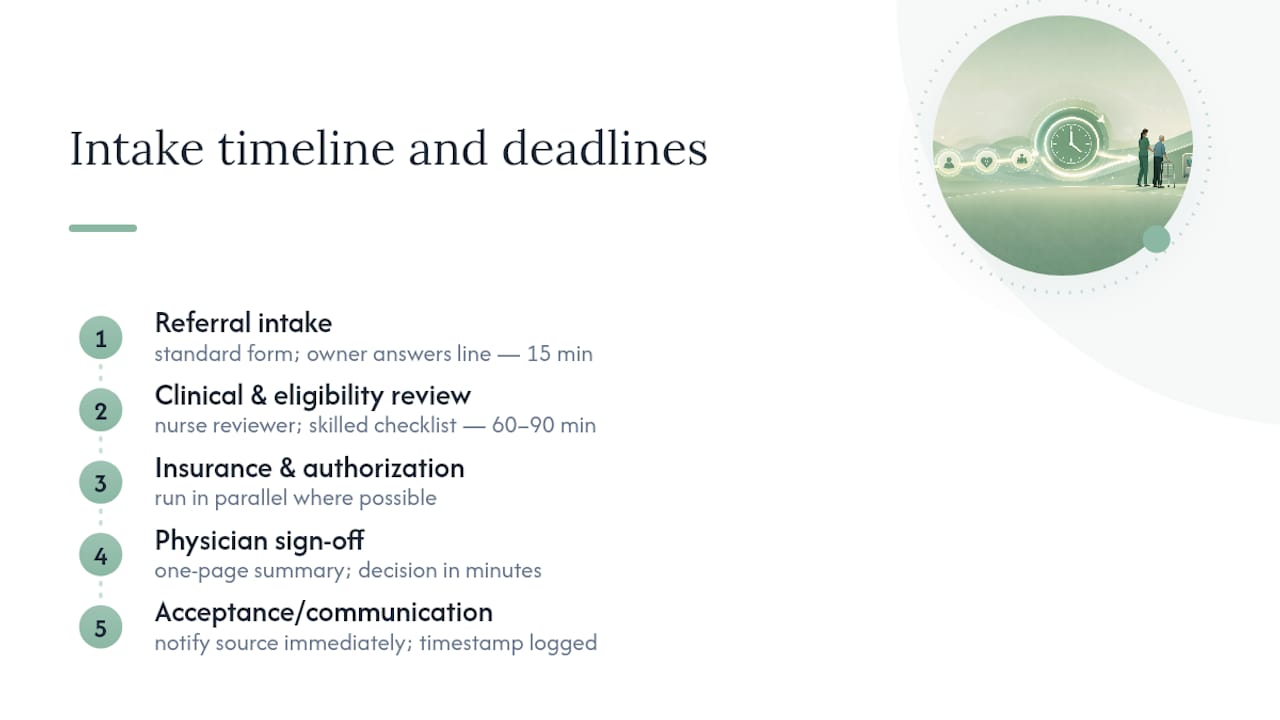
Physician sign-off comes next, using a one-page summary rather than the full chart, so a decision can happen in minutes rather than requiring the physician to re-review everything the nursing team already checked. Acceptance or denial gets communicated to the referral source immediately, with a timestamp logged in your tracker.
Final admission requires the discharge order, the swing bed admission order, certification of skilled need, the history and physical, and medication reconciliation, all completed before or at the moment the patient arrives. The WHA implementation roadmap frames this as a four-stage cycle: assess current patterns, build the checklists and workflows, activate outreach, then optimize using ongoing KPI monitoring. Standardized templates for referral forms, the capability matrix, and admission checklists, paired with a daily huddle, are what actually make this stick day to day.
Closing the Gap Between Hospital Discharge Planners and Your Team
Most swing bed admission delays trace back to a communication gap between the hospital side and the receiving facility, not a clinical disagreement. Discharge planners are juggling a dozen active cases at once; if your referral form asks for information in a different order than they’re used to providing it, expect follow-up calls and lost time.
Standardize your intake form to match the fields hospital case managers already fill out for other post-acute referrals. That single alignment removes a surprising amount of friction. Give discharge planners one direct phone line or inbox for swing bed referrals rather than routing them through a general admissions queue, and respond to every referral, accepted or not, within your stated window so planners learn your timeline is real.
When you decline a referral, say why in specific terms tied to your published capability matrix rather than a vague “not a good fit.” A planner who understands your actual limits will send you better-matched referrals going forward instead of testing the boundaries repeatedly.
Finally, close the loop after admission. A brief message confirming the patient arrived safely and is settling into care costs nothing and reinforces that your facility follows through, which matters more than any brochure the next time that planner has a borderline case to place.
Training Your Staff So Every Admission Follows the Same Process
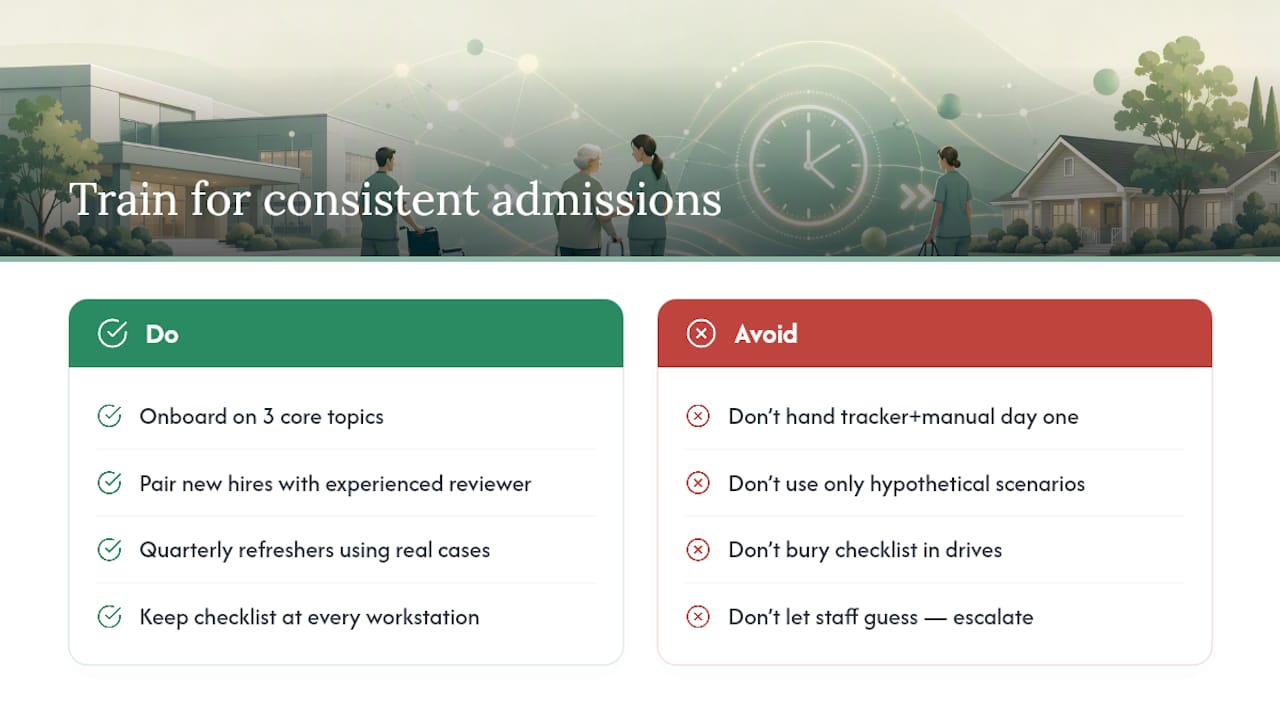
A checklist only works if every staff member runs it the same way, regardless of who’s on shift. Inconsistent execution, not a flawed checklist, is the most common reason swing bed programs see uneven referral outcomes.
New admissions staff need structured onboarding on three things specifically: the Medicare eligibility rules governing the 3-day qualifying stay and benefit days, the daily skilled documentation standards that will hold up under audit, and the capability matrix that defines what your facility can and cannot safely manage. Pair new hires with an experienced reviewer for their first several weeks rather than handing them the tracker and a manual on day one.
Run a brief quarterly refresher for the whole admissions team. CMS guidance and payer rules shift often enough that a process trained once in year one can drift out of compliance by year three without anyone noticing. Use real, de-identified referral cases from your own facility during training. Hypothetical scenarios rarely capture the payer quirks and edge cases your team actually encounters.
Keep a written reference version of the checklist accessible at every workstation, not buried in a shared drive folder three clicks deep. When a step is genuinely ambiguous, staff need a named escalation contact, not a guess, because a wrong guess documented incorrectly is harder to fix after the fact than a five-minute question would have been.
Planning the Discharge Before the Patient Even Arrives
Smooth transitions out of swing bed care start with planning that begins at admission, not the week before discharge. Waiting until the final days to think about home safety, equipment needs, or follow-up care is what produces bounce-backs and readmissions.
Build a projected discharge date into the care plan from day one, and revisit it at each interdisciplinary review rather than treating it as fixed. Involve family or caregivers early, especially when equipment, home modifications, or a caregiver training session will be needed before the patient can safely return home.
Coordinate follow-up appointments and home health referrals at least several days before the actual discharge date, not the morning of. A patient leaving without a confirmed follow-up visit is one of the more preventable causes of an early readmission. If the patient is moving to a different level of care rather than home, whether that’s long-term care or an outpatient rehab program, send the same clinical summary and medication list you’d want to receive if the roles were reversed.
Document the discharge plan the same way you document admission: with specifics, not generalities. “Discharged home with home health, family trained on wound care, follow-up scheduled” tells the next provider far more than “discharged home in stable condition,” and it protects your facility if questions arise later about the quality of the transition.
A 30-Day Snapshot: What Early Implementation Actually Looks Like
The first month of tightening up a swing bed admissions process usually starts small: one shared referral tracker, one owner for each checklist step, and a daily huddle where the team flags anything stuck longer than a few hours. Escalation rules matter here. If nursing or therapy triage hasn’t cleared a referral within the target window, it needs an automatic handoff, not a wait-and-see approach.
The first KPI worth watching closely is referral response time, since it’s the fastest signal that something in the workflow is bottlenecked. A realistic 30-day win looks less like perfect numbers and more like visible improvement: referrals moving through triage faster and fewer referrals falling through without a documented decision. Quick staff training wins include a laminated checklist at every workstation and a shared documentation template for daily skilled need notes, both of which cost almost nothing and pay off within days.
— Harry
How Smart Admissions Fits Into This Workflow
Running the nine-step checklist by hand works, but it depends entirely on staff discipline and manual timestamping, which is exactly where delays creep back in. Smartadmissions is built around that gap: an AI-driven referral management platform that connects to your existing EMR and insurance portals to verify Medicare eligibility, benefit days, and payer authorization in real time, rather than requiring a staff member to check each one manually.
It maps directly onto the steps that eat the most time: eligibility verification, referral timestamping, and status tracking across your team, plus KPI dashboards that show referral response time and conversion rate without a manual spreadsheet. Smart Admissions states its onboarding takes under an hour. If your team is ready to see how automation handles the checklist you just read, view current pricing plans and request a demo to see it against your own referral volume.
Sources
- CMS discharge planning rule (press release)
- Rural Health Research recap on swing beds
- Swing Bed Resource Manual (2026)
FAQ
What Is the Medicare 3-Day Rule for Swing Bed Admissions?
Medicare generally requires a 3-day qualifying inpatient hospital stay before a patient can be admitted to a swing bed under Part A. Admission should also occur within 30 days of that hospital discharge, with limited exceptions, and the facility must confirm remaining Part A benefit days before accepting the referral.
How Fast Should a Swing Bed Referral Decision Happen?
High-performing programs target a decision window of 1 to 4 hours from the time a referral is received to a documented acceptance or denial. Hitting that window consistently depends on a lean review sequence: nurse screening, therapy triage, and insurance verification, before a physician gets involved.
What Documentation Does Patient Choice Require?
Facilities must offer patients a genuine choice among qualified post-acute providers and record that choice, along with relevant quality and resource-use data, in the medical record. Skipping this documentation is a common and avoidable compliance gap during swing bed admissions.
What Should a Swing Bed Capability Matrix Include?
A capability matrix should list what your facility can manage, such as wound vac care, IV antibiotic therapy, and tube feeding, alongside clear exclusions like ventilator dependence or unsupported dialysis. Publishing this one-page matrix to referral partners reduces inappropriate referrals and speeds up review for both sides.
How Does Smart Admissions Help With Swing Bed Admissions?
Smart Admissions automates eligibility verification, EMR-linked documentation checks, and referral status tracking, which maps directly onto the pre-admission checklist admissions teams already use. Pricing details are available on the pricing page, with onboarding designed to take under an hour.