
Reliable weekend admissions coverage comes down to four moves: finishing eligibility and authorization work by Friday afternoon, naming a single weekend decision lead, standardizing what goes into every EMR referral packet, and tracking a short list of metrics every week. Weekend RN staffing drops sharply compared to weekdays, according to payroll-based staffing data analyzed by Health Affairs, which is exactly why late-week preparation and automated referral review matter so much. Start Monday by running a Friday readiness huddle and assigning your on-call decision lead.
TL;DR:
- Move tests, imaging, and consults forward to Thursday; complete insurance checks and prior authorizations by Friday noon, then log remaining status in each packet.
- Weekend staffing is thinner: Health Affairs found RN hours drop roughly 42%, LPN hours 17%, and CNA hours 9% compared with weekdays.
- Federal rules still require admission orders at intake, a baseline care plan within 48 hours, and a comprehensive assessment within 14 calendar days.
- Each EMR packet should include orders, medications, test status, mobility, authorization details, and a weekend flag, with conditional admission authority assigned beforehand.
- Assign a reachable lead, an RN reviewer, and an insurance verifier; target decisions within 60 to 120 minutes and record every deferral reason.
Table of Contents
- Quick weekend admissions checklist for the next 24 to 72 hours
- Why weekends are different: staffing data and federal requirements
- Thursday to Friday playbook to prevent weekend admission failures
- EMR handoffs and documentation standards for weekend referrals
- On-call roles, decision criteria, and rapid review workflow
- Measuring weekend coverage: KPIs and a simple dashboard
- How we help facilities operationalize weekend coverage
- What matters most when you tighten weekend coverage
- Start your weekend readiness pilot with Smart Admissions
- FAQ
- Sources
Quick weekend admissions checklist for the next 24 to 72 hours
Before Friday closes, your admissions team needs a short, prioritized list of tasks rather than a general sense that “weekend coverage is handled.” These five steps catch the gaps that usually surface on Saturday morning.
- Confirm prior authorizations and insurance eligibility for every pending referral by Friday at noon.
- Finalize outstanding tests or imaging and log their status directly in the EMR referral packet.
- Name a specific weekend admissions decision lead, with a backup, and post both contact numbers where your team can see them.
- Verify transportation and confirm family or caregiver logistics before shifts change for the weekend.
- Send a short, templated phone or email handoff to the hospital discharge planner confirming receipt and next steps.
None of these steps require new software to start. They require a standing Friday process that your team repeats every week until it becomes routine, which is what turns weekend admissions from a gamble into a predictable operation.
Why weekends are different: staffing data and federal requirements
Weekend admissions carry more risk than weekday ones because fewer clinical staff are on the floor to review charts, confirm orders, and complete assessments. Payroll-based journal data analyzed by Health Affairs found that RN hours fall by roughly 42% on weekends compared to weekdays, with LPN hours down about 17% and CNA hours down about 9% in the same analysis.
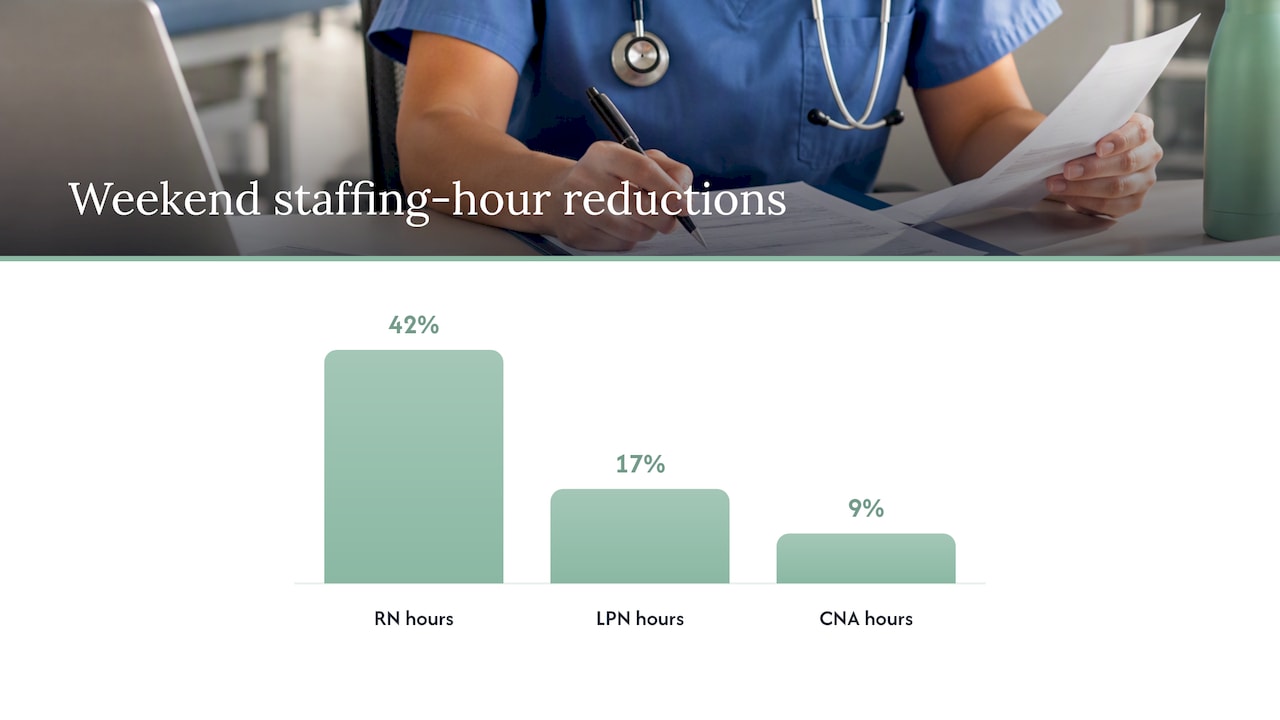
Weekend RN staffing drops by roughly 42% compared to weekday levels, according to Health Affairs, which means a weekend admission often gets less immediate clinical attention than the same patient would receive on a Tuesday.
Federal requirements do not pause for the weekend. Under 42 CFR §483.20, facilities must have admission orders in place at the time of admission, a baseline care plan within 48 hours, and a comprehensive resident assessment within 14 calendar days.
- Admission orders must be on file at the moment a resident is admitted, weekday or weekend.
- Baseline care plans are due within 48 hours of admission.
- Comprehensive assessments are due within 14 calendar days, regardless of when intake occurred.
A recent moratorium suspended enforcement of certain federal minimum staffing standards, but facility assessment and documentation obligations under 42 CFR remain in force, so weekend charting discipline still matters as much as it did before.
Thursday to Friday playbook to prevent weekend admission failures
The weekend admission that goes smoothly almost always started on Thursday. A narrative review of discharge planning studies found that shifting coordination tasks, consults, imaging, and medication reconciliation, earlier in the week consistently increases weekend discharge readiness and shortens length of stay, according to a review published in PMC.
Thursday tasks to front-load:
- Push outstanding diagnostic tests and specialty consult requests to completion, not just “in progress.”
- Submit preliminary authorization requests for any referral likely to arrive Friday or over the weekend.
- Flag incomplete records so your Friday huddle starts with a short, accurate list rather than a surprise.
Friday huddle agenda:
- Review every pending referral against the five-item checklist from the section above.
- Confirm the weekend decision lead and backup are reachable and briefed on open cases.
- Close the loop with hospital discharge planners in writing, confirming what your facility needs before Saturday.
A warm handoff to the hospital’s discharge team, one that confirms receipt, sets expectations, and gives a direct contact, reduces the back-and-forth that otherwise eats up Saturday morning.
Pro Tip: Treat Friday’s huddle as a hard stop: no referral leaves the list marked “pending” without a named owner and a next action.
EMR handoffs and documentation standards for weekend referrals
A referral that’s complete when it lands is a referral your weekend team can act on immediately. A quality improvement project that standardized EMR handoffs for weekend-pending referrals reported a sharp increase in completed weekend authorizations after adopting a consistent template, according to an ECU quality improvement report.
Every weekend referral packet should include:
- Signed physician orders and current medication list.
- Status of any pending diagnostic tests or imaging.
- Documented mobility and functional status.
- Pre-authorization status, including payer contact if still pending.
- A clear weekend-pending flag or tag inside the EMR itself.
Delegation rules matter as much as the checklist. Decide in advance who can verify insurance eligibility independently and who has authority to accept a conditional admission pending final paperwork, so no referral sits idle waiting for someone unavailable until Monday.
Pro Tip: A single required field, “weekend readiness: yes or no,” inside your EMR referral template forces the question before the packet ever reaches the weekend queue. Our guide to referral documentation best practices walks through template design in more detail.
On-call roles, decision criteria, and rapid review workflow
Weekend coverage works when three roles are defined on paper, not assumed informally: a weekend admissions lead who owns final decisions, an RN reviewer who confirms clinical appropriateness, and an administrative verifier who confirms insurance and documentation.
- Weekend admissions lead: makes the accept, conditional accept, or defer decision and is reachable by phone throughout the shift.
- RN reviewer: confirms clinical fit against current census and staffing, documented in the chart.
- Admin verifier: confirms eligibility and authorization status before any conditional acceptance is finalized.
A three-step decision checklist keeps the process consistent: accept when clinical and administrative criteria are both met, conditionally accept when one item is pending but low-risk, or defer when critical information is missing. Set a target decision window, many facilities aim for 60 to 120 minutes from hospital contact, and document the reason for every deferral so the pattern is visible later.
Measuring weekend coverage: KPIs and a simple dashboard
Tracking performance weekly turns weekend readiness from a one-time project into a standing habit. A small set of metrics, reviewed monthly, tells you where the friction actually is.
| Metric | What it tracks | Data source |
|---|---|---|
| Weekend admission turnaround time | Hours from referral receipt to decision | EMR referral log |
| Weekend authorization completion rate | Share of referrals with payer approval before admission | Admissions tracking sheet |
| Weekend RN/LPN/CNA hours vs. weekday baseline | Staffing gap by role, by day | PBJ/payroll data |
| Weekend bed fill rate | Occupied beds filled over the weekend window | Census report |
Pulling daily staffing hours from payroll or PBJ data lets you set an alert threshold, for example, flagging any Saturday where RN hours fall more than the typical weekend drop documented by Health Affairs, so your admissions lead can trigger a contingency plan before Friday ends. A brief monthly audit of weekend documentation against the 14-day assessment requirement rounds out the review.
How we help facilities operationalize weekend coverage
We designed our platform to address these common gaps: EMR integration that pulls referral data automatically, real-time eligibility verification so your Friday checklist doesn’t depend on a phone call to the payer, and automated referral validation that flags incomplete weekend packets before they reach your decision lead.
- Weekend-pending referrals get flagged automatically, so nothing sits unreviewed until Monday.
- Real-time eligibility checks remove the manual payer calls that usually stall Friday afternoons, a workflow we detail in our guide to real-time eligibility verification.
- Analytics dashboards track the same KPIs outlined above without a manual spreadsheet, helping facilities monitor weekend admissions performance.
An implementation study pairing AI-based discharge prediction with a dedicated weekend team increased the proportion of weekend discharges from a median of 14% to 18% across nearly 4,000 patients, and the approach was cost-effective at the study site, according to research published in the Internal and Emergency Medicine journal. That finding matches what we see operationally: automation paired with a defined weekend process outperforms either one alone.
What matters most when you tighten weekend coverage
The hardest part of weekend admissions isn’t the technology. It’s the discipline of finishing Thursday’s work on Thursday instead of letting it drift into Friday afternoon, when your options narrow fast. Facilities that treat late-week preparation as a fixed routine, not a best effort, see fewer delayed discharges and steadier bed fill, while staff burnout drops because nobody is improvising a decision at 7 p.m. on Saturday. Measured automation helps most when it removes the manual steps people were already skipping under pressure.
— Harry
Start your weekend readiness pilot with Smart Admissions
Our platform is built to support the playbook above with features like automated EMR referral intake, real-time eligibility verification, and weekend-specific alerts that flag incomplete packets before Friday ends. Many facilities begin with a narrow pilot focusing on Friday automation and weekend alerting before expanding to broader referral management.

- Review Monthly or Annually pricing to find the plan that fits your facility’s referral volume.
- Read our guide to automating admissions for faster bed occupancy for a closer look at implementation timelines.
- See how EMR integration works in practice before your next referral cycle starts.
Request a demo through our pricing page and bring your first weekend pilot online before next Friday’s huddle.
FAQ
What is weekend admissions coverage in skilled nursing facilities?
Weekend admissions coverage refers to the staffing, documentation, and decision-making processes a facility uses to safely accept patient referrals on Saturdays and Sundays. It typically includes a named on-call decision lead, standardized EMR referral packets, and pre-confirmed insurance eligibility completed before the weekend begins.
Why are weekend admissions harder to manage than weekday admissions?
Weekend admissions carry more risk because clinical staffing is lower. Health Affairs found that RN hours fall by roughly 42% on weekends compared to weekdays, which narrows the clinical capacity available to review and accept new referrals.
What federal requirements apply to weekend admissions?
Under 42 CFR §483.20, facilities must have admission orders in place at the time of admission, a baseline care plan within 48 hours, and a comprehensive assessment within 14 calendar days, regardless of whether the admission happens on a weekday or weekend.
How can facilities reduce weekend admission delays?
Front-loading diagnostic tests, specialty consults, and preliminary authorizations to Thursday and Friday consistently improves weekend readiness, according to a narrative review of discharge planning studies. Standardized EMR referral templates and a named weekend decision lead further reduce the back-and-forth that otherwise delays Saturday and Sunday admissions.
Can automation improve weekend admissions outcomes?
Automation paired with a defined weekend team increased the proportion of weekend discharges from a median of 14% to 18% across nearly 4,000 patients in one implementation study. Platforms like Smart Admissions apply this same pairing, combining automated referral review with a clear weekend decision process, to support faster, more reliable placements.
Sources
- TAILORED-SWIFT (Springer) — AI-led discharge + weekend team study
- Daily nursing home staffing levels highly variable, often below CMS expectations (Health Affairs)
- 42 CFR §483.20 Resident assessment (govinfo)
- Weekend discharge and late-week planning narrative review (PMC)