
Hospital case manager communication is the single biggest lever your admissions team controls once a referral arrives. The case manager decides which facility gets the call, how fast documents move, and whether a patient leaves on time. If you give that person one clear point of contact, a short list of specific asks, and a predictable rhythm of updates, your referrals move faster and your admissions are safer.
This guide is written for admissions coordinators, admission directors and administrators at skilled nursing facilities. It covers what hospital case managers are dealing with, what federal rules require of them, and seven practical habits you can start this week.
TL;DR
- Hospitals are required to plan discharges early and document post-hospital needs, so a well-timed, specific request from you fits the work they already have to do.
- Replace one-way faxes with a short “warm handoff” call or video touchpoint on complex cases.
- Ask for named missing items (for example behavioral health notes), not a generic “please resend.”
- Treat case management assistants as allies: they often move a referral through the hospital’s internal approval steps.
- Track every contact and response time so you can see which hospital relationships are slowing your beds.
Table of Contents
- What a hospital case manager is juggling
- What federal rules already require of hospitals
- Seven ways to improve hospital case manager communication
- A simple communication cadence you can copy
- Our perspective: communication is a workflow, not a personality trait
- Where Smart Admissions fits
- Measure what the relationship is worth
- Common mistakes to avoid
- FAQ
- Sources
What a hospital case manager is juggling
A hospital case manager coordinates a patient’s care across the stay and plans the exit. That means insurance authorizations, family conversations, physician orders, and placement calls, often for dozens of patients at once. The research behind this article notes that these professionals can be managing hundreds of files, which makes errors and delays likely in high-volume settings, according to a discharge planner presentation from OU Health.
That context shapes how you should communicate. A case manager who receives ten vague messages a day will answer the one that is short, specific and easy to act on. Your goal is to be that message.
Another reality: discharge is often a shared but unowned job. A review of dedicated discharge coordinators describes discharge delays that come from fragmented coordination of imaging, consults, documentation and transportation, not from clinical need. When no one owns the whole path, you can become the person who helps the referral cross the finish line.
What federal rules already require of hospitals
Your requests land better when you understand the obligations behind them. Under 42 CFR 482.43, hospitals participating in Medicare and Medicaid must run an effective discharge planning process. That process includes the patient and caregivers as active partners, identifies patients likely to suffer adverse consequences without adequate planning, and evaluates the need for post-hospital services.
CMS has also published requirements for hospital discharges to post-acute care providers, which covers communication with post-acute providers and caregivers about a patient’s needs. Your admissions team does not enforce these rules, but you can frame your requests around them: you are asking for information the hospital is already expected to assemble.
Seven ways to improve hospital case manager communication
1. Name one point of contact on each side
Discharge stalls when nobody owns it. Give each hospital case manager one named person on your team, with a direct phone number and a text-capable line, and ask who their counterpart is for your facility. If your team handles inbound calls in a scattered way, our guide to managing admissions calls lays out a step-by-step routine.
One owner per relationship means the case manager never has to guess who is following a referral.
2. Ask for specific missing items, not a resend
When a referral packet is incomplete, “please send the rest” costs the case manager time. A better approach, supported by the research, is a direct follow-up that names the exact items you need. Keep patient details out of unsecured text: use a phone call or a message that contains no protected health information, and send the clinical content through your secure channel.
Compare two messages:
- Weak: “We are still waiting on records for the referral from this morning.”
- Strong: “Hi Dana, this is Ruth from Maple Grove. For the 10:15 referral we are missing the current medication administration record and the psychiatry note. Can you send those by 2 p.m. so our clinical team can decide today?”
The second version gives a deadline, a reason and a short list. It is easy to answer in one step.
3. Use a warm handoff on complex cases
The most common failure in hospital-to-SNF communication is missing data that sits in a separate system, such as behavioral health notes or complex medication instructions. AHRQ-funded work on preventing medication-related problems in transitions to skilled nursing points to direct, real-time verbal or video communication as a stronger approach than relying only on faxed discharge summaries.
The stakes are real. Studies cited by AHRQ’s PSNet indicate up to 75% of patients can have at least one medication discrepancy between the discharge summary and facility admission orders. In the same ECHO-Care Transitions project, connecting multidisciplinary teams by videoconference was associated with lower readmissions and a shorter length of stay. An earlier study found that discrepancies among the discharge summary, the SNF referral form and the admission orders were the rule rather than the exception.
A warm handoff does not need to be long. Ten minutes covering the following is enough:
- Reason for admission and expected skilled needs
- Medication changes made during the stay, including anything stopped
- Behavioral health history and current status
- Family or caregiver concerns and home environment
- Transportation, arrival time and who will receive the patient
4. Build a recurring touchpoint with your top referral sources
Most facilities get a large share of referrals from a handful of hospitals. For those, schedule a brief recurring check-in, weekly or twice a week, to review incoming complex cases. The same AHRQ-supported research on structured hand-offs links regular multidisciplinary contact with fewer medication errors and readmissions.
Your agenda can be three questions: Which patients are likely to need skilled care in the next 48 hours? What is holding up the current ones? What can we do on our side today? If you want to understand who your key partners are, see our overview of post-acute referral networks.
5. Involve case management assistants
CMSA guidance on preventing post-acute placement delays emphasizes the case manager’s persistence in clearing placement hurdles, and suggests that admissions teams involve hospital case management assistants in logistical tracking rather than waiting passively. These assistants often know exactly where a referral sits in the hospital’s internal approval process.
Introduce yourself to them, ask how they prefer to receive updates, and thank them when a packet arrives complete. Small courtesies make your referrals easier to prioritize.
6. Ask for the documents that tend to be left out
Incomplete discharge documentation is frequently a technology problem, not neglect. EMR interoperability failures can leave behavioral health notes or other specialty records out of the main discharge summary. The CMS discharge requirements document linked above is a useful reference for what hospitals should be communicating. Build a standard ask list and send it with every acceptance conversation:
- Current medication list with last-dose times
- Psychiatric or behavioral health notes, if any
- Recent therapy evaluations and functional status
- Wound, line, or device details
- Isolation status and recent culture results
- Insurance and authorization status
- Family contact and caregiver preferences
Our piece on handling referral documentation goes deeper on keeping these packets organized once they arrive.
7. Close the loop, every time
Case managers remember which facilities respond quickly and which go silent. Whether your answer is yes, no, or not yet, tell them within the window you promised, and say why. If you must decline, state the specific barrier, such as a service you do not provide or a bed type you do not have available, so they can redirect quickly. For the reasoning behind persistent, polite follow-up, read why following up on pending referrals matters.
A simple communication cadence you can copy
Use this table as a starting template and adjust it to your hospital partners.
| Moment | Who contacts whom | Channel | What to include |
|---|---|---|---|
| Referral received | Your admissions lead to case manager | Phone or secure message | Confirm receipt, list missing items, state decision time |
| Clinical review done | Your admissions lead to case manager | Phone | Accept, decline with reason, or request more information |
| Acceptance | Both teams, clinical staff included | Warm handoff call or video | Medications, behavioral health, family, arrival plan |
| Day before transfer | Your admissions lead to case manager or assistant | Phone | Confirm transport, time, equipment, final documents |
| After arrival | Your nursing lead to hospital team | Call or secure message | Flag discrepancies found on admission |
The last row matters. When you find a discrepancy, reporting it respectfully gives the hospital a chance to improve the next handoff.
Our perspective: communication is a workflow, not a personality trait
We talk with admissions teams every day, and the pattern is consistent. The coordinator who gets referrals moving is rarely the one with the friendliest voice. It is the one with a repeatable process: the same questions, the same follow-up timing, the same record of what was asked and answered.
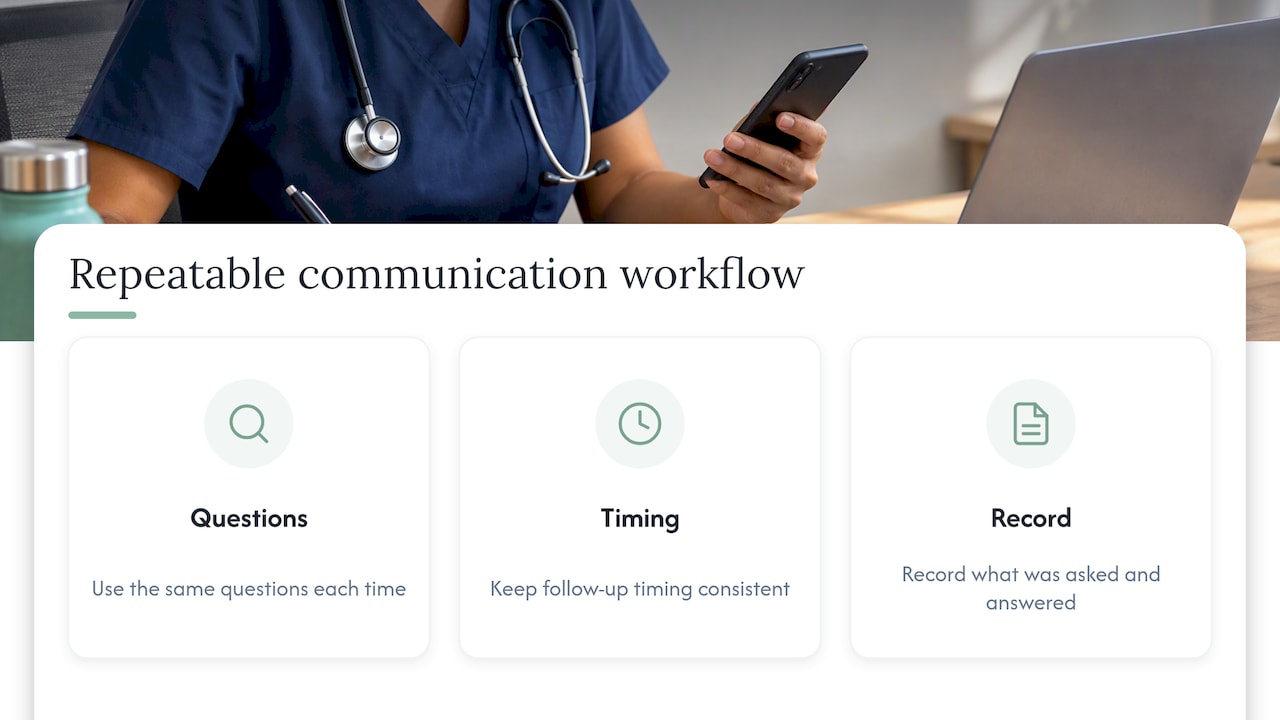
When those steps live in inboxes, sticky notes and memory, even a strong coordinator loses time to rework. A referral that sits waiting for one document can cost a facility a bed day, and the reply to a hospital often depends on whoever happens to be at the desk. That is why we built our platform around the intake workflow: connecting to your EMR and insurance portals, checking eligibility in real time, and keeping documentation in one place, so your team spends its time on the conversation with the case manager rather than on chasing paperwork.
Technology does not replace the relationship. It frees the hours you need to build it. Our advice: standardize first, then automate what is repetitive, and keep every human conversation for the moments that need judgment.
— Harry
Where Smart Admissions fits
If your team is spending its day on eligibility checks, document requests and status updates, an AI-powered referral assistant can take that load. Smart Admissions integrates with your existing EMR and insurance portals and supports referral review, clinical assessments and documentation management for skilled nursing and post-acute providers. Onboarding is designed to take under an hour, and we offer a guarantee that the software pays for itself within 30 days.
Plans are listed on our pricing page: $597 per month, or $6,447 per year. To see how automation changes day-to-day intake, read about why automating admissions speeds bed occupancy.
Measure what the relationship is worth
Better communication should show up in numbers. Track these for each major referral source for 60 to 90 days:
- Time from referral received to first response
- Time from first response to clinical decision
- Percentage of packets complete on first receipt
- Number of follow-ups needed per referral
- Referrals accepted but not admitted, with the reason
If one hospital shows long gaps between acceptance and arrival, schedule a conversation with its case management lead, not just the individual case manager. Often the cause is a shared bottleneck such as transportation or a missing authorization. Our patient transfer workflow guide and our article on reducing referral times can help you map where the time goes.
Common mistakes to avoid
- Sending the same request repeatedly. Repeating a generic message adds noise. Change it by naming what is missing.
- Putting PHI in unsecured texts. Keep texts to logistics and use your secure system for clinical details.
- Calling only when you need something. Share good news too, such as a patient who is doing well in your facility, when appropriate and permitted.
- Skipping the decline explanation. A clear reason helps the case manager find the right placement and remember what you do well.
- Treating the fax as the handoff. A fax is a document. A handoff is a conversation.
FAQ
What is a case manager in a hospital setting?
A hospital case manager is a healthcare professional, often a registered nurse or social worker, who coordinates a patient’s care and plans the transition out of the hospital. They handle insurance authorizations, family communication and post-acute placement. For your facility, they are usually the person deciding where referrals go.
How should an admissions coordinator contact a hospital case manager?
Start with a short phone call or a message with no protected health information, then move clinical details to a secure channel. State the referral, the exact items you need and the time by which you will respond. Specific requests get answered faster than general ones.
What should I ask for during a warm handoff?
Cover medication changes, behavioral health history, functional status, family concerns and arrival logistics. Medication discrepancies between hospital and facility documents are a documented risk, so a live conversation helps catch them before the patient arrives.
Do hospital case managers have to coordinate with skilled nursing facilities?
Hospitals participating in Medicare and Medicaid must maintain an effective discharge planning process under federal rules, including evaluating a patient’s need for post-hospital services. That makes coordination with post-acute providers part of their job, which is why clear, timely requests from you fit their workflow.
Sources
- 42 CFR 482.43, Condition of participation: Discharge planning (eCFR)
- Requirements for Hospital Discharges to Post-Acute Care Providers (CMS)
- Preventing Medication-Related Problems in Care Transitions to Skilled Nursing Facilities (AHRQ Digital Healthcare Research)
- ECHO-Care Transitions Successfully Reduces Patient Readmissions from Skilled Nursing Facilities (PSNet)
- Medication discrepancies upon hospital to skilled nursing facility transitions (PSNet)
- Reducing Delays, Improving Flow: The Importance of a Dedicated Discharge Coordinator (PMC)
- Strategies to Prevent Post-Acute Placement Delays (CMSA)
- Working With Discharge Planning (OU Health)