

Admissions workflow bottlenecks are the points where a referral stops moving: a missing clinical record, an insurance authorization nobody has chased, a review that waits on one person’s desk. In a skilled nursing facility, each stall costs more than time. It can cost the admission. This guide shows where the bottlenecks usually sit, how to measure them in your own building, and seven fixes you can put in place in order.
TL;DR
- Most stalls come from four places: incomplete hospital documentation, payer authorization, manual eligibility checks, and referral review that depends on one or two people.
- Facilities receive an average of 6.6 referrals per patient to secure one admission, and only 32% of referrals are accepted, so every wasted minute is multiplied.
- Map your process, time each handoff, and fix the slowest step first. Do not automate a broken step.
- Automation of intake, eligibility, and documentation removes repetitive work, but relationships with hospital case managers still decide who gets the call.
Table of Contents
- Where admissions workflow bottlenecks come from
- How to find your own bottlenecks
- 7 fixes for admissions workflow bottlenecks
- Manual vs. automated: where the hours go
- What the CMS interoperability rule means for your team
- Relationships still matter
- Our perspective: fix the process, then speed it up
- Put a number on it before you buy anything
- A 30-day plan to clear your bottleneck
- FAQ
- Sources
Where admissions workflow bottlenecks come from
A bottleneck is the one step in a process that limits the output of everything after it. In admissions, the output is a filled bed. You can have an open bed, a willing clinical team, and a motivated hospital partner, and still lose the patient because one step in between took two days.
The pressure is real. One in four Medicare patients hospitalized for an acute medical illness is discharged to a skilled nursing facility, and the same research found that 23% of them return to the hospital within 30 days. The handoff is high volume and high stakes at once. That is why the admissions desk gets squeezed from both sides: hospitals want a fast answer, and your clinical team needs enough information to say yes safely.
The bottlenecks below show up in most facilities. Your building may have one dominant problem or all of them.
Incomplete or mismatched clinical documentation
Hospital staff carry heavy caseloads and rotate often, so the packet that arrives is frequently missing something. A study of SNF screening and admission processes found that inconsistent and inadequate transfer of medical documentation was one of the main outside pressures shaping how facilities screen. Practitioners in that research estimated that fully usable discharge paperwork arrives in only about 10% of cases.
A national survey of 471 hospital and SNF pairs points the same way: SNFs reported that key information was often missing, including functional, mental, and behavioral status and whom to contact. Each gap means a phone call, a fax request, or a clinician starting an assessment from scratch.
Payer authorization and Medicare Advantage rules
Capacity is not always the cause of a slow discharge. Holly Bowen of Cascadia Healthcare told Skilled Nursing News that the real obstacle is often the administrative burden of Medicare Advantage authorization, which can delay transfers even when the facility has an open bed. The same reporting describes a gap in speed: hospitals want the patient out now, while you need time to verify acuity and coverage. Without someone dedicated to daily contact with managed care case managers, bed days are lost.
Manual eligibility verification
Checking benefits by logging in to several payer portals, one referral at a time, is slow and easy to get wrong. A missed Medicaid status or an expired coverage date shows up later as a denial. If your team still verifies by hand, read our 10 essential steps for patient eligibility verification and compare it with what your coordinators do today.
Referral review that depends on one person
When only the admissions director can decide, referrals queue up at lunch, on weekends, and during vacations. Decentralized processes make this worse, because each person screens a little differently. The same SNF screening research found that processes varied from one facility to the next, which makes response times hard to predict for hospital partners.
Duplicate data entry
A referral arrives by fax, portal, or email. Someone retypes it into the EMR, then again into a spreadsheet or tracking log. Each retyping adds delay and a chance of error, and it takes your coordinator away from the calls that win admissions.
How to find your own bottlenecks
Generic advice only helps once you know which step is slow in your building. A simple audit takes about two weeks and needs no software.
- Pick a sample. Pull the last 30 to 50 referrals, both accepted and declined.
- Time-stamp each step. Record when the referral arrived, when it was opened, when clinical review started and ended, when eligibility was confirmed, when the decision went back to the hospital, and when the patient arrived.
- Find the longest wait. Waiting time between steps is usually larger than working time within them. The longest gap is your bottleneck.
- Tag the reason for every stall. Missing records, payer pending, reviewer unavailable, bed not ready, family undecided.
- Count the losses. For each declined or lost referral, note whether the reason was clinical fit or speed. Speed losses are the ones you can recover.
A process that has been redesigned this way can improve quickly. A Veterans Affairs skilled nursing facility formed a multidisciplinary admissions team and standardized its steps, and median time from bed request to transfer fell from 3.3 days to 2.3 days. That is one day saved per patient, in a setting with an established workflow problem.
7 fixes for admissions workflow bottlenecks
1. Form a small admissions team with clear roles
The VA redesign used a unit nurse manager, a social worker, and administrative staff working as one team. You can copy that structure at any size: one person owns intake, one owns clinical review, one owns authorization and payer contact. Write down who covers each role when the owner is out.
2. Give authorization its own owner
If Medicare Advantage authorizations are a major delay, assign a person to them. Their job is daily contact with managed care case managers, tracking every pending request, and escalating before a hospital gives up and moves on. This is the role the operators in the Skilled Nursing News reporting say is often missing.
3. Make your documentation request simple and specific
Hospital staff are overwhelmed, and the research on care transitions is clear that you get better packets when you make the request easy. Send a short checklist of exactly what your clinical team needs: recent history and physical, medication list, therapy notes, wound status, and payer information. Share what your facility can and cannot manage clinically, so hospitals send you the right patients. Our guide to referral documentation best practices goes through the checklist in detail.
4. Verify eligibility at the start, not the end
Run the coverage check as soon as the referral arrives, in parallel with clinical review. Real-time checks against payer systems remove the guesswork and cut later denials. See our guidance on the 48 to 72 hour rule for real-time eligibility checks and, for state programs, Medicaid eligibility verification in five steps.
5. Connect referrals to your EMR
Retyping is the most avoidable delay on this list. When referral data flows into your EMR, coordinators stop duplicating work and clinicians see the same record. Start with what EMR integration is and what it delivers, then use our walkthrough for integrating the EMR with referrals.
6. Decide with fit criteria, not just census pressure
Speed is not the same as saying yes to everything. Researchers studying admissions under Value-Based Purchasing argue that directors must be intentional, because accepting a referral without checking the fit between patient acuity, goals, and facility resources can lead to poor outcomes, readmissions, and financial penalties. Write your acceptance criteria down, so a trained second reviewer can apply them in minutes and the director handles only exceptions.
7. Automate the repetitive steps
Once roles and criteria are clear, automation has something solid to speed up. The best candidates are intake data capture, eligibility checks, documentation tracking, and status alerts. See six examples of healthcare workflow automation and the differences between manual and automated admissions.
Manual vs. automated: where the hours go
| Step | Typical manual approach | With automation |
|---|---|---|
| Referral intake | Fax or portal, retyped into the EMR | Data captured once and routed to the right reviewer |
| Eligibility | Portal-by-portal lookup by a coordinator | Real-time check at the time of referral |
| Documentation | Phone calls and fax requests for missing records | Gaps flagged and requested right away |
| Review queue | Depends on who is in the building | Alerts and a visible queue for the whole team |
| Reporting | Spreadsheets built at month end | Referral volume, response time, and conversion tracked continuously |
Automation does not replace judgment. It protects your coordinators’ time for the conversations that need it.
What the CMS interoperability rule means for your team
Federal rules are moving in your direction. The CMS Interoperability and Prior Authorization final rule requires impacted payers to build and maintain APIs for exchanging prior authorization and clinical data, with most compliance mandates beginning January 1, 2027. CMS describes the wider effort on its interoperability and burden reduction page. Payers will not fix your workflow for you, but facilities with an EMR-connected process will be positioned to use better data exchange as it arrives.
Relationships still matter
Technology does not close the gap alone. Providers interviewed in care transition research stress that strong admissions depend on relationships: know the case managers who send you patients, give them a quick answer, and tell them plainly what you do well. Families also need a plan if a placement is not available. For relatives who must arrange support at home in the meantime, this guide to organizing care at home (in German) shows how one provider structures that planning.
Our perspective: fix the process, then speed it up
We build admissions software, and we still tell facilities to start with the process. A tool applied to a vague workflow produces faster confusion. The teams that get the most from automation know who owns each step, what a complete referral looks like, and what they will accept.
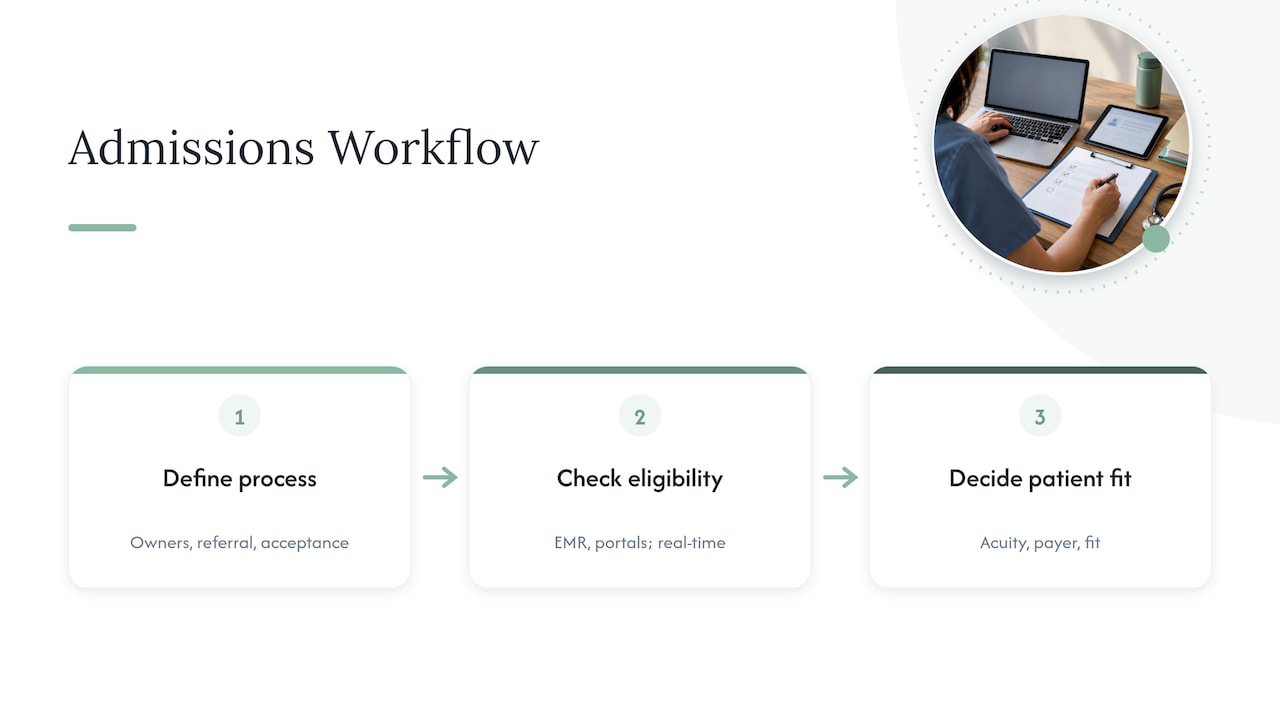
What we see as the central issue is that admissions staff spend their best hours on work a system can do: rekeying data, checking portals, chasing the same missing page. That work is a main source of burnout in admissions offices, and it directly slows the response a hospital is waiting for. Our platform was built by healthcare documentation experts around this problem. It connects to your EMR and insurance portals, checks eligibility in real time, and keeps documentation organized, so your coordinators can spend time on decisions and relationships.
We also believe in speed with discipline. A faster yes is only valuable if it is the right yes. Decision support that surfaces acuity, payer, and fit at a glance helps your director say yes to patients you can serve well, and decline the others quickly and clearly.
— Harry
Put a number on it before you buy anything
Take the audit results and calculate what one lost admission costs you: the daily rate, times the expected length of stay, minus the cost of care. Multiply by the referrals lost to slow response last quarter. If that number is meaningful, which for most facilities it is, a tool that shortens response time has a clear case.
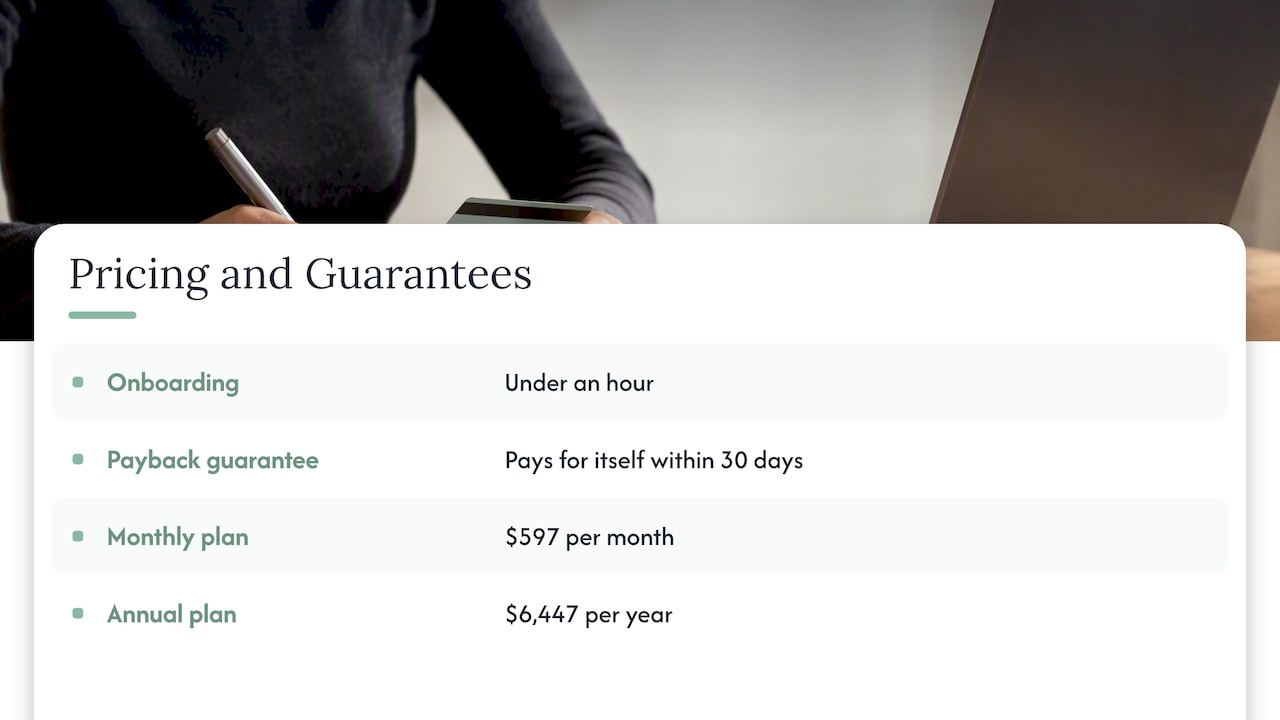
Smart Admissions is built for this. Onboarding takes under an hour, our support team is hands-on, and we stand behind a guarantee that the software pays for itself within 30 days. Plans are published: $597 per month or $6,447 per year, with optional free trial periods. If you want to see the numbers behind faster occupancy first, read why automating admissions can mean 20% faster bed occupancy, or review our intake process optimization guide. You can also explore the platform on the Smart Admissions home page.
A 30-day plan to clear your bottleneck
- Week 1: Pull 30 to 50 referrals and time-stamp each step.
- Week 2: Identify the longest wait and its cause. Name an owner for it.
- Week 3: Publish your referral checklist to hospital partners and write down acceptance criteria.
- Week 4: Move eligibility checks to the moment of referral, and decide which repetitive steps to automate first.
Re-measure after 30 days with the same method. If response times drop, keep going. If not, the audit tells you where to look next.
FAQ
What are the bottlenecks in an admissions process?
A bottleneck is any step where work waits longer than it takes. In skilled nursing admissions, the usual ones are incomplete hospital records, payer authorization, manual eligibility checks, single-reviewer decisions, and duplicate data entry.
How do you identify admissions workflow bottlenecks?
Time-stamp 30 to 50 recent referrals at every step, from arrival to patient move-in. The longest gap between two time stamps is your bottleneck. Tag each delay with a reason so you can see patterns.
What are the major steps in managing the admissions process?
The main steps are referral receipt, clinical review, eligibility and authorization, the accept or decline decision, bed and care preparation, and arrival. Each should have an owner and a target response time.
Will automation fix every delay?
No. Automation removes repetitive work such as data entry and eligibility lookups. Delays that come from payer rules or hospital documentation still need dedicated staff and good relationships with referral partners.
Sources
- Hospital to Skilled Nursing Facility Referral Rate Stable, Admission Rate Rises, Skilled Nursing News
- Care Transitions Between Hospitals and Skilled Nursing Facilities, PMC
- Variability in SNF screening and admission processes, PMC
- Information Sharing Practices Between US Hospitals and SNFs, PMC
- Slower Hospital Discharge of Medicare Advantage Patients, Skilled Nursing News
- Improving Access to Care by Admission Process Redesign in a VA SNF
- Factors Influencing Admission Decisions in Skilled Nursing Facilities, PubMed
- CMS Interoperability and Prior Authorization final rule
- CMS: Policies and Technology for Interoperability and Burden Reduction