
Healthcare SaaS platforms can slash referral review times by up to 50% and cut admission delays by 30%, yet many skilled nursing facilities still rely on outdated manual workflows. This guide explores how cloud-based software specifically designed for patient referrals and admissions transforms operations, reduces staff burnout, and drives measurable financial gains for post-acute care providers.
Table of Contents
- Introduction To Healthcare SaaS In Skilled Nursing And Post-Acute Care
- Operational Benefits Of Healthcare SaaS In Referral And Admissions Workflows
- How AI Enhances Referral And Eligibility Verification
- Reducing Staff Burnout Through Automation And Workflow Simplification
- Financial Benefits Of SaaS For Healthcare Facilities
- Common Misconceptions About Healthcare SaaS
- Comparison Of SaaS Features: AI-Enhanced Vs. Traditional Platforms
- Practical Considerations And Real-World Success Stories
- Explore Advanced Referral Management Solutions For Your Facility
- Frequently Asked Questions
Key takeaways
| Point | Details |
|---|---|
| Automation accelerates workflows | Healthcare workflow automation reduces review time by 50% and manual data entry by 40%. |
| AI enables real-time verification | AI-powered platforms deliver 48% faster referral processing through insurance eligibility checks and EMR integration. |
| Staff burnout drops significantly | Automation reduces burnout by 35% by eliminating repetitive administrative tasks. |
| Financial performance improves | Faster bed fills boost revenue 10-15% while reducing administrative overhead costs. |
| Selection requires careful evaluation | Prioritize EMR compatibility, AI features, HIPAA compliance, and user-friendly onboarding processes. |
Introduction to healthcare SaaS in skilled nursing and post-acute care
Healthcare SaaS (Software as a Service) delivers cloud-based applications that manage patient referrals, admissions, and intake workflows without requiring facilities to maintain on-premise servers or IT infrastructure. For skilled nursing homes and post-acute care centers, these platforms address specific operational pain points that traditional systems cannot solve efficiently.
Admissions teams in these facilities face unique complexities. Each patient referral requires verifying insurance eligibility, reviewing clinical documentation from multiple sources, coordinating with hospitals and physicians, and ensuring regulatory compliance before approval. Traditional methods involve phone calls, faxes, spreadsheets, and manual data entry across disconnected systems.
This fragmentation creates bottlenecks. Staff spend hours chasing paperwork, cross-referencing insurance portals, and entering duplicate information into EMR systems. Referrals sit in queues for days while beds remain empty. Critical patient data gets lost in email threads or misfiled documents.
Healthcare SaaS platforms emerged to solve these exact problems. By centralizing referral data in cloud-based systems with automated workflows, these solutions connect directly to insurance portals and EMR platforms. Real-time data exchange replaces manual lookups. Intelligent routing ensures the right staff reviews each referral immediately.
Modern healthcare workflow automation platforms go further by incorporating artificial intelligence. AI assistants can pre-screen referrals for eligibility, flag missing documentation, and prioritize cases based on clinical acuity and bed availability. This combination of automation and intelligence fundamentally changes how admissions departments operate.
Key features that distinguish healthcare SaaS for skilled nursing include:
- Automated insurance eligibility verification through real-time portal integration
- Clinical documentation management with AI-powered review assistance
- Workflow routing that assigns referrals based on staff expertise and workload
- Compliance tracking for regulatory requirements and internal quality standards
- Analytics dashboards showing referral sources, approval rates, and time-to-admission metrics
The shift from manual processes to SaaS-based automation in healthcare admissions represents more than technology adoption. It reflects a strategic decision to prioritize operational efficiency and staff well-being while improving patient access to care.
Operational benefits of healthcare SaaS in referral and admissions workflows
Automation transforms how admissions teams handle daily tasks. Instead of manually entering patient demographics and insurance details from faxed documents, SaaS platforms extract this information automatically using optical character recognition and structured data feeds. The reduction in referral review time reaches 50% because staff spend seconds validating pre-populated forms rather than minutes typing from scratch.

Data entry errors drop by 40% when automation eliminates manual transcription. Insurance policy numbers, diagnosis codes, and medication lists flow directly from source systems into your admissions database. This accuracy improvement prevents claim denials and reduces the time staff spend correcting mistakes discovered weeks after admission.
Workflow efficiency gains compound across the entire intake process. When referrals arrive electronically, the system routes them instantly to available clinical reviewers based on specialty and current workload. No more email forwards or phone tag. Each team member sees a prioritized queue showing which referrals need immediate attention and which can wait.
Resource allocation improves because administrators gain visibility into bottlenecks. Dashboard analytics reveal when certain referral sources consistently submit incomplete documentation or when specific insurance types require extra verification steps. You can adjust staffing levels during peak referral hours and identify training needs for team members who struggle with particular tasks.
Pro Tip: When evaluating SaaS platforms, prioritize those offering customizable automation rules. Your facility’s workflow differs from others, so the ability to configure routing logic, approval thresholds, and notification triggers ensures the system adapts to your processes rather than forcing you to change successful practices.
The operational improvements from intake process optimization extend beyond speed and accuracy. Staff report higher job satisfaction when technology handles repetitive tasks, allowing them to focus on patient-centered activities like coordinating care transitions and communicating with families. This shift from administrative burden to meaningful work directly impacts retention rates in an industry facing persistent staffing challenges.
How AI enhances referral and eligibility verification
Artificial intelligence capabilities separate modern healthcare SaaS platforms from basic digital workflow tools. AI reduces admission delays by 30% through automated eligibility verification that completes in seconds rather than hours. The system queries insurance portals continuously, checking coverage status, prior authorization requirements, and benefit limits without human intervention.
This real-time integration with insurance systems and EMR platforms eliminates the manual lookups that traditionally consumed significant staff time. When a referral arrives, the AI assistant immediately validates patient insurance eligibility, flags any coverage gaps or pending authorizations, and retrieves relevant clinical history from connected EMR systems. Staff receive a complete patient profile with verification status before they even open the referral.
Clinical documentation accuracy improves dramatically when AI assists with review processes. Natural language processing algorithms scan physician notes, hospital discharge summaries, and diagnostic reports to extract key clinical indicators. The system highlights critical information like fall risk scores, infection precautions, and specialized care needs that admissions staff must consider when determining appropriate placement.
The performance difference between AI-enhanced and traditional platforms becomes clear in processing speed. AI-enhanced healthcare SaaS platforms provide 48% faster referral processing because they handle multiple verification tasks simultaneously. While a staff member manually checks insurance, the AI has already validated coverage, reviewed clinical documentation, and assessed bed compatibility across your facility.
Key AI capabilities that accelerate admissions include:
- Predictive analytics that estimate approval likelihood based on historical patterns
- Automated document classification that organizes attachments by type and relevance
- Intelligent form completion that populates fields using data extracted from unstructured documents
- Risk stratification models that prioritize high-acuity patients requiring immediate placement
The role of AI in patient intake continues evolving as machine learning models improve through exposure to more referral data. Systems learn which documentation combinations predict successful admissions and which referral sources typically provide complete information. This institutional knowledge becomes embedded in the platform, benefiting all users.
Integration depth matters significantly for realizing AI benefits. Platforms connecting directly to major EMR systems and insurance portals through certified APIs deliver more reliable real-time data than those requiring manual file uploads or screen scraping. When evaluating options, verify that the SaaS provider maintains active post-acute admissions eligibility verification partnerships with the specific insurance carriers and EMR vendors your facility uses most frequently.
Reducing staff burnout through automation and workflow simplification
Repetitive administrative tasks create significant burnout risk for admissions staff in skilled nursing facilities. Entering the same patient information into multiple systems, making phone calls to verify insurance coverage, and chasing missing documents consume hours that could support higher-value activities. When team members spend entire shifts on tedious data entry, job satisfaction plummets.
Healthcare workflow automation addresses burnout at its source by eliminating these repetitive tasks. SaaS platforms handle data entry, document routing, and status tracking automatically. Staff transition from manual processors to decision makers, reviewing pre-validated information and focusing on complex cases requiring clinical judgment.
The impact on staff well-being shows up clearly in research data:
Staff burnout related to repetitive administrative tasks in admissions can be reduced by 35% after adoption of automated SaaS platforms that streamline workflows.
This 35% burnout reduction translates to tangible improvements in retention rates and workplace satisfaction. Team members report feeling more engaged when technology handles routine tasks, allowing them to apply their expertise to patient care coordination and problem-solving.
Administrative workload decreases measurably when automation takes over time-consuming processes. Tasks that previously required 30 minutes of phone calls and system lookups now complete in under 5 minutes through automated verification. Staff handle larger referral volumes without working longer hours or experiencing increased stress.
The workflow simplification extends beyond individual task automation. Intelligent routing ensures referrals reach the appropriate reviewer immediately, eliminating the frustration of manually sorting through unorganized queues. Automated notifications keep everyone informed about status changes without requiring constant email checking or system monitoring.
Job satisfaction improvements create positive feedback loops. As staff experience less administrative burden, they have more energy for patient interactions and professional development. This enhanced work experience improves retention, reducing the costs and disruptions associated with hiring and training replacement staff in a competitive labor market.
Financial benefits of SaaS for healthcare facilities
Operational improvements from healthcare SaaS directly impact facility financial performance. Faster referral processing means beds fill more quickly, reducing the revenue loss from empty capacity. Facilities adopting automation report 20% faster bed occupancy rates, translating to revenue increases of 10-15% in the first year.
Higher utilization rates compound over time. Each day a bed remains empty represents lost revenue that can never be recovered. When SaaS platforms reduce the average time from referral to admission by several days, facilities capture more patient days annually. This increased throughput improves profitability even without raising rates or adding beds.
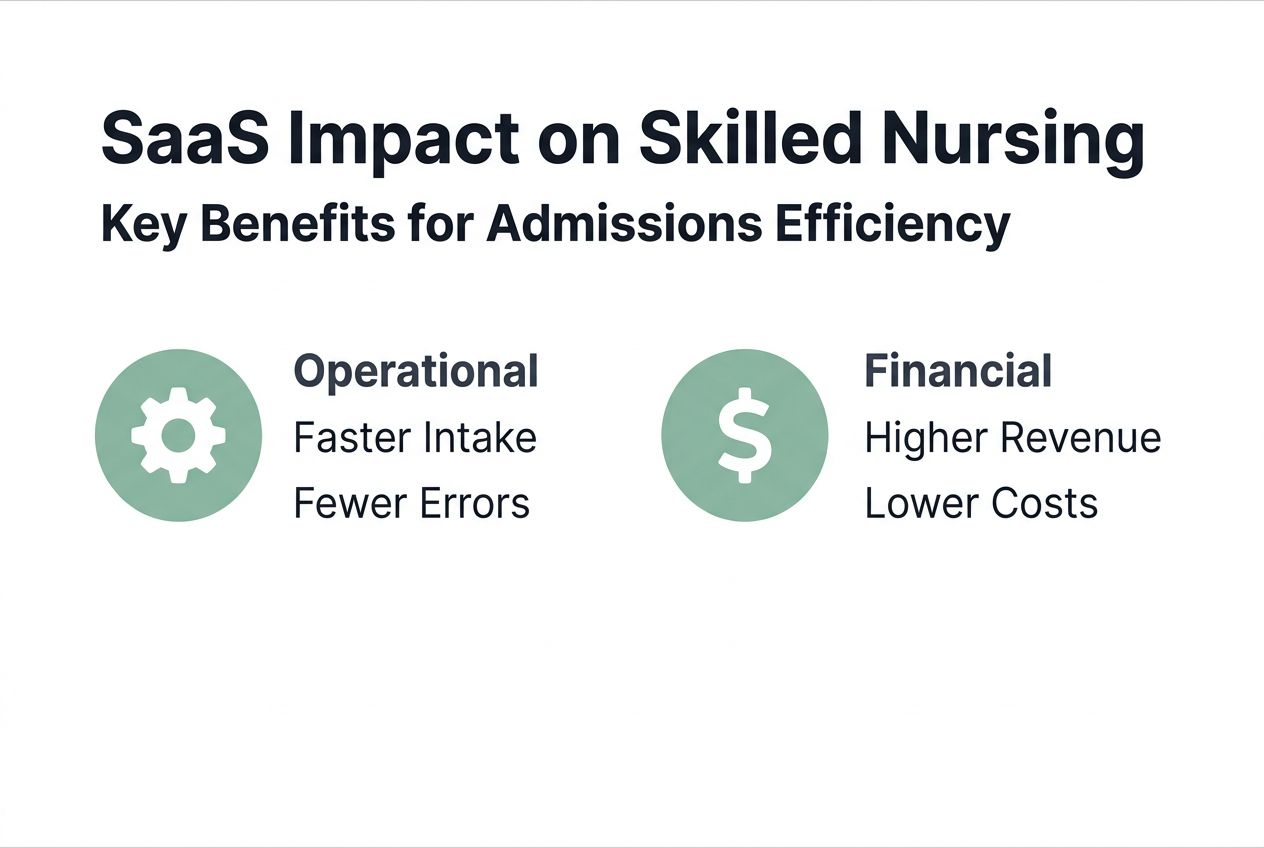
Cost savings from reduced administrative overhead add to direct revenue gains. Automation allows existing staff to handle more referrals without requiring additional headcount. The efficiency improvements mean you can process 40% more referrals with the same team size, or maintain current volumes with fewer full-time equivalents dedicated to manual data entry.
Understanding the financial transformation requires examining specific metrics:
- Calculate current cost per referral by dividing total admissions staff compensation by monthly referral volume
- Measure days-to-admission from referral receipt to patient arrival under current processes
- Identify revenue lost annually due to empty beds during referral processing delays
- Project cost reductions from automation based on time savings for repetitive tasks
- Estimate revenue increases from faster bed fills and higher occupancy rates
The cumulative financial impact becomes clear when comparing facility performance before and after SaaS adoption:
| Metric | Before SaaS | After SaaS | Improvement |
|---|---|---|---|
| Average days-to-admission | 7.2 days | 4.3 days | 40% faster |
| Monthly referrals processed | 120 | 168 | 40% more |
| Annual bed occupancy rate | 87% | 94% | 7 percentage points |
| Staff cost per referral | $85 | $51 | 40% lower |
| Annual revenue impact | Baseline | +$420,000 | 12% increase |
These improvements stem from the combined effects of automation, AI-powered verification, and streamlined workflows discussed throughout this guide. The financial case for healthcare SaaS becomes compelling when you quantify both the revenue opportunities from faster admissions and the cost savings from operational efficiency.
Referral management systems designed specifically for skilled nursing environments deliver better returns than generic healthcare software because they address the unique workflows and regulatory requirements of post-acute care. Purpose-built platforms require less customization and deliver value faster than adapting general-purpose tools.
Common misconceptions about healthcare SaaS
Several persistent myths prevent facilities from adopting healthcare SaaS solutions despite clear benefits. Understanding the reality behind these misconceptions helps administrators make informed decisions based on facts rather than outdated assumptions.
The most common concern suggests that SaaS platforms will replace admissions staff. This misunderstands the technology’s purpose entirely. Healthcare SaaS supplements and empowers staff by handling repetitive tasks, not eliminating the human judgment required for complex admissions decisions. Clinical reviewers still evaluate patient appropriateness, coordinate care transitions, and communicate with families. Automation simply removes the administrative burden that prevents them from focusing on these critical activities.
Data security fears also delay SaaS adoption unnecessarily. Modern healthcare SaaS platforms maintain rigorous HIPAA compliance with encryption, access controls, audit logging, and regular security assessments. Cloud-based systems often provide stronger security than on-premise servers because SaaS vendors invest heavily in cybersecurity infrastructure that individual facilities cannot afford. Reputable providers undergo independent security audits and maintain certifications demonstrating compliance with healthcare data protection standards.
Complexity concerns stem from past experiences with difficult software implementations. Today’s healthcare SaaS platforms prioritize user-friendly design specifically because they recognize busy admissions staff lack time for extensive training. Intuitive interfaces with guided workflows help new users become productive within days rather than months. Many platforms offer role-based access that shows each user only the features relevant to their responsibilities, reducing confusion.
Common misconceptions addressed:
- SaaS platforms require massive IT support and technical expertise to operate
- Implementation takes many months and disrupts daily operations significantly
- Cloud-based systems create compliance risks that on-premise software avoids
- Only large facilities with high referral volumes benefit from SaaS automation
- Switching to SaaS means abandoning existing EMR systems and starting over
The onboarding process for quality healthcare SaaS typically spans weeks rather than months. Vendors provide implementation support including data migration assistance, staff training, and workflow configuration. Many platforms integrate with existing EMR systems through certified APIs rather than replacing them, allowing facilities to maintain current clinical documentation processes while adding admissions workflow automation.
Comparison of SaaS features: AI-enhanced vs. traditional platforms
Choosing between AI-enhanced healthcare SaaS and traditional referral management software requires understanding the functional differences that impact daily operations and long-term outcomes. The feature gap between these platform types has widened significantly as AI capabilities have matured.
AI-enhanced platforms deliver automated eligibility verification, intelligent document processing, and predictive analytics that traditional systems cannot match. These capabilities directly address the time-consuming manual tasks that create bottlenecks in admissions workflows. The 48% faster referral processing AI platforms provide stems from simultaneous automated verification across multiple data sources while staff review clinical appropriateness.
Traditional platforms without AI features still offer value through digital workflow management and centralized referral tracking. They eliminate paper-based processes and provide better visibility than email and spreadsheets. However, staff must manually verify insurance eligibility, classify documents, and extract data from attachments, limiting efficiency gains.
Key differences between platform types:
| Feature | AI-Enhanced SaaS | Traditional Platforms |
|---|---|---|
| Insurance verification | Automated real-time checks | Manual portal lookups |
| Document processing | AI extracts and classifies | Manual review and filing |
| Referral prioritization | Predictive risk scoring | Manual sorting |
| EMR integration | Bidirectional data sync | One-way exports or none |
| Processing speed | 48% faster average | Baseline manual speed |
| Implementation complexity | Higher initial setup | Simpler configuration |
| Cost structure | Premium pricing | Lower subscription fees |
The complexity and cost tradeoffs require careful consideration. AI-enhanced platforms demand more thorough implementation planning to configure integration points and train algorithms on your facility’s historical data. Initial setup typically takes longer and costs more than traditional platforms. However, the ongoing operational benefits from automation often justify this upfront investment for facilities processing 50 or more referrals monthly.
Traditional platforms suit facilities with lower referral volumes or limited IT resources better than complex AI systems. If your team handles 20 referrals monthly, the efficiency gains from AI may not offset the additional cost and implementation effort. Simple digital workflow management might provide sufficient improvement over paper-based processes.
Pro Tip: Assess your facility’s specific needs before choosing between AI-enhanced and traditional SaaS platforms. Consider current referral volume, staff technical comfort, available IT support, and budget constraints. Request pilot programs from vendors to test platforms with real referrals before committing, ensuring the system matches your workflow requirements and delivers promised benefits.
Practical considerations and real-world success stories
Successful healthcare SaaS adoption requires strategic planning beyond vendor selection. Facilities that achieve the best outcomes follow a structured implementation approach addressing technical integration, staff training, and change management systematically.
Begin by assessing your current admissions workflow in detail. Document each step from referral receipt through patient admission, noting time spent on tasks, common bottlenecks, and error-prone processes. This baseline helps you identify which SaaS features will deliver the most value and provides metrics for measuring improvement after implementation.
Select a platform aligned with your facility’s technical environment and operational priorities. Verify compatibility with your existing EMR system, insurance portals you use most frequently, and any other clinical systems requiring integration. Confirm the vendor provides implementation support, staff training resources, and responsive technical assistance.
Pilot the platform with a small admissions team subset before full deployment. This controlled rollout reveals integration issues, workflow adjustments, and training needs without disrupting your entire operation. Gather feedback from pilot users to refine configuration and identify additional support requirements.
Common challenges during intake automation implementation include technical integration complexity, staff resistance to workflow changes, and data quality issues in legacy systems. Planning for these obstacles upfront increases success likelihood.
Real-world implementation results from similar facilities demonstrate achievable outcomes:
- 15% increase in bed occupancy within six months of SaaS deployment
- 85% of staff completed onboarding training and reported proficiency within three weeks
- 25% encountered integration challenges with legacy EMR systems requiring vendor support
- 92% of facilities reported meeting or exceeding ROI expectations by month twelve
Practical tips for smoother SaaS implementation:
- Designate an internal champion who understands both admissions workflows and basic technology to coordinate implementation
- Schedule training during lower referral volume periods to allow staff time for learning without operational pressure
- Maintain parallel manual processes briefly during initial rollout to ensure continuity if technical issues arise
- Establish clear success metrics before implementation so you can objectively measure platform impact
- Plan for EMR integration challenges by involving your IT department or EMR vendor early in the process
Success stories highlight the importance of vendor partnership quality. Facilities achieving the best outcomes worked with SaaS providers offering proactive technical support, regular platform updates addressing user feedback, and industry expertise helping optimize admissions workflows beyond basic software configuration.
Explore advanced referral management solutions for your facility
Healthcare facilities seeking to implement the operational improvements and financial benefits discussed throughout this guide need platforms built specifically for skilled nursing and post-acute care admissions workflows. Smart Admissions offers AI-powered referral management designed to reduce administrative burden while accelerating patient placement.
Our platform addresses the exact challenges explored in this guide through automated eligibility verification, intelligent document processing, and seamless EMR integration. Facilities using Smart Admissions report faster bed fills, reduced staff burnout, and improved financial performance through higher occupancy rates. Comprehensive referral management solutions help admissions teams handle more referrals with less manual effort while maintaining quality patient placement decisions.
Explore how automation in healthcare admissions can transform your facility’s intake processes and deliver measurable operational improvements.
Frequently asked questions
What are the main advantages of healthcare SaaS for skilled nursing admissions?
Healthcare SaaS automates repetitive tasks like data entry and insurance verification, reducing referral review time by up to 50% while cutting manual errors by 40%. Real-time integration with insurance portals and EMR systems accelerates patient placement and improves documentation accuracy. These efficiency gains enable faster bed fills, boosting revenue by 10-15% while reducing administrative workload on staff.
How does AI improve eligibility verification in healthcare SaaS?
AI performs automated real-time insurance eligibility checks within seconds rather than the hours required for manual verification. The technology integrates directly with EMR systems to retrieve patient clinical history while simultaneously validating coverage through insurance portals. This parallel processing reduces admission delays by 30% and improves documentation accuracy by eliminating manual data entry errors.
Can healthcare SaaS really reduce staff burnout?
Yes, automation reduces burnout by 35% by eliminating repetitive administrative tasks that consume staff time and energy. Team members transition from manual data entry to decision-making roles focused on patient care coordination. This shift improves job satisfaction and retention while allowing existing staff to handle higher referral volumes without increased stress.
What should facilities consider when choosing a healthcare SaaS platform?
Prioritize platforms offering verified integration with your specific EMR system and the insurance portals you use most frequently. Evaluate AI capabilities for automated eligibility verification and document processing that accelerate workflows. Confirm HIPAA compliance through independent security audits and assess vendor-provided onboarding support to ensure smooth implementation. Consider scalability features that accommodate future growth in referral volumes and facility expansion.