
Skilled nursing homes face a critical balancing act: maintaining high-quality care while managing staff efficiency and preventing burnout. With labor costs consuming up to 60% of operating budgets and turnover rates exceeding 50% for some roles, administrators must implement strategic solutions that optimize workforce deployment without sacrificing patient outcomes. This guide provides a comprehensive, step-by-step approach to preparing your facility for efficiency improvements, executing cross-training and automation strategies, reducing burnout through organizational changes, and verifying success through measurable KPIs.
Table of Contents
- Preparing For Efficiency Improvements: Understanding Staffing Metrics And Prerequisites
- Executing Cross-Training And Administrative Automation To Optimize Workforce Deployment
- Reducing Burnout And Turnover Through Leadership And Organizational Changes
- Verifying Success: Monitoring KPIs And Continuous Improvement Practices
- Improve Your Skilled Nursing Admissions With Smart Automation
- Frequently Asked Questions
Key takeaways
| Point | Details |
|---|---|
| Balance HPPD metrics | Optimal staffing efficiency balances hours per patient day to avoid both understaffing and burnout. |
| Automate and cross-train | Cross-training staff and automating tasks reduce labor costs and improve scheduling flexibility. |
| Address burnout systematically | Organizational interventions like wellness leadership combined with individual resilience training effectively reduce turnover. |
| Minimize agency reliance | High agency staff use correlates with increased turnover and lower financial margins. |
| Monitor KPIs continuously | Tracking HPPD, turnover rates, and occupancy enables data-driven scheduling adjustments for sustained efficiency gains. |
Preparing for efficiency improvements: understanding staffing metrics and prerequisites
Before implementing any efficiency strategy, you need to understand the metrics that drive effective staffing decisions. Hours per patient day (HPPD) measures total nursing hours divided by patient census, providing a baseline for staffing adequacy. Hours per resident day (HPRD) similarly tracks all staff hours per resident, offering a broader view of resource allocation. Staff utilization rates indicate how effectively you deploy your workforce, while turnover metrics reveal retention challenges that drain resources and institutional knowledge.
Optimal staffing efficiency balances these metrics to avoid both understaffing and burnout. Understanding that labor represents the largest expense in long-term care operations helps prioritize where to focus improvement efforts. These KPIs guide data-driven scheduling that maintains quality while controlling costs.
| Metric | Definition | Benchmark Range |
|---|---|---|
| HPPD | Nursing hours per patient day | 3.5 to 4.2 hours |
| HPRD | Total staff hours per resident day | 4.1 to 4.5 hours |
| Staff utilization | Percentage of scheduled hours worked productively | 85% to 92% |
| Turnover rate | Annual percentage of staff departures | Below 40% (varies by role) |
Successful efficiency improvements require several preparatory steps. First, collect at least three months of historical scheduling data, census reports, and staffing cost breakdowns. Second, conduct a comprehensive staffing audit to identify bottlenecks, overtime patterns, and scheduling inefficiencies. Third, secure leadership commitment by presenting data showing the financial and quality impact of current inefficiencies. Finally, establish baseline measurements for all key metrics so you can track improvement over time.
What top-performing SNFs do differently often starts with rigorous data collection and analysis. They understand that healthcare workflow automation builds on solid foundational metrics rather than replacing them.
Pro Tip: Conduct quarterly staffing audits rather than annual reviews to spot efficiency gaps early and make timely adjustments before small problems become systemic issues.
Executing cross-training and administrative automation to optimize workforce deployment
Cross-training creates a flexible workforce capable of filling multiple roles during absences, census fluctuations, or unexpected demands. Start by identifying high-impact cross-training opportunities where skills overlap naturally, such as training CNAs in basic dietary assistance or equipping LPNs with admission documentation capabilities. Develop structured training programs with clear competency milestones, hands-on practice periods, and certification processes that ensure quality standards.
Launch your cross-training initiative in phases. Begin with voluntary participants who show interest in skill expansion, then gradually expand to broader staff populations. Pair experienced staff with trainees for mentorship, creating knowledge transfer that strengthens team cohesion. Document all cross-training certifications in your scheduling system so supervisors can deploy staff strategically based on verified competencies.
Cross-training delivers multiple benefits:
- Scheduling flexibility during staff shortages or sick leave
- Reduced reliance on expensive agency staff for coverage gaps
- Lower overtime costs by filling shifts internally
- Enhanced staff engagement through skill development opportunities
- Faster response to census changes without emergency hiring
Cross-training and automating administrative tasks work synergistically to optimize utilization and reduce labor costs. While cross-training addresses workforce deployment, automation tackles the repetitive administrative burden that consumes productive hours.
Administrative automation opportunities abound in skilled nursing operations. Scheduling software eliminates manual shift planning, automatically balancing staff skills against patient acuity and regulatory requirements. Documentation automation reduces redundant data entry across systems. Referral management platforms streamline patient intake workflows that traditionally required multiple phone calls, faxes, and manual verification steps.
To implement automation effectively, follow these steps:
- Identify your highest-volume administrative tasks through time studies and staff surveys.
- Evaluate automation solutions that integrate with your existing EMR and operational systems.
- Pilot the technology with a small team to identify workflow adjustments before full deployment.
- Train all affected staff thoroughly, emphasizing how automation reduces their workload rather than replacing them.
- Monitor adoption rates and gather feedback to refine processes during the first 90 days.
- Measure time savings and error reduction to quantify ROI and justify continued investment.
Automating documentation cuts review time by 40%, freeing staff to focus on direct patient care instead of paperwork. This efficiency gain directly reduces the administrative burden that contributes to burnout. When you combine workflow automation in admissions with cross-trained staff, you create a responsive operational model that adapts to daily demands without constant crisis management.

Pro Tip: Involve frontline staff in selecting automation tools by having them test competing solutions and provide input on usability, ensuring higher adoption rates and better workflow integration.
Reducing burnout and turnover through leadership and organizational changes
Burnout reduction requires a dual approach combining organizational changes with individual support mechanisms. Research shows that organizational interventions reduce burnout more effectively than individual-only approaches. Establishing a Chief Wellness Officer or wellness leadership role signals institutional commitment to staff wellbeing and creates accountability for burnout prevention initiatives.
Leadership rounding provides a structured method for executives to connect regularly with frontline staff, identify emerging concerns, and demonstrate visible support. During rounds, leaders ask specific questions about workload challenges, resource needs, and suggestions for improvement. This direct communication channel builds trust and surfaces issues before they escalate into turnover triggers.
Organizational changes should be complemented by individual resilience techniques:
- Mindfulness programs that teach stress management and emotional regulation skills
- Peer support groups where staff share experiences and coping strategies
- Recognition programs celebrating contributions and milestones to boost morale
- Flexible scheduling options that accommodate personal needs and work-life balance
- Professional development opportunities that provide career growth pathways
One critical factor affecting both burnout and financial performance is agency staff reliance. High agency staff use increases turnover and lowers financial margins by disrupting team continuity and consuming budget that could fund competitive wages for permanent employees.
Facilities with heavy agency dependence report turnover rates of 58.3% for RNs, 51.2% for LPNs, and 64.7% for CNAs, significantly higher than facilities using primarily permanent staff. The financial impact compounds as agency premiums drain resources that could otherwise support retention initiatives.
Reducing agency reliance requires building adequate permanent staffing levels through competitive compensation, supportive work environments, and the efficiency gains from cross-training and automation discussed earlier. When you streamline administrative burdens through workflow automation, you make positions more attractive to quality candidates seeking sustainable workloads.
Combine top-down organizational changes with bottom-up resilience building for maximum impact. Leadership must model healthy work-life boundaries, allocate resources for wellness initiatives, and hold managers accountable for team morale metrics. Simultaneously, equip individual staff with tools and support to manage stress, build peer connections, and find meaning in their work. What top-performing SNFs understand is that retention and efficiency are interconnected: reducing burnout through systematic approaches creates the stable workforce necessary for operational excellence.
Verifying success: monitoring KPIs and continuous improvement practices
Measuring the effectiveness of your efficiency improvements requires systematic KPI monitoring and adaptive management practices. Without verification, you cannot distinguish genuine progress from temporary fluctuations or confirm that investments in cross-training and automation deliver expected returns.
| Approach | Staffing Model | Flexibility | Cost Control | Quality Outcomes |
|---|---|---|---|---|
| Traditional | Fixed schedules based on historical patterns | Low, rigid shift assignments | Moderate, high overtime costs | Variable, depends on staffing adequacy |
| Data-driven | Flexible schedules adjusted by census and acuity | High, cross-trained staff deployment | Strong, optimized utilization | Consistent, matched to patient needs |
Implement a structured KPI monitoring process:
- Define specific targets for each metric based on your facility’s baseline and industry benchmarks.
- Measure performance weekly or biweekly to identify trends before they become problems.
- Analyze variances by comparing actual results against targets and investigating root causes of deviations.
- Adjust staffing plans, training priorities, or automation workflows based on data insights.
- Report results to leadership and staff transparently, celebrating wins and addressing challenges collaboratively.
- Refine targets quarterly as your facility’s performance improves and new benchmarks become achievable.
Tracking KPIs like HPPD, turnover, and occupancy enables data-driven adjustments for lasting efficiency. Occupancy rates influence staffing needs directly, so monitoring census trends helps you anticipate scheduling adjustments. Turnover rates reveal whether your burnout reduction efforts are working and where retention challenges persist.
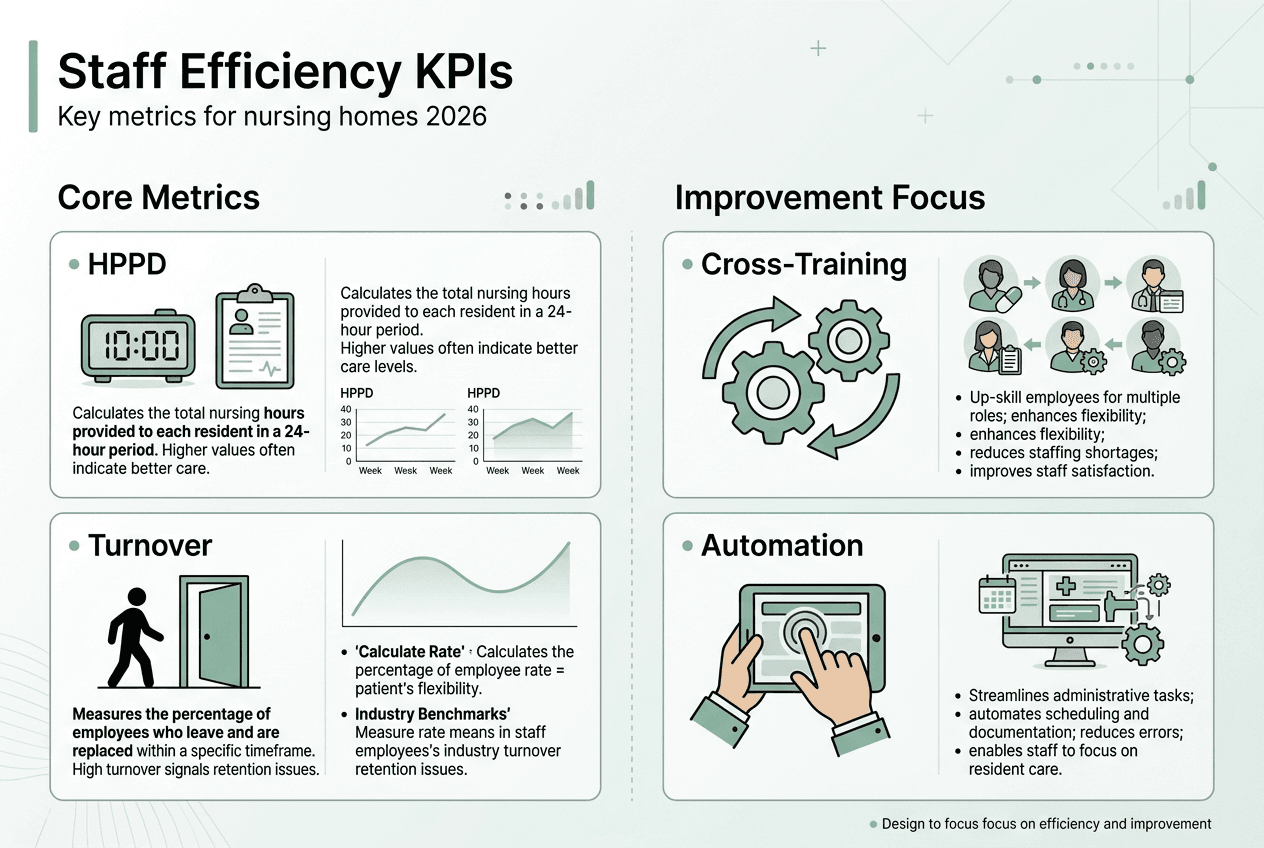
Interpreting these metrics requires context. A temporary HPPD spike during flu season may be appropriate to maintain quality, while sustained elevation suggests inefficiency. Similarly, research shows no consistent link between higher staffing levels and quality outcomes, supporting flexible, data-driven approaches over rigid minimum ratios.
Establish continuous feedback loops between frontline staff and management. Regular huddles allow teams to discuss daily challenges and suggest operational improvements. Anonymous surveys capture honest input about workload, morale, and resource needs. Act on feedback promptly to demonstrate that staff voices influence decisions, building engagement and trust.
What separates sustained efficiency gains from short-term improvements is adaptive management. Your facility’s needs evolve with census changes, regulatory updates, and workforce dynamics. Quarterly benchmarking against your own historical performance and industry standards keeps improvement efforts aligned with current realities. Adaptive scheduling tools that integrate real-time data enable proactive adjustments rather than reactive crisis management.
Intake process optimization and automation for efficiency become more effective when guided by continuous KPI monitoring. You can identify which automation investments deliver the highest ROI and where cross-training creates the most scheduling flexibility.
Pro Tip: Create a dashboard displaying key efficiency metrics that updates automatically from your scheduling and EMR systems, making performance visible to all stakeholders and enabling real-time decision-making.
Improve your skilled nursing admissions with smart automation
While cross-training and burnout reduction strengthen your workforce, automating your admissions process accelerates bed occupancy and reduces the administrative burden on already stretched staff. Smart Admissions streamlines patient intake by automating referral review, insurance verification, and clinical assessment documentation that traditionally consume hours of manual work.
Our AI-powered referral management tools integrate seamlessly with your existing EMR and insurance portals, providing real-time eligibility verification and clinical decision support. This automation in healthcare admissions complements your staffing optimization efforts by freeing admissions staff to focus on relationship building with referral sources rather than paperwork processing.
Facilities using Smart Admissions report 20% faster bed occupancy rates and 40% reduction in referral review time. These efficiency gains directly support your broader operational goals by improving revenue through higher census while reducing the workload that contributes to staff burnout. Explore our referral management systems to see how automation aligns with cross-training and flexible scheduling strategies. Discover why automating admissions delivers measurable improvements in both financial performance and staff satisfaction.
Frequently asked questions
How do I determine the right staffing levels for my facility?
Use HPPD and HPRD as baseline benchmarks, but adjust for your facility’s specific acuity mix, layout, and service offerings. Incorporate turnover and utilization data to create balanced schedules that maintain quality without excessive overtime. Regular quarterly reviews of these metrics against patient outcomes help refine targets over time.
What are the most effective ways to reduce staff burnout in nursing homes?
Combine organizational leadership initiatives such as wellness officers and regular leadership rounding with individual resilience training for staff. Avoid heavy reliance on agency staff, which disrupts team continuity and increases permanent staff workload. Create visible pathways for career advancement and recognize contributions consistently to build engagement.
How can automation improve admissions efficiency specifically?
Automation reduces paperwork bottlenecks and manual verification tasks that delay bed occupancy decisions. It enables better data tracking across the referral pipeline and streamlines communication with referral sources. Real-time insurance verification and clinical assessment support help admissions teams make faster, more confident acceptance decisions.
How often should facilities review staff efficiency KPIs?
Quarterly KPI reviews are recommended to identify trends and make strategic adjustments before small issues escalate. Weekly or biweekly operational monitoring helps manage day-to-day scheduling, while quarterly deep dives inform broader decisions about cross-training priorities, automation investments, and retention initiatives. Frequent data analysis supports proactive management and reduces burnout risk by addressing workload imbalances early.