
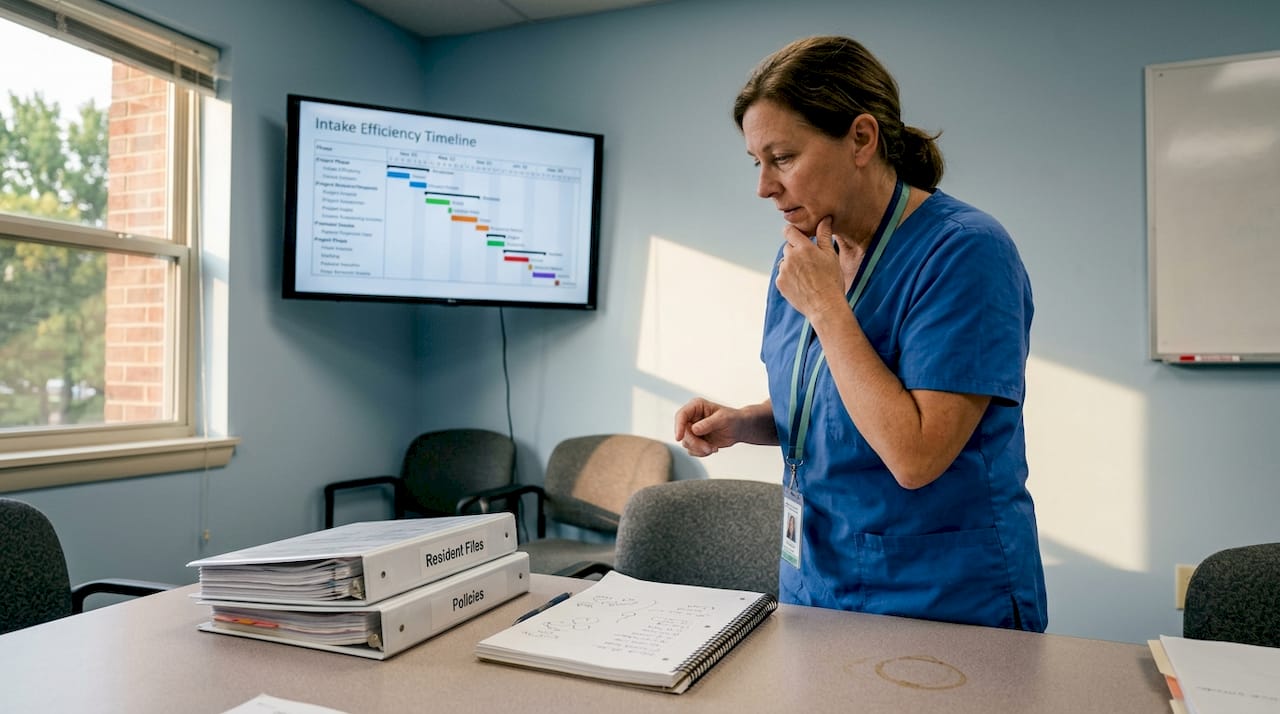
Skilled nursing facilities run on precision, but too much of that precision is spent on paperwork rather than patients. Nurse documentation time consumes between 19% and 35% of every shift, pulling clinical staff away from the bedside work that actually drives outcomes. For administrators and admissions coordinators, this is not just a staffing inconvenience. It is a measurable drain on revenue, compliance, and care quality. This article breaks down the real cost of manual tasks in skilled nursing, shows how automation directly addresses those costs, and gives your team a practical framework for moving forward with confidence.
Table of Contents
- The true cost of manual tasks in skilled nursing
- How automation transforms the patient intake process
- Wider organizational benefits: Beyond efficiency
- Overcoming obstacles: Addressing concerns with automation
- Next steps: Start reducing manual tasks in your admissions process
- Frequently asked questions
Key Takeaways
| Point | Details |
|---|---|
| Manual tasks drain resources | SNFs lose both time and money when staff are burdened with manual processes. |
| Automation drives results | Facilities using automation save thousands per admission and reclaim time for patient care. |
| Industry-wide savings | Automated workflows can help healthcare save up to $25B annually in administrative costs. |
| Staff benefit, not just replace | Automation empowers clinicians, reduces burnout, and shifts focus to direct patient services. |
| Overcoming barriers | Concerns about cost and change can be mitigated with phased rollouts and clear ROI goals. |
The true cost of manual tasks in skilled nursing
Manual administrative work in skilled nursing facilities (SNFs) is not simply inefficient. It is expensive in ways that compound over time. When your admissions coordinators spend hours faxing referral documents, re-entering patient data across systems, and manually verifying insurance eligibility, those hours translate directly into delayed bed fills and lost revenue.
Consider the scale. SNFs lose tens of thousands monthly in staff time due to manual documentation alone. That figure does not account for the downstream costs of errors, delayed admissions, or compliance gaps that surface during audits. The financial picture becomes even clearer when you map out where time actually goes.
| Task | Average time (manual) | Impact |
|---|---|---|
| Referral intake and review | 45 to 90 minutes per referral | Delayed bed assignment |
| Insurance eligibility verification | 30 to 60 minutes per patient | Billing errors and denials |
| Clinical documentation entry | 2 to 4 hours per shift | Reduced patient contact time |
| Prior authorization requests | 1 to 3 hours per case | Delayed care initiation |
Beyond the numbers, there is a human cost. Staff who spend the majority of their shifts on repetitive data entry report higher rates of burnout and disengagement. High turnover in SNF administrative roles creates a cycle where new staff must be trained on manual processes, further reducing efficiency. Exploring patient intake workflow optimization strategies is one of the most direct ways your facility can interrupt that cycle.
“Manual workflows in skilled nursing are not just slow. They are structurally costly, affecting every layer of operations from staffing to patient satisfaction.”
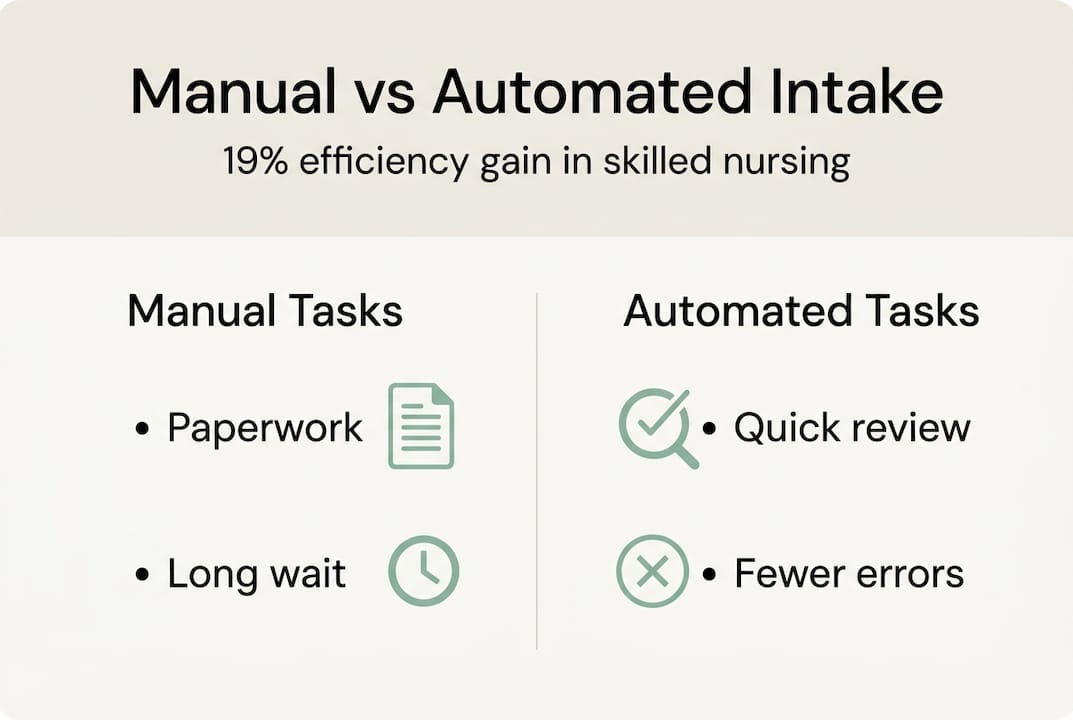
For a side-by-side view of what these inefficiencies look like in practice, reviewing a manual vs automated intake comparison can help your team visualize the gap between current state and what is possible.
How automation transforms the patient intake process
Once the costs of manual work are clear, the next step is understanding how automation directly addresses those pain points. Automated intake does not simply speed up existing steps. It restructures the entire workflow so that your team focuses on decisions rather than data entry.
Here is what changes when intake is automated:
- Referral receipt and triage happen in real time. Incoming referrals are captured digitally, categorized by acuity, and routed to the right clinical reviewer without manual sorting.
- Eligibility verification runs automatically against insurance portals the moment a referral arrives, flagging coverage gaps before admission rather than after.
- Clinical documentation is pre-populated from EHR (electronic health record) data, reducing duplicate entry and the errors that come with it.
- Prior authorization requests are generated and tracked within the same system, eliminating the need to manage separate fax queues or phone queues.
- Bed assignment and notification are triggered automatically once clinical criteria are met, compressing the time between referral and admission.
The evidence behind these improvements is strong. Automation reduces length of stay by 4 to 5 days in SNF networks, saving between $2,224 and $2,780 per admission. For a facility processing 20 admissions per month, that represents a potential savings of more than $44,000 monthly.
| Metric | Manual process | Automated process |
|---|---|---|
| Referral review time | 45 to 90 minutes | 5 to 15 minutes |
| Eligibility verification | 30 to 60 minutes | Real time |
| Documentation errors | High frequency | Significantly reduced |
| Time to bed assignment | 24 to 48 hours | Same day in many cases |
For a broader view of what this looks like in practice, the intake workflow automation overview and admissions automation efficiency resources offer facility-specific guidance.
Pro Tip: Start your automation rollout by identifying the two or three intake steps where errors or delays occur most frequently. Targeting those bottlenecks first produces the fastest measurable ROI and builds staff confidence in the new system.
Wider organizational benefits: Beyond efficiency
With tangible intake improvements in place, it is worth widening the lens to see how automation affects your entire organization. The benefits extend well beyond faster admissions.
The financial opportunity at the industry level is significant. Healthcare can save $25 billion annually by automating administrative transactions, according to the 2022 CAQH Index. For individual SNFs, even a fraction of that savings potential translates into meaningful budget relief.
Here are the key organizational benefits your facility can expect:
- Reduced staff burnout. When your team spends less time on repetitive data entry, they report higher job satisfaction and are less likely to leave. Lower turnover reduces recruitment and training costs.
- Stronger compliance posture. Automated systems apply consistent rules to every transaction, reducing the risk of documentation gaps that trigger audit findings.
- Faster patient access to care. Shorter time from referral to admission means patients receive appropriate care sooner, which supports better clinical outcomes and higher satisfaction scores.
- Improved revenue cycle performance. Real-time eligibility checks and automated prior authorization reduce claim denials, accelerating cash flow.
- Better data for decision-making. Automated systems generate structured data that your leadership team can use to identify trends, forecast capacity, and allocate resources more effectively.
Pro Tip: Track your denial rate and average days to admission before and after implementing automation. These two metrics give you a clear, quantifiable picture of ROI that you can present to leadership and board stakeholders.
For a deeper look at how these benefits connect across your operations, the resources on workflow automation in admissions and transforming healthcare admissions provide practical frameworks your team can apply directly.
Overcoming obstacles: Addressing concerns with automation
To maximize automation’s benefits, your team needs to address common concerns before they become barriers. Three worries come up most often: cost, operational disruption, and job security.
On cost, the upfront investment in automation is real, but so is the return. Low-profit SNFs may face higher initial barriers, but automation amplifies clinicians rather than replacing them, and quick ROI is achievable when implementation is targeted. The key is setting clear ROI targets before you begin, so your team can measure progress and adjust.
On disruption, a phased adoption approach reduces risk significantly. Rather than replacing all manual processes at once, your facility can automate one workflow at a time, allowing staff to build familiarity and confidence before the next phase begins.
On job security, this concern deserves a direct answer. Automation does not eliminate roles in skilled nursing. It shifts the nature of those roles. Staff who previously spent hours on data entry can redirect that time to patient interaction, care coordination, and complex problem-solving. That is a better use of clinical and administrative expertise.
Here is a practical approach for navigating the transition:
- Engage staff early. Involve admissions coordinators and clinical staff in selecting and configuring automation tools. Their input improves adoption and reduces resistance.
- Set phased milestones. Define what success looks like at 30, 60, and 90 days. Celebrate early wins to build momentum.
- Communicate the why. Help your team understand that automation is designed to reduce their administrative burden, not monitor their performance.
- Provide structured training. Offer role-specific training sessions rather than generic system walkthroughs. Staff learn faster when training reflects their actual daily tasks.
- Monitor and adjust. Use system analytics to identify where adoption is lagging and address those gaps with targeted support.
For facilities exploring intake automation solutions, the most successful implementations share one common factor: leadership that communicates clearly and consistently throughout the transition.
Next steps: Start reducing manual tasks in your admissions process
The evidence is clear. Automating manual tasks in your skilled nursing facility reduces costs, improves staff satisfaction, and accelerates patient access to care. Your team does not need to overhaul every process at once. Starting with the highest-impact areas in your admissions workflow produces measurable results quickly and builds the organizational confidence to expand from there.
Smart Admissions is built specifically for SNFs and post-acute care providers ready to move beyond manual intake. From faster bed occupancy through automation to structured referral management system examples, the platform gives your team the tools to reduce referral review times, verify eligibility in real time, and fill beds faster. If your facility is ready to take the next step, explore the admissions automation guidance available through Smart Admissions and connect with our team to see how the platform fits your specific workflow.
Frequently asked questions
What types of manual tasks can skilled nursing facilities automate?
Facilities can automate admissions intake, eligibility verification, claims processing, referral tracking, and clinical documentation. The 2022 CAQH Index identifies these as the highest-value targets for administrative automation across the healthcare industry.
How quickly can SNFs see ROI from automating tasks?
Many facilities see measurable ROI within the first few months, driven by reduced administrative time and shorter patient stays. Automation reduces length of stay by 4 to 5 days per admission, generating savings of $2,224 to $2,780 per patient.
Does automation mean staff will lose their jobs in SNFs?
No. Automation amplifies clinicians rather than replacing them, shifting staff time from repetitive paperwork to higher-value patient care and care coordination activities.
How does reducing manual tasks affect patient outcomes?
Faster admissions, fewer documentation errors, and more staff time at the bedside all contribute to better outcomes. Reducing documentation time frees clinical staff to focus on direct patient care, which is the most direct driver of satisfaction and clinical results.
What is the biggest challenge when automating manual tasks?
Overcoming staff resistance and managing upfront investment are the most common barriers. A phased adoption approach with clear ROI targets and early staff engagement addresses both, as research on SNF automation challenges consistently confirms.