
AI referral review for SNFs works when it answers the two questions that decide whether an admission pays for itself: what will PDPM reimburse for this patient, and what will the medications cost you? A hospital case manager wants an answer in minutes. Your team has to read a fax, a portal packet or an email, then judge clinical fit, payer, beds and drug cost before saying yes. Smart Admissions is built for that job: it reads each referral and scores it against your facility’s own capabilities, staffing, payer mix, PDPM reimbursement and bed availability, so you can give a confident yes or a defensible no.
This guide shows what to check on every referral, why each check matters financially, and where a human must stay in the loop.
Key Takeaways
- PDPM pays by patient characteristics, not therapy minutes, so the reimbursement story is mostly written in the referral packet before the patient arrives.
- The 5-Day assessment drives payment for most Part A stays, which makes the first days after admission the costliest place to find a surprise.
- High-cost drugs such as IV antibiotics, and prior authorization gaps around them, are a leading way an admission loses margin. Flag them before acceptance.
- A defensible decision is documented, consistent with your admissions policy and reviewed by a person, with AI surfacing gaps rather than deciding alone.
- Smart Admissions scores each referral against your facility’s own rules and flags high-cost medications before you accept.
Table of Contents
- Why Referral Review Has Become a Financial Decision
- The PDPM Factors an AI Referral Review Should Read
- High-Cost Medications: The Cost PDPM Does Not Show
- Five Checks for Every Referral
- Keeping a Human in the Loop, and Making It Count
- What It Looks Like in Your Workflow
- Put Smart Admissions to Work on Your Referrals
- FAQ
- Sources
Why Referral Review Has Become a Financial Decision
A referral used to be a clinical question: can we care for this person? Under PDPM it is also an economic one. Payment is built from case-mix components, and each is tied to what is in the packet: diagnosis, function, cognition, swallowing, comorbidities and special services. Add medication cost, which sits outside those components, and a referral that looks fine clinically can still be a poor admission.
At the same time, you cannot simply decline everything uncertain. Federal rules require a nursing facility to establish and implement an admissions policy under 42 CFR §483.15. They also bar requiring third-party payment guarantees as a condition of admission, and require disclosing the facility’s special characteristics or service limitations before admission. Your yes or no should therefore trace back to written criteria, not to who happened to be on shift.
That is the case for structured review: the same questions asked of every referral, answered quickly, with the reasoning saved. Our guide to admissions decision-making for skilled nursing facilities covers the policy side in more depth.
The PDPM Factors an AI Referral Review Should Read
The CMS PDPM Technical Report lays out which patient characteristics drive each payment component. A useful review pulls each of them from the referral and shows you the likely effect.
| PDPM component | What drives it | What to look for in the referral |
|---|---|---|
| PT and OT | Primary reason for SNF care and functional status at admission | Surgical or medical reason for the stay, prior level of function, current mobility and self-care |
| SLP | Primary reason for care, cognitive status, swallowing disorder or mechanically altered diet, SLP-related comorbidities | Diet orders, aspiration notes, cognitive screening, stroke or neurological history |
| Nursing | Clinical information, functional status, extensive services, depression, restorative nursing | IV therapy, ventilator or trach care, depression documentation, wound and pressure injury status |
| NTA (non-therapy ancillary) | Comorbidities and extensive services | Full diagnosis list, including conditions that are easy to omit from a hospital summary |
The same report notes that PT, OT and NTA payments also vary by point in the stay, so a short projected stay and a long one do not produce the same revenue per day.
Why the first assessment matters most
The MDS 3.0 Chapter 6 manual states that the 5-Day assessment is the only required PPS assessment used to support reimbursement, and that MDS data calculates the PDPM classification needed for payment. A professional education handout from eFOHCA adds that for most Medicare Part A stays, payment for the whole stay rests on that initial assessment, so a thorough and accurate one early in the stay matters.
For referral review, the lesson is practical. If the packet is thin on comorbidities or function, your estimate will be thin too, and the gap will surface after the patient is in the bed. A good review lists what is missing rather than guessing.
What the rates mean for a worked example
Rates change each October with the SNF PPS final rule. The FY 2026 rule, published in the Federal Register on August 4, 2025 and effective October 1, 2025, updated payment rates and made technical revisions to PDPM code mappings. According to an FY 2026 summary of that rule, the unadjusted urban federal per diem base rates were PT $75.73, OT $70.49, SLP $28.28, Nursing $132.00, NTA $99.59 and non-case-mix $118.21. Rural rates differ, and all of these are before case-mix, wage index and value-based purchasing adjustments.
These are base rates, not what you will be paid. The case-mix index multiplies each component, and the wage index adjusts the total. Check each October’s final rule for the current year’s figures, because they reset annually.
Here is why the factors matter. Two referrals might both be hip fracture repairs. One patient has a documented swallowing disorder, depression and several NTA-relevant comorbidities. The other has few documented conditions. The first can classify into higher SLP, Nursing and NTA groups, but also needs more staff time and possibly more drugs. Neither is automatically a yes or a no. The point is to see the trade-off in minutes, with the assumptions visible. Our article on raising case mix index accuracy goes into how documentation shapes classification.
High-Cost Medications: The Cost PDPM Does Not Show
PDPM’s components do not tell you what a specific drug regimen will cost you. A referral with IV antibiotics, specialty injectables or a complex oral regimen can turn a well-classified stay into a thin-margin one. That is why we build medication flags into the review, so the drug list is read before acceptance, not after the first pharmacy invoice.
Treatments that signal a high-complexity stay
Medicare Advantage plans often define complexity tiers for SNF stays. One published example, the THP Medicare utilization management manual, describes a high-complexity tier that includes IV medications, tube feedings, complex wound care including wound vacs, trach care, transfusions, chemotherapy or radiation, and paraplegia, hemiplegia or hemiparesis. It ties documentation to MDS Sections K, M and O. Whatever your payers call their tiers, these are the items to scan for in every packet.
Prior authorization is part of the cost
Medicare Advantage and Part D plans use utilization management tools. One provider manual lists prior authorization, step therapy and quantity limits, and notes that prior authorization may require lab results and medication history. For an admissions team, that means a high-cost or non-formulary drug with no authorization on file is a flag for pharmacy review before you say yes.
The delay has a measurable price. A peer-reviewed study of 200 patients on high-priced outpatient IV antibiotics at one hospital, published in Clinical Infectious Diseases, found discharge delays in 53% of patients with a prior authorization delay versus 15% without. Median direct hospital costs were $19,576 versus $7,770. Among patients with a delay, 63% went to a subacute facility, and subacute referral denial was a more common barrier (41% versus 17%).
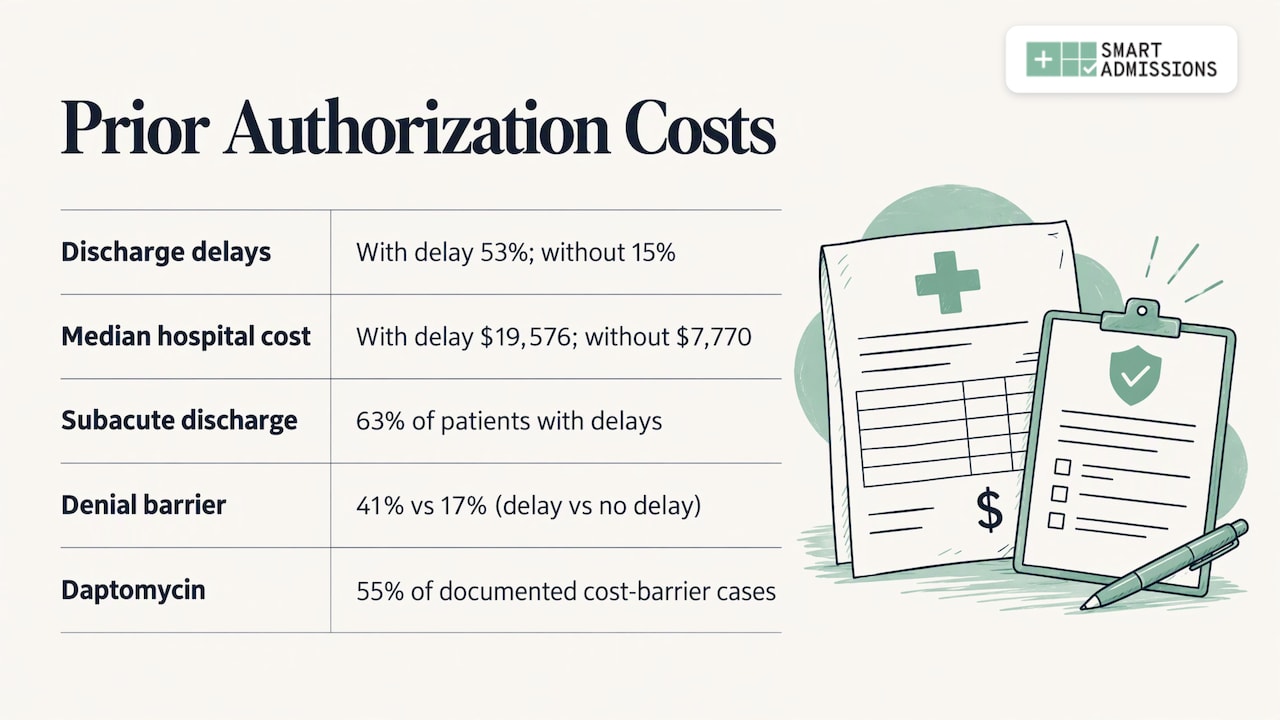
That study measures hospital costs, not your costs, and it covers one drug class at one institution. But it shows the pattern you face from the other side: expensive drugs, unresolved authorization and slow referral decisions go together. Among patients with documented cost barriers, the same study found daptomycin was the most common agent (55% of those cases), with a median cost per course of $2,952.
What to verify on every medication list
- Which drugs are IV, injectable or specialty, and the expected duration of therapy.
- Whether the payer has approved them, and whether authorization is pending, denied or never requested.
- Who supplies the drug and who bears the cost under the patient’s payer and your consolidated billing position.
- Whether your pharmacy can obtain and administer it on the day of arrival.
Smart Admissions med cost alerts flag high-cost medications before acceptance, so these questions reach your team with the referral rather than after it.
Five Checks for Every Referral
Here is a repeatable routine for AI referral review that fits an admissions director’s day. Each step names where it goes wrong by hand and what our platform does for it.
- Read the whole packet, whatever the channel. Referrals arrive by hospital portal, fax and email, and the key detail is often on page nine of a fax. Smart Admissions reads every incoming referral across those channels, so no packet is triaged by whichever page someone opened first.
- Confirm the basics federal rules expect. Under 42 CFR §483.20, the facility needs physician orders for immediate care at admission and a comprehensive assessment within 14 calendar days. Check that orders, medications, diagnoses and special treatments are in the packet, and mark what is missing.
- Estimate the PDPM picture. Map diagnosis, function, cognition, swallowing and comorbidities to the components above. Our PDPM-aware scoring shows the reimbursement story up front, so you see revenue and acuity together.
- Screen medications for cost and authorization. Use the checklist in the previous section. A flagged drug is a pharmacy question, not an automatic decline.
- Match to capability, staffing and beds. Can your team deliver the care today? Is the right bed open? Referral-to-bed matching places the right patient in the right bed, and the score reflects your own clinical capabilities and payer mix, not a generic template.
When all five are done, you can say yes with a reason or say no with a reason. Our guide to AI referral screening walks through the screening steps in more detail, and the article on minimizing referral errors covers common mistakes.
Fitting care needs to staffing and capability
The fifth check is the one with the least outside guidance, so build it from your own data. Write down, for your building, the services you can deliver every day of the week: IV therapy, wound vac management, tracheostomy care, bariatric equipment, dialysis transport, behavioral support. Note the shifts and staff skills each depends on. Then add payer rules and bed types. Because Smart Admissions configuration matches each facility’s rules, those written criteria become what each referral is scored against, and the same rule applies to every referral, which supports consistent decisions.
Keeping a Human in the Loop, and Making It Count
AI review should speed up judgment, not replace it. CMS FAQs from 2024, as described in a 2026 review in PMC, say AI coverage decisions must rest on the individual patient’s medical history and clinical notes, and a physician or appropriate professional must review medical necessity before an adverse decision. Those rules govern Medicare Advantage coverage, but they describe a sound standard for any admissions decision.
A JAMA Network Open study of 1,750 referrals, Vergara et al. (2025), looked at AI gatekeeping in Brazil and concluded the best approach combines human judgment and AI support. A 2025 Virginia Department of Licensing and Regulation study adds that a human in the loop works only when people also guard against over-trusting or dismissing AI output, and that much health data falls outside HIPAA.
Practical safeguards for your team:
- Have the admissions director or clinical liaison confirm every no, and any yes involving a flagged drug.
- Require the summary to show which data it used and which fields were missing. A 2026 PMC paper on medication-related AI argues systems should disclose their data and assumptions and surface gaps for human clinical or pharmacy review.
- Keep a record of each decision and its reason, and review declined referrals periodically to see whether your criteria are too tight.
- Ask any vendor how patient data is stored and who can access it, and involve your compliance officer.
Our Perspective
Speed is table stakes. Every hospital liaison expects an answer in minutes, and a fast answer is worthless if it is the wrong one. What separates a good admission from a costly one is whether the referral was judged against your facility, not against a generic checklist.
That is why we built Smart Admissions as a facility-specific decision engine. It reads each referral however it arrives, then weighs your clinical capabilities, staffing, payer mix, PDPM reimbursement and bed availability. Med cost alerts catch high-cost drugs before acceptance, and the score shows the reimbursement story up front.
The people who built it have worked in admissions, MDS and reimbursement. We know that the admissions director’s value is in hospital relationships and judgment, not in re-keying packets. Our aim is to take the paperwork off that desk so the director can make the call with the facts in front of them.
Harry
What It Looks Like in Your Workflow
Smart Admissions is EHR-independent and integrates with PointClickCare, so accepted referrals flow into your existing workflow without duplicate entry. Leadership gets visibility into referral sources, response times, acceptance rates and lost opportunities across one facility or a whole network. For veterans homes, the platform supports DD214 review to speed eligibility decisions.
If you want the integration details, see how AI admissions software works with PointClickCare. For a step-by-step view of the platform, read how it works.
Put Smart Admissions to Work on Your Referrals
Smart Admissions is a subscription platform for skilled nursing facilities, rehabilitation centers, state veterans homes and other post-acute providers. Pricing is published: $597 per month, or $6,447 per year. Setup is configured to your facility’s rules, and support comes from people who understand SNF operations.

See both plans on the pricing page, or start from the Smart Admissions home page to see how referral review, PDPM-aware scoring and med cost alerts fit your admissions desk.
FAQ
What does AI referral review for SNFs actually do?
It reads each incoming referral, summarizes it and scores it against your facility’s own criteria. With Smart Admissions, those criteria include clinical capabilities, staffing, payer mix, PDPM reimbursement and bed availability. Your admissions director then decides with the summary in front of them.
Which PDPM factors matter most when reviewing a referral?
The primary reason for SNF care, functional status, cognitive status, swallowing and diet, comorbidities, and extensive services such as IV therapy drive the PT, OT, SLP, Nursing and NTA components, according to the CMS PDPM Technical Report. The 5-Day assessment then supports payment for most Part A stays.
Why flag high-cost medications before acceptance?
Drugs such as IV antibiotics can add cost that PDPM’s components do not reflect, and missing prior authorization can stall an admission. Flagging them at referral lets your pharmacy and clinical team confirm coverage and supply before the patient arrives.
Can AI make the final accept or decline decision?
It should support the decision, not make it alone. Federal guidance on AI in Medicare Advantage coverage calls for review by an appropriate professional before an adverse decision, and the research on referral gatekeeping favors combining human judgment with AI support. Your director or clinical lead keeps the final call.
Sources
- 42 CFR Part 483, requirements for long term care facilities (2022 edition)
- 42 CFR §483.20 resident assessment (2023 edition)
- CMS PDPM Technical Report, April 2018
- MDS 3.0 Chapter 6, v1.20.1
- Core of Nursing Knowledge: MDS, RUGs and Quality Programs (eFOHCA)
- FY 2026 SNF PPS final rule, Federal Register
- FY 2026 SNF final rule summary with per diem rates
- THP Medicare utilization management
- Medicare Advantage Provider Manual, October 2025
- Discharge delays and costs associated with outpatient parenteral antimicrobial therapy, Clinical Infectious Diseases
- Medicare Advantage and the use of AI, PMC 2026
- Accuracy of AI for gatekeeping, JAMA Network Open
- AI in Healthcare, Virginia DLR limited study, 2025
- Artificial Intelligence Should Not Prescribe Alone, PMC 2026