
Adopt a phased, team-led change management plan: pilot your new referral and admissions system on one unit, train staff by role, and measure success by referral-to-decision time and bed fill rate. This approach typically runs 3 to 4 months at the unit level before facility-wide rollout, and it consistently produces faster bed fill, lighter administrative load, and more reliable eligibility checks.
TL;DR:
- Hold facility wide expansion until the pilot shows steady daily use and referral data matches manual spot checks; expansion then takes about three additional months.
- During the pilot, hold weekly team meetings and route unresolved issues to the executive sponsor within days, especially when system access exceeds admissions authority.
- Pair role specific sessions with on demand modules and onsite support for the first two weeks, then schedule a refresher 30 days after launch.
- Before configuration, verify EMR and ADT data exchange and receipt of required admission, discharge, and transfer notices, or staff may have to chase them manually.
Table of Contents
- What evidence-backed admissions change management looks like
- How long does a phased rollout actually take?
- Who sits on the change team and who approves what
- Designing training that survives staff turnover
- Getting IT and workflow integration right the first time
- What to measure, and how to avoid the 18-month slump
- Keeping compliance and staffing plans current
- Why steady pacing beats a rushed rollout
- How Smart Admissions fits into this rollout plan
- FAQ
- Sources
What evidence-backed admissions change management looks like
Change management admissions work means the planning, training, and support we use to roll out new referral and intake software across a facility. It is not abstract organizational theory. It is the practical sequence that gets a new system from pilot unit to full adoption without stalling.
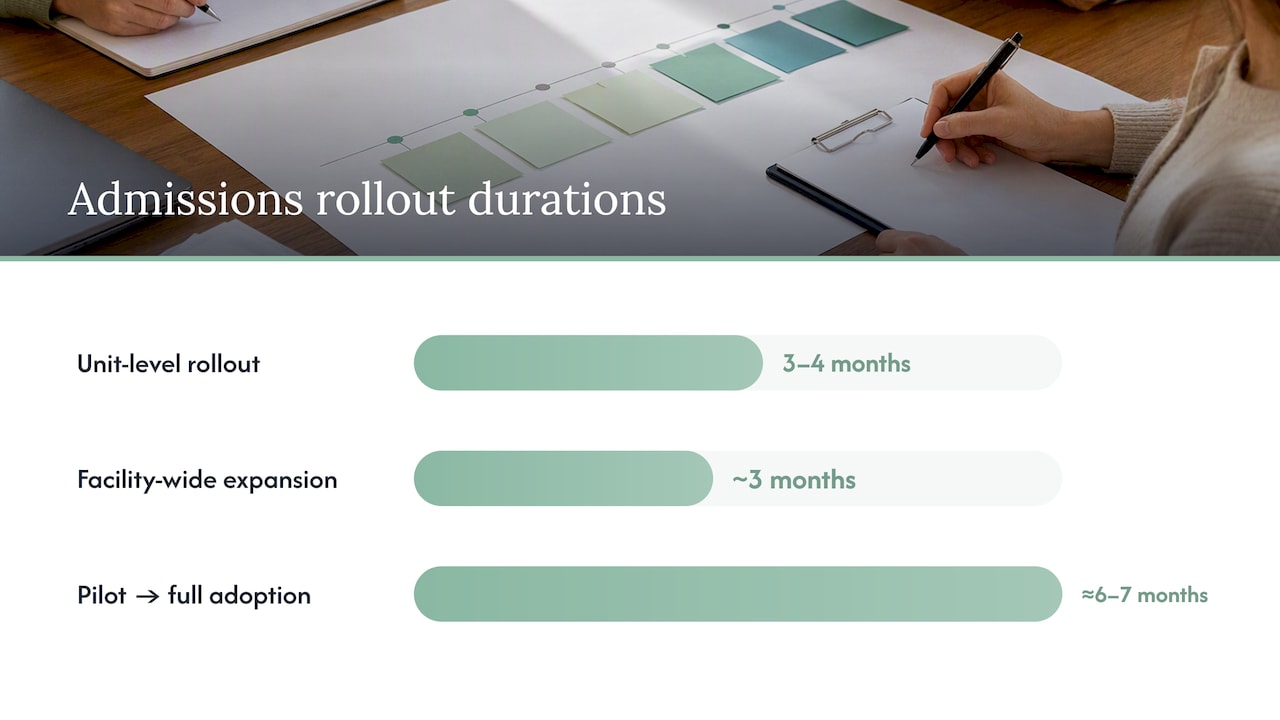
The AHRQ implementation timeline notes that unit-level rollout of clinical report tools typically takes 3 to 4 months, with facility-wide expansion adding roughly 3 more months, depending on leadership stability and staff experience with quality improvement work.
This timeline matches what admissions teams generally need when adopting platforms that pair EMR and insurance portal integration with real-time eligibility verification. Teams starting this process can lean on:
- Admissions-specific playbooks for intake automation
- Role-based training templates for clinical and admissions staff
- Onboarding support designed for fast go-live
How long does a phased rollout actually take?
A realistic pilot has three stages: configure the system for one unit, run it alongside existing workflows, then validate the data before expanding.
- Months 1 to 2: Configure intake workflows, connect EMR and insurance eligibility feeds, and train the pilot unit.
- Months 3 to 4: Run the system live on the pilot unit, track referral-to-decision time daily, and fix workflow gaps as they surface.
- Months 5 to 7: Expand facility-wide once pilot data shows stable adoption and accuracy.
The AHRQ implementation guide recommends validating staff access and data accuracy before adding meeting routines, like huddles or care planning sessions, that reinforce the new workflow.
| Phase | Duration | Primary activity |
|---|---|---|
| Unit pilot | 3 to 4 months | Configure, pilot, validate |
| Facility-wide scale | About 3 additional months | Expand, reinforce, monitor |
Expansion should wait for two signals: steady daily use on the pilot unit and referral data that matches manual spot checks.
Who sits on the change team and who approves what
A change team with the wrong mix of roles is the most common reason admissions software stalls after launch. The AHRQ implementation guide for automatic referral programs points to a defined, multidisciplinary structure as a condition for success, not an optional extra.
Your core team should include:
- Executive sponsor: approves budget and resolves cross-department conflicts
- Change leader or champion: often a director of nursing, with authority to enforce new workflows
- IT lead: owns EMR and ADT integration decisions
- Quality improvement (QI) lead: tracks data accuracy and process gaps
- Admissions supervisor: represents daily intake realities
- Clinical representative: flags care-planning and documentation impacts
Executive sponsorship matters most when EMR or ADT changes require system access beyond what admissions staff can authorize on their own. Set a weekly cadence during the pilot and a clear escalation path so unresolved issues reach the sponsor within days, not weeks.
Designing training that survives staff turnover
Generic, one-size-fits-all training is the fastest way to lose staff confidence in a new system. Role-specific training, delivered through multiple channels, holds up far better over time.
- Admissions coordinators need deep training on eligibility verification screens and referral intake fields.
- Clinical staff need shorter sessions focused on how referrals appear in their existing documentation flow.
- IT and super users need technical walkthroughs of integration points and troubleshooting steps.
Blend on-demand modules with live sessions and onsite “at the elbow” support during the first two weeks of go-live. AHRQ’s findings on health IT implementation describe this onsite support, paired with continual course correction, as central to sustaining adoption rather than watching it decline after the initial launch excitement fades.
Pro Tip: Schedule refresher training 30 days after go-live, when early mistakes have surfaced but habits have not yet hardened around workarounds.
Confirm training worked by checking error rates on eligibility entries and time-to-complete for new referrals, not just attendance at sessions. Because turnover in admissions and clinical roles is constant in post-acute care, build re-training into your onboarding checklist for every new hire rather than treating it as a one-time event. A partner guide on software onboarding offers useful detail on reducing early user drop-off, a risk that applies directly to admissions staff learning a new referral system.
Getting IT and workflow integration right the first time
The software should remove manual steps, not add new ones layered on top of the old process. That only happens when IT is involved before configuration starts, not after problems appear.
- Confirm what your EMR and ADT systems can exchange automatically versus what still requires manual entry.
- Embed referral and admission prompts directly into existing discharge and intake order sets.
- Configure work queues so referrals route automatically to the right admissions staff member.
- Build eligibility checks and opt-out rules that match your actual payer mix and clinical criteria.
The AHRQ automatic referral implementation guide finds that embedding referral logic into discharge order sets and routing tasks through multi-patient lists improves referral capture, even though thorough testing adds time before go-live.
CMS interoperability rules require hospitals to send ADT notifications at admission and at discharge or transfer, and encourage routing those notifications through health information exchanges, according to CMS guidance on ADT notifications. Confirming your facility receives these notifications reliably is a prerequisite, not a nice-to-have, for any admissions workflow redesign. For more detail on connecting these systems, see this guide to EMR integration.
What to measure, and how to avoid the 18-month slump
Track a small set of numbers weekly, not a long dashboard nobody reads.
- Bed fill rate: the clearest sign the system is working as intended
- Referral-to-decision time: shows whether intake is actually faster
- Eligibility verification accuracy: catches errors before they become denials
- Manual touches per referral: should decline steadily after go-live
| Cadence | Owner | Focus |
|---|---|---|
| Daily | Admissions supervisor | Queue status, pending referrals |
| Weekly | Change leader | Adoption trends, error rates |
| Monthly | Executive sponsor | Bed fill rate, financial impact |
Adoption commonly dips well after launch, once the initial push fades and daily habits settle into shortcuts. Scheduling periodic refreshers and keeping an enhancement roadmap visible to staff helps counter that drift before it shows up in the numbers.
Keeping compliance and staffing plans current
A new admissions system changes who you admit and how fast, which means your facility assessment and staffing plan need to reflect that shift, not sit untouched in a drawer.
- Update your facility assessment when admitting resident types you previously turned away, consistent with CMS facility assessment guidance.
- Build new-hire onboarding policy around the admissions system from day one, not as an afterthought weeks later.
- Keep contingency staffing plans current for coverage gaps during the pilot and scale phases.
- Map your ADT and interoperability checkpoints to internal workflows so notification requirements are met without manual chasing.
These are not separate administrative chores. They are part of the same rollout plan, reviewed on the same cadence as your adoption metrics.
Why steady pacing beats a rushed rollout
The facilities that struggle with admissions software rarely fail on technology. They fail on pacing, either rushing facility-wide before the pilot unit proves stable or abandoning training the moment go-live happens. Treat the rollout as ongoing operations with scheduled check-ins, not a project with a finish line. The teams that keep adjusting after month six see the steadiest adoption curves.
— Harry
How Smart Admissions fits into this rollout plan
We built Smart Admissions around the exact sequence this guide describes: a phased rollout, role-specific support, and measurable adoption, rather than a generic software deployment bolted onto admissions staff who had no say in it.
Alt text: change management admissions
What we bring to each phase of your rollout:
- EMR and insurance portal integration configured during your pilot setup, not after
- Real-time eligibility verification built into the referral screen your admissions team already uses
- Role-based workflows that match the training structure this guide recommends
- Onboarding with responsive support through go-live and beyond
If you are planning a pilot on one unit or scaling an existing rollout facility-wide, our pricing page lays out Monthly and Annually plans so you can start with the option that matches your rollout timeline.
FAQ
What is change management for admissions software?
Change management for admissions software is the structured process of planning, training, and supporting staff through adoption of new referral and intake systems. It typically runs as a phased rollout, starting with one unit before scaling facility-wide, per AHRQ’s implementation timeline.
How long does admissions software implementation take?
Unit-level implementation generally takes 3 to 4 months, with facility-wide rollout adding about 3 more months, according to AHRQ. The exact pace depends on leadership stability and staff familiarity with quality improvement processes.
Who should be on an admissions change management team?
A multidisciplinary team should include an executive sponsor, a change champion with enforcement authority, an IT lead, a quality improvement lead, and representatives from admissions and clinical staff. This structure is outlined in AHRQ’s automatic referral implementation guide.
How do we prevent staff from abandoning the new system after launch?
Ongoing training, onsite “at the elbow” support, and continual course correction are central to sustaining adoption, based on AHRQ’s findings on long-term care health IT implementation. Scheduling refresher sessions and tracking adoption metrics monthly helps catch drift before it becomes a decline.
Does Smart Admissions help with the training phase of a rollout?
Smart Admissions offers onboarding support designed to be fast, with responsive, high-touch assistance through go-live. Specific training materials and timelines are best confirmed directly through our pricing page.
Sources
- AHRQ — Implementation Steps and Timeline (On-Time program)
- AHRQ — Implementation of health IT in long-term care settings: findings
- CMS — ADT patient event notification FAQs