
TL;DR:
- Poor data handoffs between hospitals and skilled nursing facilities significantly increase readmission rates and operational risks. Integrating EHR systems like Epic and Cerner streamlines patient information flow, reduces errors, and accelerates admissions processes, leading to better patient outcomes and increased revenue. Success depends on technology interoperability, staff training, leadership support, and ongoing organizational change.
Preventable readmissions cost the U.S. healthcare system billions each year, and a surprising share of them trace directly back to poor data handoffs between hospitals and skilled nursing facilities. When your admissions team receives incomplete or delayed patient information, every subsequent step in the intake process becomes slower and riskier. Inadequate data transfer has been linked to 23% higher readmission rates, and that number reflects a problem your facility can address. This guide explains why integration matters, what it looks like in practice, and how your team can navigate the most common challenges to build a faster, more reliable admissions process.
Table of Contents
- The high cost of fragmented systems in SNF admissions
- Key benefits: How integrated systems transform admissions
- What makes an integrated system work? Tech, process, and training
- Challenges and how to overcome them: Real-world scenarios
- Perspective: The real integration lesson SNFs can’t afford to ignore
- Streamline your admissions process with proven solutions
- Frequently asked questions
Key Takeaways
| Point | Details |
|---|---|
| Fragmented systems waste time | Disconnected workflows lead to lost referrals, compliance risks, and avoidable readmissions. |
| Integration drives efficiency | Linking SNF and hospital data platforms shortens wait times and speeds up admissions. |
| Tech alone isn’t enough | Leadership, staff training, and phased rollouts are critical to successful integration. |
| Start with compatibility | Prioritize FHIR/HL7 and major EHR platform connections for maximum data access. |
The high cost of fragmented systems in SNF admissions
To understand why integrated systems are critical, we first need to address the consequences of fragmented, siloed workflows currently affecting skilled nursing facilities (SNFs) and rehabilitation centers. Fragmented systems are not just inconvenient. They are expensive, risky, and increasingly difficult to justify when better options exist.
When your admissions coordinators must manually copy patient data from a hospital fax, enter it into your EHR, and then re-enter portions into your insurance portal, you multiply the chances of error at every step. A single transposed digit in a diagnosis code or a missed medication can delay authorization, trigger a compliance flag, or worse, result in a patient receiving the wrong level of care upon arrival.
“Siloed systems cause data fragmentation, referral leakage, and compliance risks. Integration projects fail most often without leadership buy-in, proper training, and true interoperability.”
The financial consequences compound quickly. Referral leakage, meaning referrals that are lost, ignored, or delayed until another facility accepts them, represents a direct revenue loss that many SNFs underestimate. Facilities with fragmented tools struggle to respond to referrals fast enough to capture the patient. That lost admission is a lost revenue cycle, sometimes multiplied dozens of times per month.
Here is a summary of the core risks created by non-integrated workflows:
- Redundant data entry across EHR, insurance portals, and internal tracking systems raises error rates and consumes staff time
- Missed or delayed referrals due to fragmented communication channels, leading to measurable referral leakage
- Compliance and documentation errors caused by siloed data, increasing audit risk and liability exposure
- Slower patient intake that raises the risk of avoidable readmissions and reduces bed fill rates
- Staff burnout from repetitive, manual tasks that could otherwise be automated through connected systems
As all-in-one integrated platforms gain traction across industries, the healthcare sector is recognizing that siloed tools are not just inefficient but operationally dangerous. The question is no longer whether to integrate, but how to do it effectively.
Key benefits: How integrated systems transform admissions
Having outlined the risks of fragmented systems, let’s detail how integration leads to step-change improvements for admissions teams.
The most immediate benefit your team will notice is speed. When hospital EHR systems like Epic or Cerner push patient data directly into your admissions workflow, your coordinators are reviewing complete clinical summaries, insurance information, and physician notes without having to chase faxes or make follow-up calls. That time savings translates directly into faster referral acceptance decisions.
According to a JMIR study on EHR integration outcomes, integrated systems produce measurable results across multiple performance metrics. These include a 16.5-day reduction in specialist wait times, a 4 to 40% decrease in redundant procedures and radiographies, and up to a 30% faster referral response time in SNF settings. These are not marginal gains. They represent a fundamentally different pace of operation.
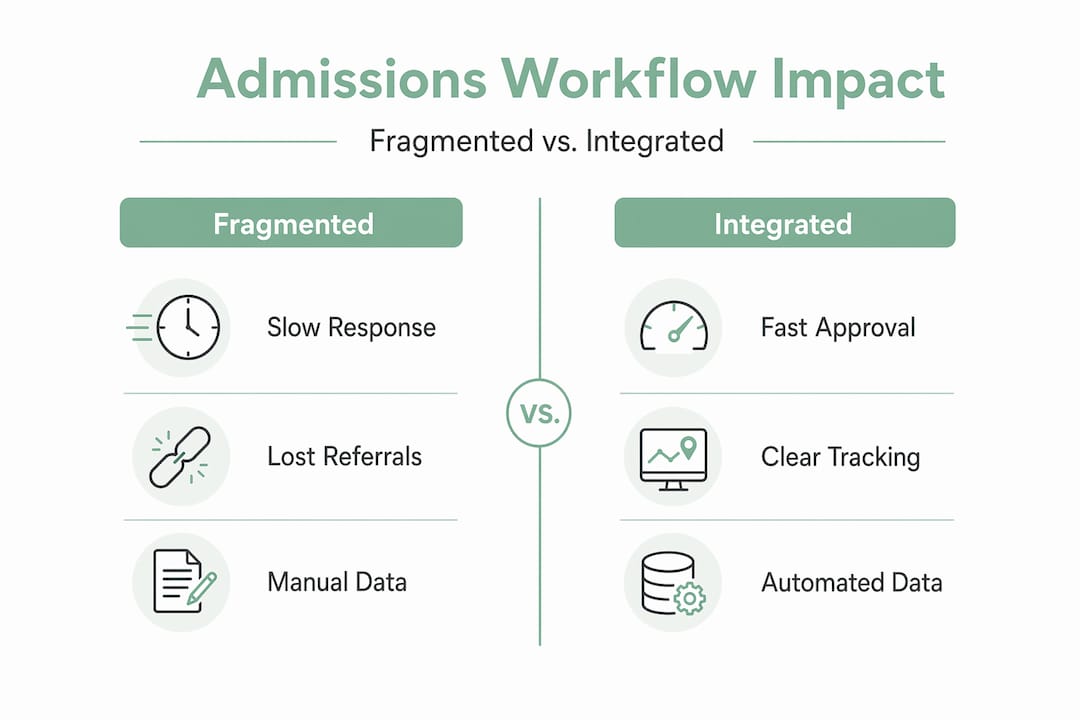
| Metric | Fragmented workflow | Integrated workflow |
|---|---|---|
| Referral response time | 24 to 48 hours | Under 12 hours |
| Data entry steps per admission | 4 to 6 manual steps | 1 to 2 automated steps |
| Specialist wait time reduction | Baseline | Up to 16.5 days faster |
| Redundant testing/procedures | Standard rate | 4 to 40% reduction |
| Referral acceptance rate | Below average | Up to 30% faster response |
Beyond speed, integration improves continuity of care. When clinical information flows without interruption from the discharging hospital to your facility, your nursing staff arrives at day one of care with a complete picture of the patient’s condition, medications, and care preferences. That continuity reduces care errors and improves patient outcomes, which in turn supports your facility’s quality ratings and value-based reimbursement performance.
To achieve these results, your facility should follow a structured approach to leveraging integrated tools:
- Establish a referral intake baseline. Document your current referral response times, acceptance rates, and error frequency before integration begins, so you can measure impact clearly.
- Connect directly to hospital EHR systems. Prioritize platforms that offer bidirectional data exchange with Epic and Cerner, the two dominant hospital systems.
- Automate eligibility verification. Use integration to trigger real-time insurance eligibility checks the moment a referral arrives, eliminating manual portal lookups.
- Standardize clinical assessment templates. Pull structured data from hospital records into predefined templates so your admissions coordinators review consistent, complete information every time.
- Track referral conversion metrics. Use built-in analytics to monitor which referral sources convert at the highest rates and where delays occur in your pipeline.
Pro Tip: Review your referral management system examples to benchmark your current workflow against facilities that have already completed integration. Seeing specific use cases helps your team set realistic expectations and identify quick wins before a full rollout.
Understanding the full scope of referral management in healthcare gives your team the foundation to evaluate vendor solutions against your specific operational needs.
What makes an integrated system work? Tech, process, and training
To capitalize on these benefits, it’s important to understand the factors that determine whether an integrated system succeeds or falls short. Technology is only one piece of the equation.

On the technical side, the single most important factor is interoperability. Your chosen platform must support FHIR (Fast Healthcare Interoperability Resources) and HL7 (Health Level Seven) standards because these are the data exchange protocols that hospital systems use. Epic and Cerner together cover approximately 61% of the hospital market, so ensuring your admissions platform can communicate with both is non-negotiable. Without this compatibility, you are simply adding another silo.
| Integration requirement | Why it matters | Risk if absent |
|---|---|---|
| FHIR/HL7 compatibility | Enables data exchange with Epic/Cerner | No real-time data transfer |
| HIPAA-compliant data handling | Protects patient privacy in transmission | Legal and audit exposure |
| Bidirectional data flow | Allows updates to flow both ways | Incomplete records at SNF |
| API-based connectivity | Supports scalable, stable connections | Integration breaks with updates |
| Role-based access controls | Limits data exposure by staff role | Unauthorized data access |
Beyond technology, the financial impact of integration is well documented, and facilities that invest in the right technical foundation see returns through improved occupancy and reduced compliance penalties.
The process side of integration is equally important. Your facility should plan a phased rollout rather than switching all workflows at once. Begin with a single referral source or admission type, validate that data flows correctly, and then expand. This reduces disruption and gives your team time to build confidence with the new tools before full deployment.
The human side is where most integration projects actually succeed or fail. Large-scale integrations fail at a rate of approximately 70%, and the primary cause is not technical. It is organizational. Staff who do not understand why the system is changing, or who were not involved in the transition, tend to revert to old habits. Leadership must communicate the purpose and benefits clearly, and training must be hands-on rather than limited to written manuals.
Key factors for successful implementation include:
- Executive sponsorship: An administrator or director must visibly champion the integration, not just approve it
- Cross-functional training: Admissions coordinators, nursing staff, and billing teams all need role-specific instruction
- Designated super users: Identify staff members in each department who receive advanced training and serve as first-line support
- Feedback mechanisms: Create a formal process for staff to report issues or suggest workflow improvements during and after rollout
- Ongoing vendor support: Confirm that your platform provider offers responsive, accessible support beyond the initial onboarding period
Pro Tip: Before signing any vendor contract, ask specifically about their EMR integration guide and whether their support team has direct experience with SNF and post-acute care workflows. Generic healthcare IT support often lacks the context to solve admissions-specific integration problems quickly.
Challenges and how to overcome them: Real-world scenarios
Of course, no transformation comes without challenges. Let’s confront the roadblocks administrators are most likely to face and provide practical solutions.
The cost concern is real. Large-scale system integrations can involve significant upfront investment, and for some organizations, the total price tag has reached $100 million or more. SNFs obviously operate at a different scale, but the underlying principle holds: underestimating costs and timelines is a primary reason integrations stall or collapse. Budget for training, troubleshooting, and a transition period where productivity temporarily dips before it improves.
The 70% failure rate for major integration projects is a sobering figure, but it comes with a clear lesson. Failures are almost always tied to rushed implementation or insufficient preparation rather than flawed technology. A phased rollout with clearly defined milestones gives your team the ability to catch problems early without the pressure of having already committed every process to the new system.
Here are the most common integration obstacles and how to address each one:
- Staff resistance: Involve frontline staff in planning and selection early in the process. People support what they help build.
- Data migration errors: Run parallel systems during transition to catch discrepancies before the old system is retired.
- Vendor overpromising: Ask for references from facilities similar to yours in size and patient population, and speak to those references directly.
- Scope creep: Define integration goals specifically before signing contracts. Expanding scope mid-project drives cost and complexity upward.
- Inadequate testing: Allocate formal testing periods before each phase goes live. Do not skip user acceptance testing with actual admissions staff.
The upside is significant and increasingly well-documented. SNF admission rates rose 8% in 2024, with stable referral volumes, suggesting that efficiency gains from tools like EHR integration are allowing facilities to convert more referrals into actual admissions. That kind of improvement does not happen through manual processes alone.
Use the SNF integration checklist to structure your planning process and ensure no critical step is skipped during rollout. A detailed checklist also helps leadership communicate expectations and timelines to board members or ownership groups who need to approve the investment.
Perspective: The real integration lesson SNFs can’t afford to ignore
After walking through the technology, processes, and challenges, there is a takeaway that most integration guides miss entirely. Integration is not primarily a technology project. It is a culture project that happens to involve technology.
Your admissions coordinators spend years developing mental shortcuts and informal systems for managing referrals under pressure. When a new platform arrives, even a genuinely superior one, it disrupts those patterns. Without deliberate effort from leadership to acknowledge that disruption and support staff through it, the new system becomes an obstacle rather than a solution.
The facilities that see the strongest results from integration are the ones that treat the rollout as an ongoing organizational change rather than a one-time software installation. They schedule regular check-ins after go-live. They act on staff feedback. They measure outcomes every quarter and adjust workflows when the data suggests a better approach.
One of the most effective steps your facility can take is to reduce referral review time by re-examining not just the tools, but the decision-making steps that happen around those tools. Sometimes a process bottleneck is not in the software at all. It is in an approval chain that no longer reflects how your admissions team actually operates.
The uncomfortable truth is that even the best integrated platform will underperform in a facility where leadership treats it as an IT task rather than a strategic priority. Winning facilities invest in the technology and invest equally in the people who use it. That is what separates facilities that hit 30% faster referral responses from those that complete an integration project and see no measurable change.
Streamline your admissions process with proven solutions
If you’re ready to put these essential integration principles into practice, here’s where to start. Smart Admissions is built specifically for SNFs and rehabilitation centers that need a faster, more reliable path from referral to admission.
Explore referral system examples to see how facilities like yours have restructured their intake workflows with integrated tools. When you’re ready to connect your EHR to your admissions pipeline, our step-by-step guide on how to integrate EMR with referrals walks your team through the process clearly. And to see how automation fits into the bigger picture, review our resources on workflow automation in admissions so your facility can move from reactive to proactive intake management.
Frequently asked questions
What is the biggest benefit of integrated referral and admission systems for SNFs?
Integrated systems reduce administrative burden and errors by delivering complete, real-time patient information directly from hospitals into your admissions workflow, enabling faster and more accurate intake decisions.
What is the main cause of failure in system integration projects for healthcare admission?
Lack of staff training and insufficient leadership support account for the majority of the 70% failure rate seen in major healthcare integration projects, not technical limitations.
How much can wait times drop with true integration?
A recent study found that specialist wait times can be reduced by up to 16.5 days when EHR integration is implemented effectively across care settings.
What tech standard should SNFs prioritize for interoperability?
Facilities should prioritize FHIR and HL7 compatibility because Epic and Cerner, which use these standards, together serve approximately 61% of the hospital market.