
How AI helps SNFs assess patient fit before admission comes down to one job: reading every referral the way your best admissions director would, against your own facility’s capabilities, staffing, payer mix and beds, and doing it in minutes. The software prepares a scored summary. Your team makes the decision. That split is what lets you say a confident yes or a defensible no to a hospital while the patient is still waiting on a bed.
This guide covers the five checks that make up a fit assessment, what AI can and cannot contribute to each, and the safeguards that keep clinical judgment in charge.
Key Takeaways
- A fit assessment tests five things: clinical needs, payer and reimbursement, medication cost, bed and staffing match, and documentation quality. AI can run all five on every referral, not just the ones you have time for.
- Published research shows models can flag likely post-acute dispositions early, but they support the clinician and do not replace the physician or the admissions team.
- Federal nondiscrimination rules for AI patient-care decision tools apply to covered entities, so human review, override ability and audits belong in your process from day one.
- Smart Admissions evaluates each referral against your facility’s own rules and returns a scored summary, so your team spends time deciding instead of reading faxes.
Table of Contents
- What “Patient Fit” Means Before Admission
- Check 1: Match Clinical Needs to What Your Facility Can Deliver
- Check 2: Payer Coverage and PDPM Reimbursement
- Check 3: Medication Cost Before You Say Yes
- Check 4: Bed, Staffing and Unit Match
- Check 5: Documentation Quality and Eligibility
- What the Evidence Shows About AI Screening
- Keep Your Team in Charge of the Decision
- Safeguards: Bias, Privacy and Vendor Questions
- How Smart Admissions Puts the Five Checks Into One Workflow
- Start With the Plan That Fits Your Facility
- Our Perspective
- FAQ
- Sources
What “Patient Fit” Means Before Admission
Patient fit is the answer to a simple question: can your building deliver the care this person needs, safely, with the staff and beds you have, under a payer arrangement that sustains the stay? A referral that fails any one of those parts is a risk, even if the diagnosis looks routine.
Most admissions teams already do this work by hand. A coordinator opens a hospital portal packet, a fax or an email, hunts for the therapy notes, the medication list, the insurance details and the discharge date, and then checks with nursing, therapy and the business office. The answer may take 45 minutes or several hours. Hospital case managers are often sending the same referral to several facilities at once, so the first credible answer tends to win the patient.
AI changes the reading and matching step. It does not change who is accountable.
Check 1: Match Clinical Needs to What Your Facility Can Deliver
The first check is clinical. Does the patient need IV therapy, wound care, ventilator support, bariatric equipment, dialysis transport, behavioral health management or intensive therapy minutes? Does your building handle those needs on the unit that has an open bed?
AI helps by pulling these needs out of unstructured referral documents, which arrive in inconsistent formats. Research gives a sense of how much signal sits in routine hospital notes. A study on predicting post-acute care discharge disposition used 1,600 patient records with 306 attributes drawn from discharge and assessment notes to predict where patients would go after the hospital.
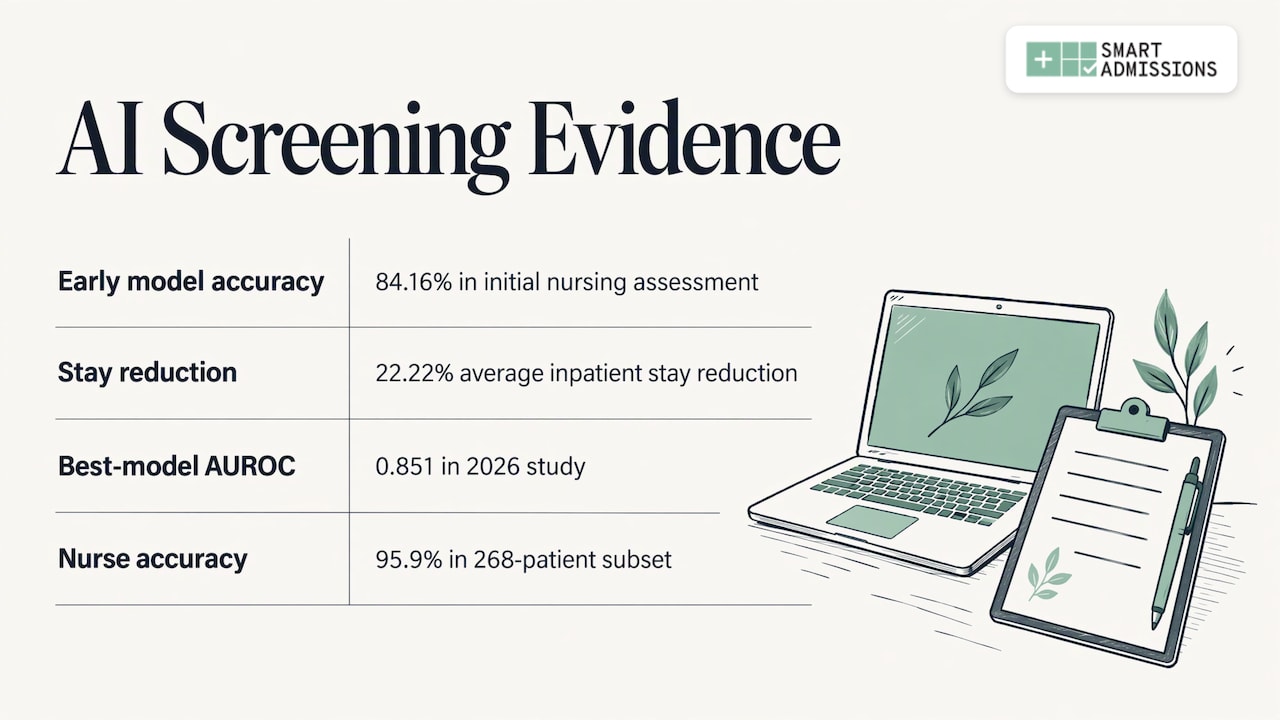
A more recent peer-reviewed study published in 2026 found that condensing a raw history and physical note from a median of 2,120 tokens to a 141-token summary still let the best model reach an AUROC of 0.851 for predicting SNF discharge. In plain terms, a short, well-extracted summary can carry much of the information a reviewer needs.
What this means for you: the value is in extraction and comparison. A tool that reads the whole referral and lists the clinical needs against your capabilities saves the first 15 to 20 minutes of every review.
What to configure so the match reflects your building
A generic clinical screen fails because every facility is different. Write down, in advance:
- Services you provide and those you do not, such as specific IV therapies, tracheostomy care or dialysis.
- Equipment on hand and lead time for equipment you would need to order.
- Unit-level limits, for example which wings can take behavioral health or bariatric residents.
- Therapy coverage by discipline and weekend availability.
- Diagnoses or conditions your clinical leadership has decided to decline.
Smart Admissions is built as a facility-specific decision engine: it evaluates each referral against your own clinical capabilities, staffing, payer mix, PDPM reimbursement and bed availability, and its configuration matches each facility’s rules. Those rules are yours, so the yes or no reflects your standards rather than a vendor’s.
Check 2: Payer Coverage and PDPM Reimbursement
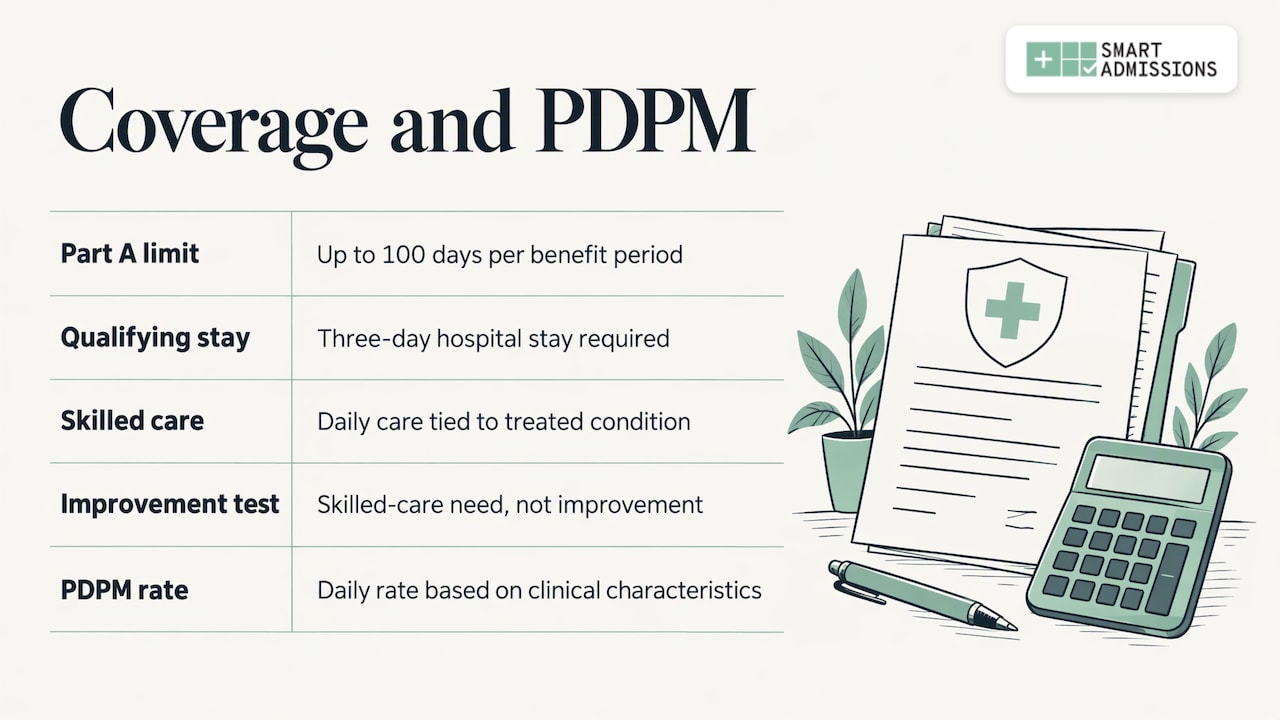
The second check is whether the stay will be covered and what it will pay. For Medicare Part A, SNF coverage is limited to up to 100 days per benefit period after a qualifying three-day hospital stay, and it requires daily skilled care related to the condition treated in the hospital. The same source notes that the 2013 Jimmo v. Sebelius settlement clarified that coverage turns on the need for skilled care, not on whether the patient is expected to improve.
That last point matters at the front door. A referral that looks like a patient who is “plateaued” is not automatically a denial risk, and a team that screens on improvement potential alone will turn away patients who qualify.
PDPM, the Patient Driven Payment Model, is the Medicare SNF payment system that sets the daily rate from the patient’s clinical characteristics. The documentation in the referral drives the likely case mix. AI that reads diagnoses, comorbidities and functional status can show a reimbursement picture before you accept, rather than after the MDS is done. Smart Admissions provides PDPM-aware scoring so the reimbursement story is visible up front.
If you want to go deeper on the rules behind the payer check, our guides on the three tests for Medicare SNF eligibility and a 15-minute PDPM preadmission checklist walk through each one.
Keep reimbursement in its place
Payer information should inform the decision, not make it. The APTA, AOTA and ASHA consensus statement on clinical judgment says care decisions should rest on independent clinical reasoning and objective data, and it names less care driven by profit motive or predictive analytic tools as unacceptable. For admissions, the practical reading is clear: use payer data to plan and to decide whether you can sustain a stay, and keep clinical need as the basis for the care you deliver once the resident is in your building.
Check 3: Medication Cost Before You Say Yes
A single high-cost drug can change the economics of a stay. Referral packets list medications, but the cost implication rarely surfaces until pharmacy reviews the admission, which is often after the patient arrives.
AI can read the medication list in the referral, identify drugs that are expensive to supply, and flag them before acceptance. Smart Admissions includes med cost alerts for exactly this purpose, so your team knows about a high-cost medication while there is still time to discuss it with the hospital, confirm coverage, or plan the stay.
For context on how cost is weighed in prescribing decisions, a managed-care pharmacy review explains that formulary decisions prioritize safety and efficacy, with cost used as a comparator when alternatives are therapeutically equivalent. The same logic suits admissions: the alert starts a conversation with the prescriber, the pharmacy and the payer. It does not change a patient’s therapy.
Check 4: Bed, Staffing and Unit Match
A patient can fit clinically and financially and still be a poor match for the bed you have open. Referral-to-bed matching asks which specific bed, on which unit, with which staffing pattern, suits this resident.
Staffing is the constraint most administrators feel. MedPAC’s December 2025 SNF payment update reports that median facility RN hours per resident day fell from 0.6 in 2023 to 0.5 in 2024, and that 12-month nursing staff turnover was 46.3% in 2024, following a CMS methodology change. With staffing that tight, accepting a high-acuity patient onto a short-staffed unit is a quality and survey risk as well as a financial one.
A useful bed-match rule set includes:
- Current and projected census by unit, including pending discharges.
- Nursing and therapy hours available on the shift of arrival.
- Room and roommate considerations, such as isolation or gender.
- Equipment that must be in place on day one.
- Arrival timing, since a late-day admission needs different staffing than a morning one.
Smart Admissions places the right patient in the right bed by evaluating each referral against bed availability alongside the clinical and payer checks. For the planning side, see our guide to what bed management is.
Check 5: Documentation Quality and Eligibility
The fifth check is whether the paperwork will hold. Missing PASRR screening, an unclear qualifying stay or thin physician documentation are common reasons admissions get delayed or payment gets pended. Our guide to PASRR requirements for admissions teams covers the screening step, and the Medicare eligibility rules cover the qualifying-stay checks.
For state veterans homes, eligibility turns on service records. Smart Admissions supports DD214 review to speed those eligibility decisions.
AI is useful here because it reads the whole packet consistently. A person reviewing the 14th referral of the day can miss a line on page 11. A system that reads every page flags the gap at the same standard every time, and your coordinator can ask the hospital for the missing item immediately.
What the Evidence Shows About AI Screening
Research on post-acute disposition prediction is encouraging, and it is specific about the role of the tool.
The earlier arXiv study built a predictive model that could identify patients eligible for acute rehab or SNF during the initial nursing assessment. It reported 84.16% accuracy and an average 22.22% reduction in inpatient length of stay, and it let insurance authorization begin on day one while clinical activities continued. The authors state that the model did not interfere with clinical processes or replace physician decisions.
The 2026 study cited above reports that its best model reached an AUROC of 0.851, while nurse case managers were 95.9% accurate in the 268-patient subset with documented disposition. The lesson for an admissions team is realistic: models are strong at organizing information quickly, and experienced people remain the benchmark for the final call.
A 2024 systematic review in the Journal of Multidisciplinary Healthcare found AI can help record, organize and manage EHR data. It also found AI-generated triage notes and ICD codes were less accurate and specific than human-generated ones. That supports a design where AI summarizes and scores, and your staff confirms the details that drive the decision.
Keep Your Team in Charge of the Decision
The fastest way to get AI wrong in admissions is to let the score become the decision. The Center for Medicare Advocacy’s paper on AI tools in Medicare coverage decisions reports that utilization-management tools may nudge providers toward decisions more restrictive than Medicare coverage guidelines, and that users often implement recommendations without critical examination.
Your process should prevent that. Build these habits:
- Every score comes with a readable summary of why, so the reviewer can check the reasoning against the referral.
- A named person accepts or declines every referral, and records the reason.
- Declines are reviewed periodically against Medicare coverage rules, so no one turns away a patient who qualifies.
- Disagreements between the score and the reviewer are logged and used to tune your rules.
With that discipline, the score gets your team to a decision faster, and the decision stays defensible when a hospital case manager asks why.
Safeguards: Bias, Privacy and Vendor Questions
Two official sources set a practical baseline.
HHS Office for Civil Rights guidance on nondiscrimination in AI states that Section 1557’s general prohibition on discrimination applies to AI patient-care decision support tools from July 5, 2024, and that requirements to identify and mitigate discrimination risks took effect May 1, 2025. Suggested measures include written policies, an internal AI registry, qualified human review with staff override, training, real-world performance audits and patient disclosure where a tool poses discrimination risk.
The Joint Commission’s guidance on the responsible use of AI tells organizations to request information from vendors on known risks, biases and limitations, to verify that training data were representative, to test algorithms on local populations, and to monitor and audit tools before and after deployment.
A short governance checklist
- List the tool in your AI registry with its purpose and owner.
- Write a policy stating that staff make the final admission decision.
- Train admissions staff on how to read and override a score.
- Review accept and decline patterns by payer, diagnosis and referral source each quarter.
- Confirm HIPAA safeguards and access controls with your compliance officer.
The same audit view also helps your business. Referral source analytics show response times, acceptance rates and lost opportunities, and our guide to referral source analytics lists seven metrics worth tracking.
How Smart Admissions Puts the Five Checks Into One Workflow
Smart Admissions reads every incoming referral, whether it arrives through a hospital portal, fax or email, then summarizes and scores it against your facility’s own rules. Your admissions director sees the clinical match, the PDPM reimbursement picture, medication cost alerts and bed availability in one place, and responds with a yes or a defensible no in minutes instead of hours.
It is EHR-independent and integrates with PointClickCare, so accepted referrals flow into your existing workflow without duplicate entry. Leadership gets visibility into referral sources, response times, acceptance rates and lost opportunities across one facility or a whole network. You can see the workflow on the how it works page, or read how referral reviews went from 45 minutes to 5.
Start With the Plan That Fits Your Facility
Smart Admissions is a subscription: $597 per month, or $6,447 per year, as published on our pricing page. A free trial is available, so your team can run real referrals through your own rules. Start from the free trial page.

Onboarding is fast, and support comes from people who understand SNF operations.
Our Perspective
Speed is table stakes. Every hospital expects an answer in minutes, and a fast yes to the wrong patient costs more than a slow one. What admissions teams need is a better first read of every referral.
We built Smart Admissions as a facility-specific decision engine because fit is local. Your clinical capabilities, your staffing, your payer mix and your open beds are not anyone else’s. When the system reads each referral against those facts, the director can spend time on the hospital relationship instead of the fax pile.
The people who built it have run admissions and worked in MDS and reimbursement. That experience is why we show the reimbursement story and the medication cost up front, and why the final decision always sits with your team.
Harry
FAQ
Can AI decide whether my SNF should admit a patient?
No. AI reads and scores the referral, and your admissions director or clinical lead makes the decision. Research on disposition models describes them as supporting clinicians without replacing physician decisions, and federal guidance points to qualified human review and override mechanisms.
What information does AI use to assess patient fit?
It works from the referral packet: diagnoses, history and physical notes, therapy and nursing assessments, medication lists and insurance information. It compares those against your services, staffing, payer mix and bed availability. The quality of the match depends on how clearly you define your own rules.
How fast can an AI-assisted referral review be?
Smart Admissions is designed so admissions directors can respond in minutes instead of hours. Your actual turnaround also depends on how complete the hospital’s packet is and how quickly your team confirms the summary.
Does it work with our EHR?
Smart Admissions is EHR-independent and integrates with PointClickCare, so accepted referrals move into your existing workflow without duplicate entry.
Sources
- Early Prediction of Post-acute Care Discharge Disposition (arXiv)
- Enhancing the prediction of hospital discharge disposition (PMC, 2026)
- MedPAC, Skilled nursing facility payment update, December 2025
- Center for Medicare Advocacy, AI-powered decision-making technology in Medicare
- APTA, AOTA and ASHA, Consensus Statement on Clinical Judgment
- Prior Authorization and Utilization Management Concepts in Managed Care Pharmacy (PMC)
- Systematic review of AI in nursing, Journal of Multidisciplinary Healthcare
- HHS OCR, Ensuring Nondiscrimination Through the Use of Artificial Intelligence
- The Joint Commission, The Responsible Use of AI in Healthcare