
Prior authorization for a skilled nursing facility (SNF) stay is a payer’s review, done before or at admission, that decides whether it will cover the stay. Medicare Advantage plans, and many commercial plans, use it. Your team gets the best results by verifying the requirement early. Then you send a complete clinical packet and track the clock. Finally, you appeal denials with the right evidence.
This guide walks admissions coordinators and directors through each step. It covers the rules that apply in 2026 and the documents that move requests forward. It also explains how to keep authorization work from slowing your response to hospitals.
TL;DR
- Prior authorization is a payer’s coverage decision for the stay. It is separate from the Medicare 3-day inpatient stay rule, which is a coverage eligibility test.
- Requirements differ by plan. Verify them by member in the payer’s portal before you accept the referral.
- A complete packet is the fastest route to approval: physician orders, therapy evaluations, progress notes, proposed length of stay and a discharge plan.
- CMS sets decision windows of 72 hours for expedited requests and seven calendar days for standard requests for impacted payers. Track the clock from the day you submit.
- An authorization number is not a payment guarantee, and appeals of SNF denials often succeed, so build a repeatable appeal routine.
Table of Contents
- What prior authorization means for an SNF stay
- When payers require prior authorization
- The 7 steps to a faster SNF prior authorization
- Timelines at a glance
- Why requests get denied or delayed
- What to do when a request is denied
- Authorization is not a payment guarantee
- Our perspective
- Put the front end of authorization on autopilot
- FAQ
- Sources
What prior authorization means for an SNF stay
Prior authorization is a utilization review by the payer. A nurse or medical director reads your clinical information and decides whether the stay meets the plan’s coverage criteria. Your facility then admits the patient with an approval on file, or it knows early that the stay is at risk.
It helps to keep two questions apart, because staff often blur them:
- Eligibility: Does the patient qualify for the SNF benefit at all?
- Authorization: Has this payer agreed to cover this stay at this facility?
For Medicare, the eligibility question starts with the hospital stay. Medicare generally requires a medically necessary inpatient hospital stay of at least 3 days in a row before it covers SNF care. An approved ACO waiver or a Medicare Advantage plan may waive that minimum. Time in the emergency room or under observation before the inpatient order does not count toward the three days, even if the patient stays overnight.
Those are the rules on who qualifies. Prior authorization is a different process, run by the plan, and it can apply even when the patient clearly meets the clinical picture. If your team needs a refresher on the eligibility side, our guide to the 3 tests for Medicare SNF eligibility covers the checks that prevent denials.
When payers require prior authorization
Requirements vary by payer, product and sometimes contract. Two published examples show the range.
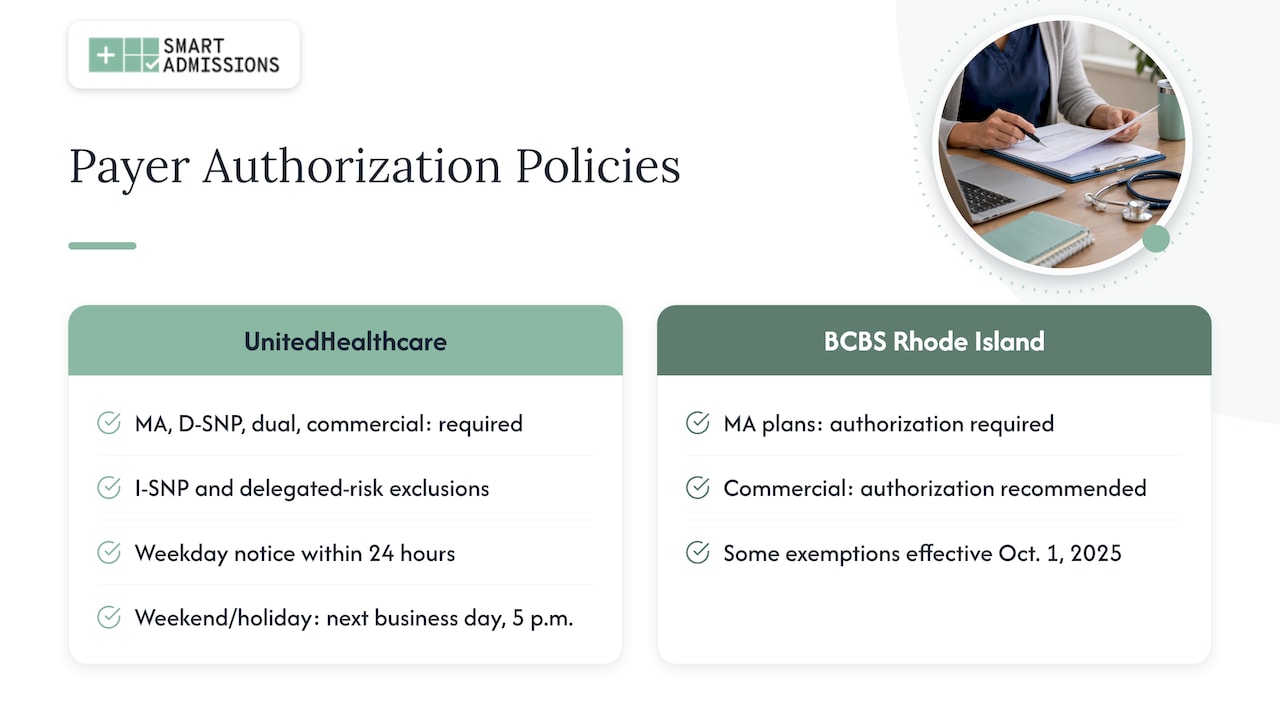
UnitedHealthcare requires approved authorization before SNFs admit its Medicare Advantage, D-SNP, dual eligible and commercial plan members. Its listed exclusions include I-SNP members and certain members in delegated risk agreements. Its guidance also sets a notification deadline. Facilities notify Home and Community Care Transitions within 24 hours for weekday admissions, or by 5 p.m. local time on the next business day for weekend and holiday admissions.
Blue Cross & Blue Shield of Rhode Island takes a similar but not identical approach. Its policy states that prior authorization is required for Medicare Advantage plans and recommended for commercial products, with possible exemptions for certain commercial plans effective October 1, 2025.
The lesson: never assume. A requirement that applies to one plan from a payer may not apply to the next. Use the payer’s portal for the specific member, because the answer depends on the plan the patient actually holds. Our Medicare Advantage eligibility checks show what to confirm before you commit a bed.
The 7 steps to a faster SNF prior authorization
1. Verify the plan and the requirement at referral
Check eligibility and benefits in the payer’s provider portal, or call the number on the member’s ID card. UnitedHealthcare tells facilities to do exactly this, then request authorization before admission. Run the check by member, not by payer name, and record the answer, the date and who gave it.
Do this before you tell the hospital yes. A fast yes that turns into an unpaid stay costs more than a few extra minutes of review.
2. Screen the referral against your own capabilities
Authorization only matters if you can safely care for the patient. Compare the clinical needs with your staffing, equipment and bed availability. Then look at the likely payer outcome. Our admissions decision-making guide lays out how to make a defensible accept or decline call from that comparison.
3. Build the clinical packet once
Payer instructions are consistent on what a request needs. UnitedHealthcare lists physician’s orders and contact details, therapy evaluations and progress notes, the proposed length of stay, the discharge plan and supporting medical information.
A simple packet checklist:
- Hospital discharge summary and current orders
- PT, OT and speech evaluations, with recent progress notes
- Medication list, with any high-cost drugs flagged
- Skilled need statement: why the care requires nursing or therapy
- Proposed length of stay and goals
- Discharge plan, including the expected destination
Our admissions documentation checklist and documentation management guide go deeper on keeping this package complete.
4. Submit through the fastest channel the payer offers
Use the portal when it is available, since it creates a timestamp and a record. Fax and phone remain common, so log the time of every submission. If the payer accepts electronic submission, send the packet the same day you accept the referral.
5. Track the decision clock
CMS has set decision windows for impacted payers. Payers must decide as expeditiously as the patient’s condition requires, within 72 hours for expedited requests and seven calendar days for standard requests. The clock starts when the payer receives the request. It does not stop or restart for additional documentation that was not disclosed when the request was submitted.
CMS also measures this in calendar time, not business hours. Its example: an expedited request received at 1:00 AM Sunday must get a response no later than 1:00 AM Wednesday. Weekends do not pause the clock.
These deadlines come from the CMS interoperability and prior authorization rule, and the requirements begin primarily in 2026. They apply to impacted payers, so confirm how they apply to a specific plan. Build a worklist that shows every pending request, its submission time and its deadline.
6. Respond fast to payer questions
Most delays come from information gaps, not from the decision itself. Assign one person per shift to watch for payer requests and answer them the same day. Keep therapy notes and orders where that person can reach them in seconds.
7. Document the outcome and learn from it
Record the decision, the reason, the turnaround time and the payer. Over a quarter, these records show which plans delay you and which documentation gaps repeat. Our denial root cause analysis steps show how to turn that data into fewer denials.
Timelines at a glance
| Request type | CMS decision window for impacted payers | What your team does |
|---|---|---|
| Expedited | 72 hours | Flag clinical urgency, submit complete documents at once |
| Standard | 7 calendar days | Follow up daily, answer payer questions the same day |
| Weekend or holiday admission | Same calendar clock, no pause | Use the payer’s after-hours notification rule |
For hospitals, a 72-hour or seven-day window is long. Patients waiting in an acute bed push case managers to ask for answers within hours. That is why the front-end screen in steps 1 and 2 matters: you can give the hospital a confident response while the authorization proceeds.
If you work with plans that use a third-party utilization review contractor, delays can compound. Our piece on closing 48-hour gaps in third-party SNF authorizations covers that pattern.
Why requests get denied or delayed
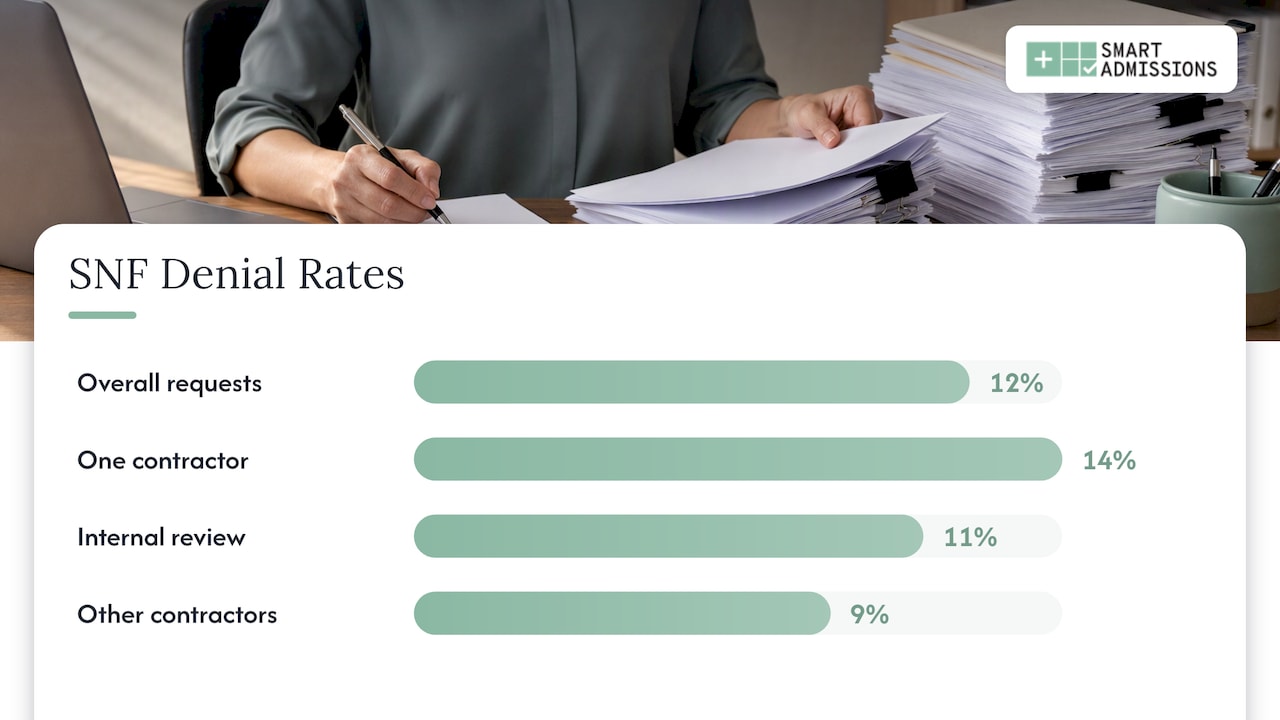
Denials are common enough to plan for. An Office of Inspector General (OIG) review of Medicare Advantage organizations found that 19 organizations collectively denied 12% of SNF admission requests in June 2024. Rates ranged from 23% down to 0.4%. The spread tells you the same patient can meet very different resistance depending on the plan.
The same review found denial rates differed by who processed the request. Requests handled by one contractor were denied at 14%, compared with 11% for plans reviewing internally and 9% for other contractors. Plans overturned 97% of that contractor’s SNF denials on appeal.
Common, avoidable causes on the facility side include:
- Missing or outdated therapy evaluations
- A skilled need that is not stated plainly
- No discharge plan or an unrealistic proposed length of stay
- Submission after the patient is already in the bed
- Wrong plan or product confirmed at verification
On the payer side, CMS is raising transparency. The rule requires impacted payers to include a specific reason when denying a prior authorization request. It also requires them to publicly report prior authorization metrics. A specific denial reason gives your team something concrete to answer in an appeal.
For a facility-level playbook, see how to reduce admission denials.
What to do when a request is denied
The OIG data is encouraging for providers who appeal. Enrollees and providers appealed 18% of SNF denials, and plans overturned 95% of those appealed in favor of the enrollee. OIG raised concerns that some patients were initially denied medically necessary care and that some denials may never have been appealed.
A practical appeal routine:
- Read the denial reason. Match it to the criteria the plan cites.
- Check the deadline. Appeal timeframes are stated in the denial notice and the plan’s provider manual, so read both the day the notice arrives.
- Ask the physician to add clinical support. A short statement on skilled need, tied to the therapy notes, is often the missing piece.
- Request a peer-to-peer conversation if the plan offers one.
- File the appeal and log it, with the date, the reviewer and the outcome.
Keep the patient’s safe placement at the center. If the patient is still in the hospital, talk with the case manager about the timeline before you accept.
Authorization is not a payment guarantee
Teams sometimes treat an approval as the end of the process. Payer language is more careful. UnitedHealthcare states that an authorization confirmation number is not a determination of coverage or a guarantee of payment. Nurses and medical directors review the clinical information to reach the coverage decision.
Medicare Advantage has a protection worth knowing. Under 42 CFR § 422.138, when a Medicare Advantage organization approved a covered item or service through prior authorization or a concurrent determination, it may not deny coverage later on the basis of lack of medical necessity. It may not reopen that decision except for good cause or reliable evidence of fraud or similar fault, as the regulation defines. The same rule limits prior authorization to confirming diagnoses and medical criteria, ensuring basic benefits are medically necessary, and ensuring supplemental benefits are clinically appropriate.
Save every approval, the date and the clinical information you sent. If a payer later questions a covered stay, that record is your starting point, and the regulation text is the reference to cite.
Our perspective
Prior authorization is the part of admissions where speed and accuracy collide. Hospitals want an answer in minutes. Payers take hours or days. Your team sits in the middle, and the cost of a wrong yes lands on your facility.
We built Smart Admissions around that tension. Speed alone is table stakes. What matters is that every referral, whether it arrives by hospital portal, fax or email, is read and judged against your facility’s own clinical capabilities, payer mix, PDPM reimbursement and bed availability. Each referral is summarized and scored, so your admissions director can send a confident yes or a defensible no.
That front-end clarity makes prior authorization work easier. You know which referrals need a payer review, what the clinical story is, and which high-cost medications deserve attention before acceptance. Med cost alerts exist for exactly that reason. And because the platform is EHR-independent and integrates with PointClickCare, accepted referrals move into your workflow without duplicate entry.
Our team has run admissions and worked in MDS and reimbursement. We know that every minute your coordinator spends re-keying data is a minute not spent with a hospital case manager.
Harry
Put the front end of authorization on autopilot
Smart Admissions reads each incoming referral, scores it against your facility’s rules and summarizes the case, so your team starts the authorization work with the facts in hand. Plans are $597 per month or $6,447 per year. You can also see how the platform works before you decide.
FAQ
Does Original Medicare require prior authorization for an SNF admission?
The core Medicare test is eligibility, not authorization: a medically necessary inpatient stay of at least three days in a row before SNF care, with some waivers. Medicare Advantage plans and commercial payers are where prior authorization requirements typically arise. Verify each patient’s plan before admission.
How long does an SNF prior authorization take?
For impacted payers, CMS sets 72 hours for expedited requests and seven calendar days for standard requests, measured in calendar time. A complete packet submitted early gives your team the best chance of staying inside those windows. Plans may decide sooner.
What documents should we send with the request?
Send physician orders, therapy evaluations and progress notes, the proposed length of stay, the discharge plan and supporting medical information. These are the items payers such as UnitedHealthcare list. Check the plan’s own instructions, since some ask for more.
Can we appeal an SNF denial?
Yes. In the OIG’s June 2024 review, plans overturned 95% of appealed SNF denials. Read the denial notice for the deadline and the reason, and add clinical support that answers that reason directly.
Does an approval mean the plan must pay?
Not automatically. Payers state that an authorization number is not a guarantee of payment. Under 42 CFR § 422.138, though, a Medicare Advantage organization that approved a service through prior authorization generally may not later deny it for lack of medical necessity, except in the cases the regulation defines.
Sources
- SNF Care Coverage, Medicare.gov
- Skilled nursing facility prior authorization, UnitedHealthcare Provider
- Skilled Nursing Facilities Admission and Concurrent Review, BCBSRI
- Improving Prior Authorization Processes, CMS
- CMS Finalizes Rule to Expand Access to Health Information and Improve the Prior Authorization Process
- Medicare Advantage Organizations’ Use of Prior Authorization, HHS OIG
- 42 CFR § 422.138, Prior authorization