
Denial root cause analysis means tracing each denied claim or admission request back to the internal process failure that caused it, then fixing that process instead of reworking one claim at a time. For skilled nursing facilities (SNFs), the failure usually sits upstream: a referral reviewed without complete documentation, an authorization not logged, a notification sent late. This guide walks your admissions and revenue cycle team through seven steps to run denial root cause analysis, with checklists you can use this week.
TL;DR
- A denial reason is the payer’s explanation. A root cause is the internal breakdown that triggered it. Your analysis has to reach the second one.
- Write each root cause operationally, for example “no documentation of prior conservative treatment in the referral packet,” not “documentation insufficient.”
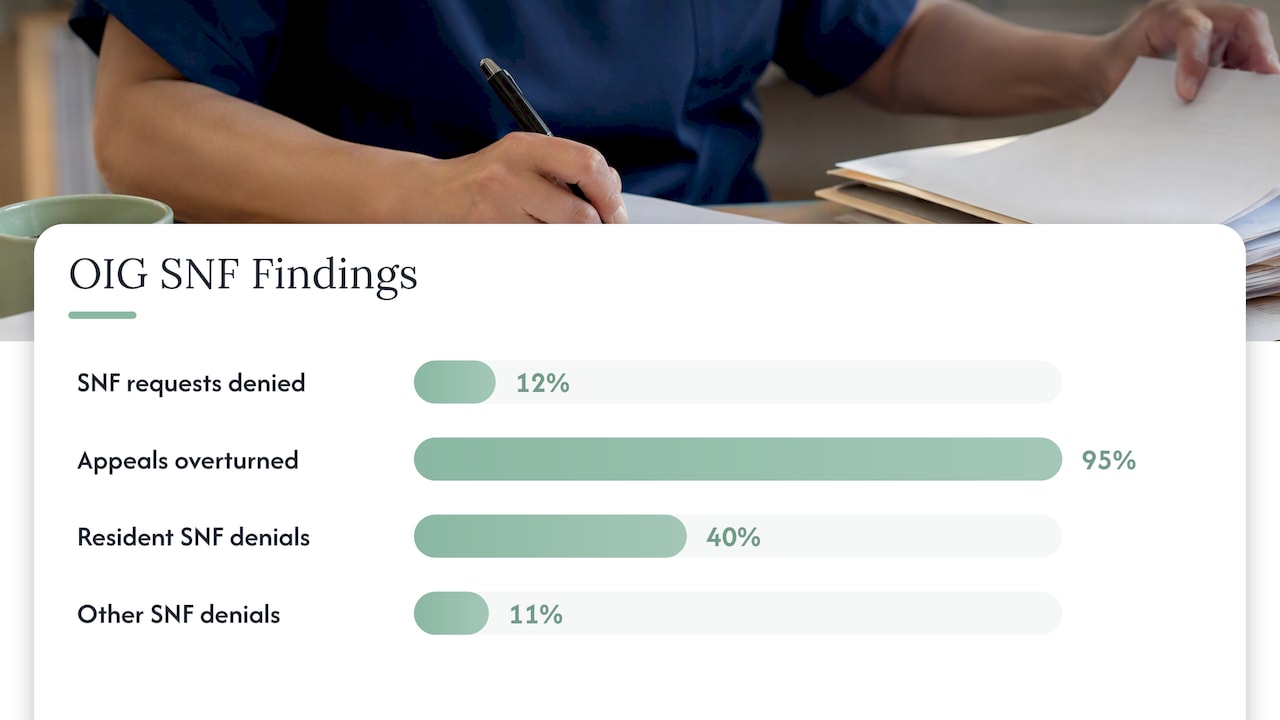
- Medicare Advantage SNF denials deserve extra scrutiny: federal auditors found that 95% of appealed denials were overturned.
- Many of the costliest denials come from people and process gaps, such as missed notifications, not from clinical disagreements.
- Automating eligibility checks, deadline tracking, and documentation at intake removes the most repeatable causes.
Table of Contents
- Why denial root cause analysis matters in post-acute care
- Reason, issue, and root cause: getting the vocabulary right
- The 7 steps of denial root cause analysis
- Root causes that show up repeatedly in SNF admissions
- Handling Medicare Advantage denials differently
- What a good denial review meeting looks like
- Where automation fits
- Our perspective on denial root cause analysis
- Put the findings to work with Smart Admissions
- FAQ
- Sources
Why denial root cause analysis matters in post-acute care
Working denials one claim at a time keeps your team busy and your revenue leaking. The same denial returns next month because nothing upstream changed. A root cause approach asks a different question: what did we do, or fail to do, that made this denial possible?
For SNFs the stakes start at admission. The HHS Office of Inspector General (OIG) reviewed June 2024 data and found that Medicare Advantage organizations denied 12% of SNF admission requests. When those denials were appealed, 95% were overturned in the enrollee’s favor. The same report notes denial rates for SNF-level care were 40% for existing nursing home residents versus 11% for other enrollees.
Two lessons follow. First, an initial denial is not always the final word, so your team needs a fast, documented appeal path. Second, the denials you can prevent are the ones where your own file was thin, late, or missing.
There is also a plain cost argument. HFMA reports that automating claim status checks can save 22 minutes per account and cut transaction cost from $13.66 to $1.54. Multiply that by every account your staff touches manually and the burnout cost becomes visible.
Reason, issue, and root cause: getting the vocabulary right
Most analysis programs stall because the team stops at the payer’s wording. HFMA’s guidance separates three layers, and it helps to use them consistently.
| Layer | What it is | SNF example |
|---|---|---|
| Reason | The payer’s stated justification | “Medical necessity not met” |
| Issue | What was wrong in the file | Therapy notes did not show prior conservative treatment |
| Root cause | The internal failure behind the issue | Intake checklist does not require prior-treatment documentation before submission |
HFMA gives a parallel example: when a denial cites medical necessity, the root cause may be missing documentation of prior conservative treatment or of status, not the patient’s condition. The fix is a workflow change, not an argument about the patient.
Avoid broad buckets. HFMA’s experts warn that a category such as “documentation does not support level of care” is too vague to act on. Define it operationally so that a specific person can change a specific step.
The 7 steps of denial root cause analysis
Step 1: Pull denial data with the codes attached
Start with your remittance data. Claim Adjustment Reason Codes (CARCs) explain why a payment was adjusted or denied, and there are more than 100 standardized codes in the ANSI set. The X12 organization maintains the official code list and explains how group codes such as CO and PR change who is responsible for the balance.
Export at least 6 to 12 months of denials with these fields:
- Payer and plan type (traditional Medicare, Medicare Advantage, Medicaid, commercial)
- CARC and any remark codes
- Dollar amount and service dates
- Admitting coordinator, referral source, and unit
- Date of referral, admission, authorization request, and denial
Include pre-admission denials, not just billed claims. A referral that a plan refused or pended never reaches the billing file, yet it costs you an occupied bed.
Step 2: Group denials by pattern, not by payer wording
Sort by volume and dollars. A small number of patterns usually account for most of the loss. Typical SNF groupings are authorization missing or invalid, eligibility or coverage, medical necessity, timely notification, additional information requested, and coding or modifier errors.
Coding indicators are useful signals. CARC 4, for instance, applies when the procedure code conflicts with a modifier or a required modifier is missing. A cluster of those points to a billing edit or charge capture problem, not to admissions.
Step 3: Trace each pattern to the workflow step that failed
Pull a sample of 10 to 20 files per pattern and walk each one backward. Ask these questions in order:
- Was eligibility verified before the admission decision, and was the result saved?
- Did the referral packet contain everything the payer’s criteria require?
- Was an authorization requested, and is the authorization number recorded?
- Was the payer notified of the bed assignment on time?
- Did clinical updates reach the payer when they were due?
- Who touched the file, and what did they see on their screen?
The answers usually name a step, a handoff, or a missing tool. That is your candidate root cause.
Step 4: Write each root cause so someone can act on it
Use a simple template: “[Specific failure] because [specific condition], which leads to [denial type].” Compare these two:
- Weak: “Documentation issues.”
- Strong: “Therapy evaluation is not attached to the referral packet because the hospital portal export omits it and nobody checks, leading to additional-information denials.”
The strong version names an owner, a fix, and a way to measure the result. HFMA states the goal directly: the root cause should be written so the reader can act on a specific cause.
Step 5: Separate people problems from system problems
Human factors drive many of the most expensive denials. HFMA’s reporting on avoiding the costliest denials concludes that people and process challenges trigger denials year after year. In SNFs, the usual suspects are tasks that busy teams push down the list: notifying the plan of a bed assignment within the required window, and sending regular clinical updates.
Before blaming individuals, check workload. If one coordinator handles referrals, eligibility, authorizations, and family calls, a missed deadline is a staffing design problem. Retraining will not fix it. Removing manual steps will.
Step 6: Assign fixes, owners, and deadlines
For each root cause, record one corrective action, one owner, and one date. Common fixes include:
- Add a required-documents checklist to the intake form, and block submission until it is complete.
- Run eligibility and benefit verification before the clinical review, not after.
- Log every authorization number electronically at the moment it is received.
- Create a deadline alert for notification and clinical update dates.
- Standardize the appeal packet so that an expedited appeal can go out the same day.
Our patient eligibility checklist for SNF admissions gives you a ten-step version of the first fix that you can adapt.
Step 7: Measure, then repeat on a schedule
Track each pattern monthly: denial count, dollars, overturn rate, and days from referral to decision. Review the top three patterns in a standing 30-minute meeting with admissions, clinical, and billing leads. When a pattern drops, close it and move to the next. When it does not, your root cause was probably too broad, so rewrite it.
If you want a broader process around this loop, our denials management process guide lays out seven steps for revenue cycle teams.
Root causes that show up repeatedly in SNF admissions
Every facility is different, but admissions teams tend to find the same handful of failures. Use the table as a starting hypothesis list, then confirm against your own files.
| Denial pattern | Likely root cause to test | First fix |
|---|---|---|
| Authorization missing or invalid | Authorization number not logged, or request sent to the wrong channel | Electronic authorization log, linked to the resident record |
| Additional information required | Clinical updates sent late or incomplete | Scheduled update reminders tied to review dates |
| Late notification | Bed assignment not reported to the plan within 24 hours | Automated deadline alert at the time of admission |
| Coverage or eligibility | Benefits verified once, not rechecked at admission | Real-time verification at referral and again on admission day |
| Medical necessity | Referral packet missing prior-treatment or level-of-care evidence | Documentation checklist by payer criteria |
| Out-of-network | Network status not checked before accepting the referral | Network check in the referral workflow |
The 24-hour notification item deserves emphasis. It is a technical denial that costs real money and is entirely preventable, which is why it is one of the first things we suggest automating. Our guidance on out-of-network referral rules covers the network check, and the Medicare Advantage eligibility checks article covers the delays that appear when plan rules are not checked up front.
Handling Medicare Advantage denials differently
When the payer is a Medicare Advantage plan, treat the first decision as provisional. The OIG found that enrollees and providers appealed only 18% of SNF denials, yet nearly all of those appeals succeeded, as described in the OIG report. That gap suggests many valid admissions are never contested.
Build an appeal routine into your root cause work:
- Record which denials were appealed and which were not, and the reason.
- Check whether an expedited appeal is available for urgent admissions.
- Know the escalation path. LeadingAge’s guidance on the SNF prior authorization tool explains that Level 2 review by the Independent Review Entity is automatic, with the plan required to send the case within 24 hours of upholding its denial.
- Be ready to challenge denials built on false premises. Attorney George Colman, JD, advises in an HFMA article on long-term care payment challenges that facilities should contest claims, for example, that therapy must stop when no progress is visible.
If your facility works with utilization management vendors, our piece on stopping gaps in NaviHealth SNF authorizations shows where authorization timing tends to slip. For the coverage rules themselves, see the three tests for Medicare SNF eligibility.
What a good denial review meeting looks like
The analysis only pays off if someone acts on it. Keep the monthly review short and consistent.
Before the meeting
- Refresh the denial report by pattern.
- Flag any pattern that grew by more than the last month’s baseline.
- Pull three sample files per top pattern.
During the meeting
- Read the root cause statement aloud and confirm it names a specific step.
- Confirm owner and due date for each open fix.
- Decide whether to escalate to the hospital referral partner or the payer.
After the meeting
- Update checklists and training notes within one week.
- Share one concrete change with front-line staff, so they see their feedback produce results.
That last item matters for morale. Admissions coordinators who see denials fall after their input are more likely to keep logging accurate notes.
Where automation fits
Some root causes cannot be solved by checklists alone, because they come from volume. A coordinator reviewing dozens of referrals a week will occasionally skip a verification step. Software does not get tired at 4:45 p.m.
The most useful automation targets are the repeatable ones: eligibility verification against insurer portals, structured capture of clinical documents from the referral, deadline tracking, and an audit trail of what was received and when. Our resources on manual versus automated admissions and EMR integration for referrals go deeper on how those pieces connect, and our guide to referral documentation best practices covers the file quality side.
Our perspective on denial root cause analysis
We build software for admissions teams, and the pattern we see in the field is consistent: denial work starts too late. By the time a denial reaches billing, the cause is weeks old and the people involved have moved on. The most effective change is to bring root cause thinking to the referral itself.
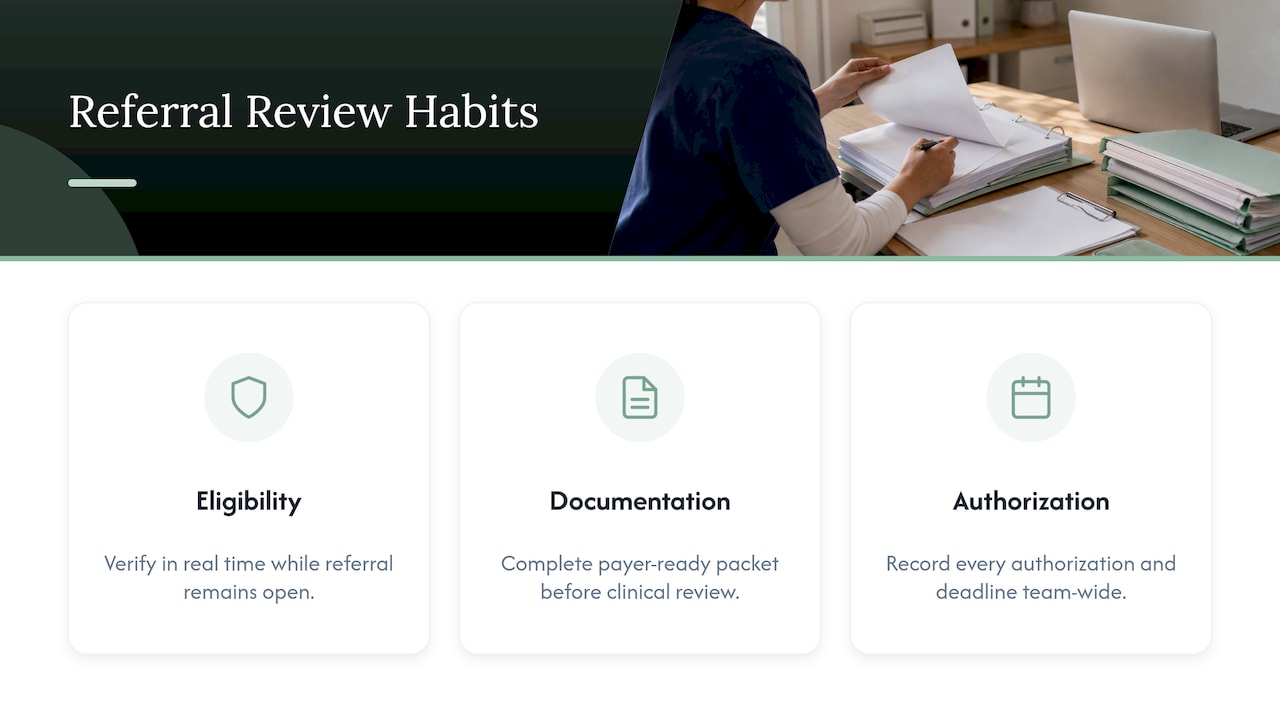
That means three habits. First, verify eligibility in real time while the referral is still open, not after the resident arrives. Second, require a complete, payer-ready documentation packet before the clinical review, so the review is about the patient and not about chasing paperwork. Third, record every authorization and deadline where the whole team can see it.
We also think facilities should be wary of one-size-fits-all fixes. A 40-bed rural facility with one coordinator has different bottlenecks than a multi-site operator with a central intake team. Start from your own denial data, find the two or three patterns that cost the most, and fix those first. Small, specific changes compound faster than a large program nobody finishes.
— Harry
Put the findings to work with Smart Admissions
Once your analysis shows that eligibility gaps, missing documents, or missed deadlines drive your denials, Smart Admissions helps close them at intake. Our AI referral management assistant connects with your EMR and insurance portals to support real-time eligibility verification, clinical assessments, and documentation management. Plans are published at $597 per month or $6,447 per year, and we back the software with a guarantee that it pays for itself within 30 days. You can also read how our approach reduces admission denials before you decide.
FAQ
What are the 5 steps of root cause analysis?
A common five-step version is: define the problem, collect data, identify possible causes, find the underlying cause, and implement and monitor a fix. For denials, that translates to selecting a denial pattern, pulling files and codes, tracing the workflow, writing an actionable root cause statement, and tracking results monthly. The seven steps above add explicit ownership and a review rhythm.
What is the difference between a denial reason and a root cause?
The reason is the payer’s stated justification, such as medical necessity not met. The root cause is the internal failure that made the denial possible, such as a missing prior-treatment record in the referral packet. HFMA’s guidance stresses writing root causes so a team can act on them.
What does denial reason code 4 mean?
CARC 4 is used when the procedure code is inconsistent with the modifier or a required modifier is missing. It is a coding signal, so your investigation should start with charge capture and billing edits rather than admissions workflow.
How often should an SNF review denial root causes?
Monthly works for most facilities, with a deeper quarterly look at trends by payer. Keep the monthly meeting short and focused on the top three patterns. If a pattern does not improve after a fix, rewrite the root cause more specifically instead of repeating the same fix.
Sources
- Getting to the root causes of denials (HFMA)
- Avoiding the Costliest Denials (HFMA)
- Why LTC providers should prepare for a whole new wave of payment challenges (HFMA)
- Medicare Advantage Organizations Overturned Nearly All Appealed Prior Authorization Denials for SNF Admission (OIG)
- OIG report OEI-09-24-00331 (PDF)
- Claim Adjustment Reason Code, CMS Blue Button API
- Claim Adjustment Reason Codes (X12)
- Guidance on the MA Prior Authorization Tool for Skilled Nursing Facilities (LeadingAge)