
TL;DR:
- Digital patient intake automates referral processing, drastically reducing admission times from 12 to under 2 hours.
- It uses AI and ML to extract data, verify insurance, and coordinate workflows across multiple channels.
- Implementing digital intake enhances efficiency, accuracy, staff satisfaction, and long-term operational insights.
Reducing referral-to-admission time from 12 hours to under 2 is not a minor operational tweak. It is a fundamental shift in how skilled nursing facilities and rehabilitation centers compete for census, serve referral partners, and retain staff. Many administrators still assume that intake improvements are incremental, a form here, a faster fax there. In reality, digital patient intake replaces the entire manual chain with automated, parallel workflows that verify insurance, extract clinical data, and flag documentation gaps before your team even opens a chart. This guide explains what digital patient intake is, how it works, and exactly how your facility can put it into practice.
Table of Contents
- What is digital patient intake?
- Key components of a digital patient intake process
- Digital vs. traditional patient intake: Efficiency gains and pitfalls
- Benefits of digital intake for skilled nursing and rehab centers
- Getting started: Steps to implement digital patient intake
- Our take: The hidden value in digital patient intake transformation
- Ready to streamline your admissions workflow?
- Frequently asked questions
Key Takeaways
| Point | Details |
|---|---|
| Faster admissions | Digital patient intake can reduce referral-to-admission times by up to 90% for complex cases. |
| Improved accuracy | AI-driven systems catch data errors early for cleaner clinical and compliance records. |
| Seamless integration | Modern digital intake works alongside EMR and referral portals for smooth hand-offs. |
| Scalable efficiency | Parallel processing enables staff to manage more cases without added workload. |
What is digital patient intake?
Digital patient intake is the use of technology to collect, verify, organize, and transfer patient information during the admissions process, replacing paper forms, manual data entry, and siloed communication with automated, integrated workflows. For skilled nursing facilities (SNFs) and rehabilitation centers, this means every referral, from hospital discharge planners to physician offices, flows through a centralized system that processes information in real time.
Traditional intake depends on fax machines, spreadsheets, and staff manually re-entering data from referral packets into electronic health record (EHR) systems. Each handoff introduces delay and error risk. Digital intake eliminates these friction points by using artificial intelligence (AI) and machine learning (ML) to read, extract, and route data automatically.
Here is what a modern digital intake system handles:
- Referral capture: Accepts incoming referrals from multiple channels, including fax, secure portal, and email, and centralizes them in one queue.
- Automated data extraction: AI reads referral documents and pulls structured data, diagnoses, medications, insurance details, into the appropriate fields.
- Insurance and eligibility verification: The system checks coverage in real time without requiring a staff member to call a payer.
- Bed availability matching: Cross-references clinical needs against current census and bed status to identify placement options immediately.
- Parallel processing: Multiple cases advance simultaneously rather than one at a time, which is the core reason facilities see up to 90% faster admissions for complex, high-acuity cases.
“Digital intake in SNFs and rehab centers involves AI-automated referral processing, extracting data, and parallel processing, which greatly reduces admission times.”
For a deeper look at what records and documents this process touches, the digital intake documentation guide covers each component in detail. The bottom line: digital patient intake is not a single tool. It is a coordinated system that transforms how your facility moves a patient from referral to bed.
Key components of a digital patient intake process
Having defined digital patient intake, let’s walk through what this process actually looks like step by step. Each component builds on the previous one, creating a chain where speed and accuracy reinforce each other.
- Referral capture and initial triage: The system accepts referrals from fax, email, and portal sources, then automatically categorizes them by urgency, payer type, and clinical complexity. Staff see a prioritized queue rather than a stack of unread faxes.
- Automated data extraction: Using AI and ML, the platform reads referral packets, often 50 pages or more, and processes packets instantly, dramatically improving admissions workflows. Diagnoses, medication lists, and insurance IDs are pulled into structured fields without manual re-entry.
- Centralized verification: Insurance eligibility, prior authorization status, and bed availability are checked simultaneously. This parallel verification step is where the largest time savings occur.
- Documentation compilation: The system assembles the clinical and compliance documentation needed for the admissions decision, including face sheets, physician orders, and consent forms, organized for clinical review.
- Workflow routing: Completed packets are routed to the appropriate reviewer, whether that is a clinical admissions nurse, a financial counselor, or a department director, based on predefined rules.
Pro Tip: AI-powered intake solutions can detect common errors in referral packets, such as missing diagnosis codes or expired insurance information, before your staff ever opens the file. This prevents back-and-forth with referral sources and keeps the process moving.
The table below shows how digital intake compares to a manual process at each stage:
| Process stage | Manual intake | Digital intake |
|---|---|---|
| Referral capture | Fax, manual logging | Automated, multi-channel |
| Data extraction | Staff re-entry | AI extraction |
| Insurance verification | Phone calls | Real-time automated check |
| Documentation review | Paper sorting | Centralized digital queue |
| Routing to reviewer | Email or verbal | Rule-based automated routing |
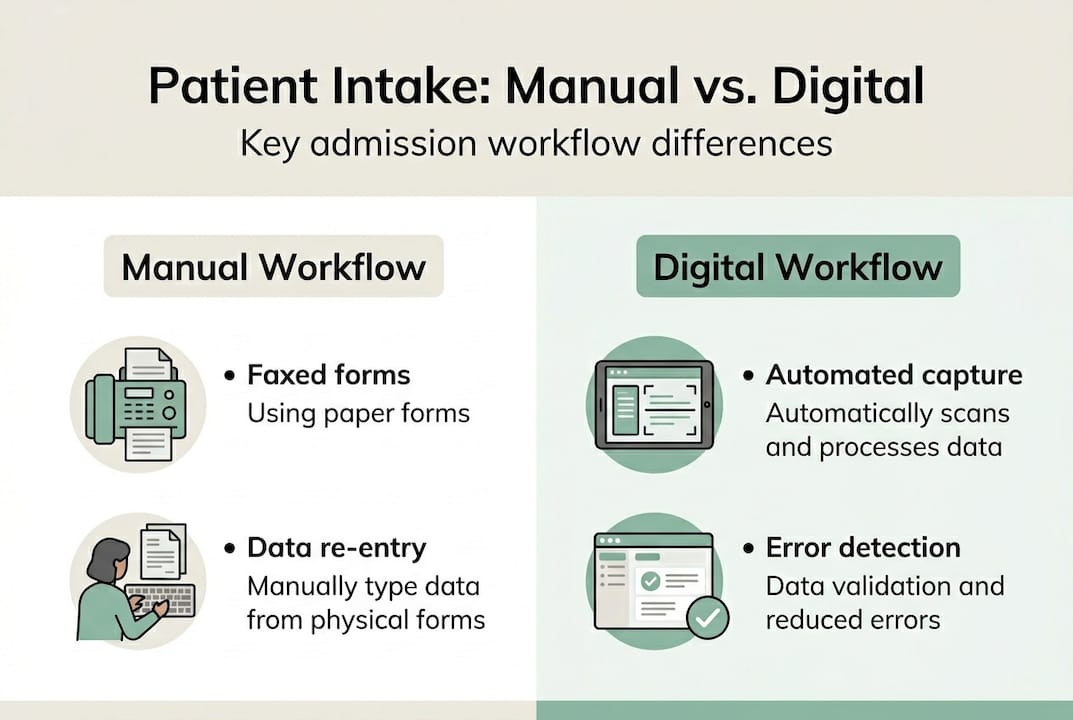
For teams looking to go further, intake workflow optimization resources and workflow automation in healthcare guides provide additional frameworks for refining each stage.
Digital vs. traditional patient intake: Efficiency gains and pitfalls
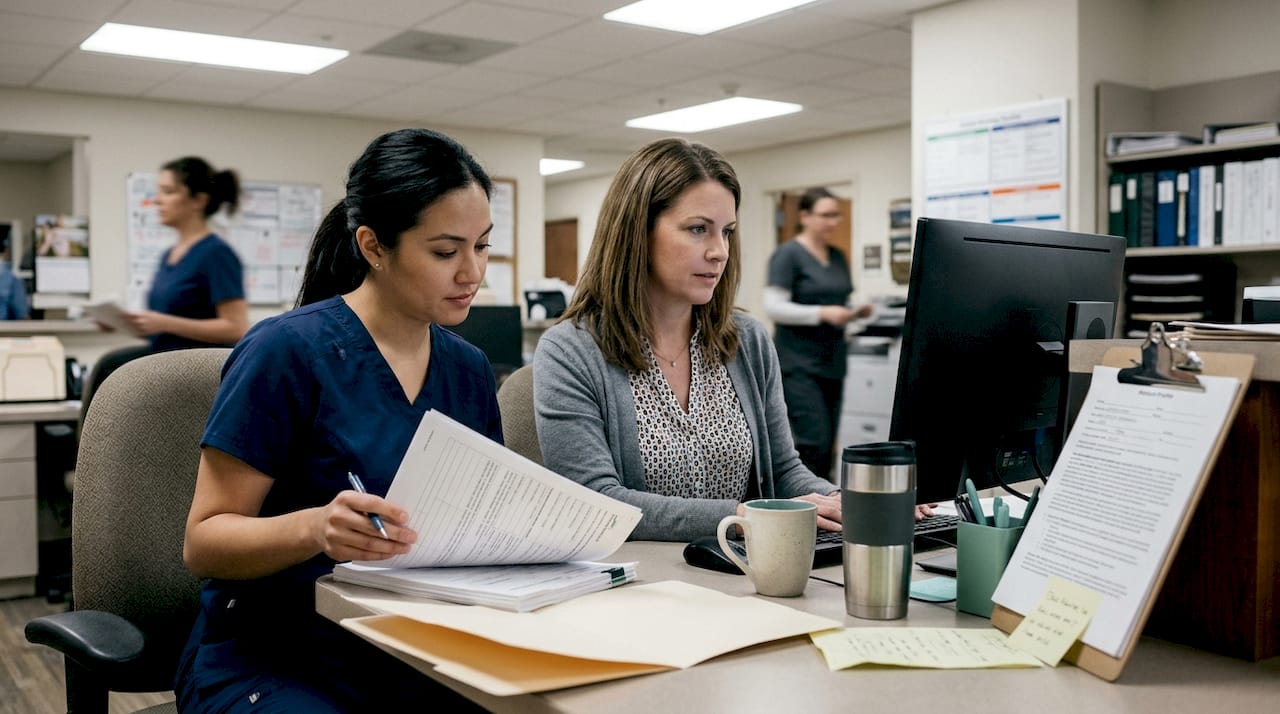
Understanding the process is essential, but how does it truly compare to the old way of doing things? The data is clear. Referral-to-admission times can drop from 12 hours to less than 2, especially for high-acuity cases that involve complex insurance, multiple diagnoses, or specialized clinical needs.
| Category | Manual process | Digital process |
|---|---|---|
| Average time per referral | 8 to 12 hours | Under 2 hours |
| Error rate | High (manual re-entry) | Low (AI extraction) |
| Staff touchpoints per case | 6 to 10 | 2 to 3 |
| Parallel case processing | Not possible | Standard |
| Compliance documentation | Inconsistent | Standardized |
The efficiency gains from automated admissions are real, but so are the pitfalls if your transition is poorly planned. The most common challenges facilities encounter include:
- Incomplete data from referral sources: Digital systems can only work with what they receive. If referring hospitals send incomplete packets, AI flags the gaps but cannot fill them. Strong referral partner communication remains essential.
- Integration gaps: A digital intake tool that does not connect with your existing EHR or payer portals creates new silos rather than eliminating old ones. Confirm FHIR and HL7 standards compatibility before selecting a platform.
- Training and adoption barriers: Staff accustomed to paper-based workflows may resist new systems. Structured onboarding and clear role-specific training reduce this friction significantly.
- Over-reliance on automation: AI handles extraction and verification well, but clinical judgment still belongs to your team. Digital intake supports your staff; it does not replace them.
Facilities that address these pitfalls early see the strongest results. Reviewing intake optimization strategies before implementation helps your team anticipate and resolve these issues proactively.
Benefits of digital intake for skilled nursing and rehab centers
Now let’s clarify the direct value administrators and staff gain from going digital. The improvements are measurable across operations, clinical quality, and referral relationships.
- Faster admissions and higher census: Quicker bed occupancy is one of the most immediate financial benefits. When referral-to-admission time drops, beds fill faster, and your facility captures revenue that would otherwise go to a competitor.
- Cleaner clinical hand-offs: Complete, error-checked records reach your clinical team before the patient arrives. Nurses and therapists spend less time tracking down missing information and more time on care.
- Reduced staff burnout: Admissions coordinators who spend hours on manual data entry and phone-based insurance verification report significantly higher stress levels. Automating these tasks returns meaningful time to your team.
- Stronger referral partner relationships: Hospitals and physicians prefer facilities that respond quickly and accurately. A digital intake process signals professionalism and reliability, which drives repeat referrals.
- Regulatory compliance support: Standardized documentation workflows reduce the risk of incomplete records during audits or survey reviews.
- Improved family experience: When admissions move faster and staff are better prepared, families receive clearer communication and a smoother transition for their loved ones.
Pro Tip: Use your intake platform’s analytics dashboard to monitor where cases stall most often. Tracking metrics like time-per-stage and error frequency by referral source helps your team identify specific bottlenecks and address them with targeted process changes. Reviewing workflows for skilled nursing can provide additional benchmarks for comparison.
Getting started: Steps to implement digital patient intake
With the benefits clear, how can your organization achieve a smooth transition? Implementation does not require a full technology overhaul on day one. A phased, structured approach reduces risk and builds staff confidence.
- Assess your current workflow: Map each step of your existing intake process, from the moment a referral arrives to the patient’s first day on the unit. Identify where delays, errors, and redundant steps occur most frequently.
- Define your requirements: Determine what integrations you need, specifically your EHR system, payer portals, and referral sources. Confirm that any platform you evaluate supports FHIR and HL7 standards for data exchange.
- Evaluate and select a platform: Look for solutions built specifically for SNF and post-acute care environments. Generic intake tools often lack the clinical and payer-specific features your team needs.
- Train your staff: Develop role-specific training for admissions coordinators, clinical reviewers, and financial staff. Clear documentation and hands-on practice sessions reduce resistance and errors during the transition.
- Set measurable metrics: Before go-live, establish baseline numbers for referral-to-admission time, error rates, and staff hours per case. These baselines let you quantify improvement after implementation.
- Review and refine: Schedule monthly reviews of intake analytics for the first six months. Adjust workflows based on what the data shows.
Pro Tip: Start with a pilot program in one unit or one referral source category before rolling out facility-wide. This limits disruption, surfaces unexpected issues early, and gives your team a chance to build confidence with the new system. Implementing digital intake unlocks immediate, measurable efficiencies when done right, and a pilot approach is one of the most reliable ways to ensure that. For additional guidance, optimizing intake process resources offer practical checklists for each implementation phase.
Our take: The hidden value in digital patient intake transformation
Most conversations about digital intake focus on speed, and speed matters. But the facilities that gain the most from this transformation are the ones that recognize what comes after efficiency: data.
Every referral processed through a digital intake system generates structured, searchable data. Over time, that data reveals patterns: which referral sources send the highest-acuity patients, which payers create the most authorization delays, which clinical profiles correlate with longer lengths of stay. This is information your team currently cannot access because it is buried in paper files and manual logs.
Facilities that use this data strategically can strengthen referral relationships by demonstrating outcomes, improve regulatory compliance by catching documentation gaps before they become survey findings, and build a case for staffing and resource allocation decisions. These are advantages that compound over time.
Most competitors focus on the immediate ROI of faster admissions. The real advantage belongs to facilities that treat digital intake as a long-term investment in operational intelligence. Pairing intake transformation with broader automation strategies for healthcare positions your facility to lead, not just keep pace.
Ready to streamline your admissions workflow?
If your facility is ready to move from manual intake to a faster, more reliable process, Smart Admissions provides the tools and support to make that transition achievable. Our platform is built specifically for SNFs, rehabilitation centers, and post-acute care providers, with AI-powered referral management that integrates with your existing EHR and payer portals.
Explore how faster bed occupancy translates into measurable revenue gains, or review referral management examples to see how other facilities have structured their workflows. When you’re ready to take action, our intake automation transformation resources walk you through every step, from initial assessment to full deployment.
Frequently asked questions
How does digital patient intake save time for skilled nursing facilities?
By automating data extraction, insurance verification, and workflow routing, digital intake cuts delays for high-acuity cases, reducing referral-to-admission time from 12 hours to under 2 hours in many facilities.
What technology is used in digital patient intake?
AI and ML tools automate referral packet data extraction, while EMR integrations using FHIR and HL7 standards handle verification and workflow routing across connected systems.
Can facilities start digital patient intake without overhauling all legacy systems?
Yes. Most facilities implement digital intake incrementally, beginning with a pilot in one unit or referral category and gradually connecting new tools with existing EHRs and payer portals as confidence builds.