
TL;DR:
- Not all nursing home care qualifies for Medicare Medicare covers skilled services provided by licensed professionals.
- Proper documentation and timely admission within specific criteria are essential to secure Medicare coverage.
- Implementing automated verification tools improves admission processes and reduces coverage denials.
Many discharge planners and case managers are surprised to learn that not all nursing home care qualifies for Medicare reimbursement. The distinction between skilled and custodial care is one of the most consequential decisions your team makes during care transitions, yet it remains one of the most misunderstood. This guide defines skilled nursing facilities (SNFs) with precision, breaks down Medicare coverage requirements, and gives your team practical tools for coordinating admissions that hold up to payer scrutiny.
Table of Contents
- Defining skilled nursing facilities: Core features and services
- Skilled vs. custodial care: Why the distinction matters
- Medicare coverage and SNF admission criteria: What professionals must know
- Operational realities: Coordinating admissions and maximizing skilled coverage
- The realities no one tells you about skilled nursing facility admissions
- Make SNF admissions faster and easier with the right tools
- Frequently asked questions
Key Takeaways
| Point | Details |
|---|---|
| SNF means skilled care | A skilled nursing facility provides post-acute medical and rehabilitative services requiring qualified personnel. |
| Coverage requires criteria | Medicare covers only medically necessary skilled services after a qualifying hospital stay, not custodial care. |
| Documentation is critical | Accurate documentation supporting skilled need is essential for claim approvals and ongoing coverage. |
| Admission is a team process | Providers, case managers, and social workers must align care goals and paperwork for a smooth SNF transition. |
Defining skilled nursing facilities: Core features and services
A skilled nursing facility is a type of nursing facility with the necessary staff and equipment to treat, manage, and observe a patient’s condition and evaluate care. That definition, drawn directly from Medicare, is more specific than most people realize. Not every nursing home meets the threshold, and not every patient placed in one qualifies for Medicare’s SNF benefit.
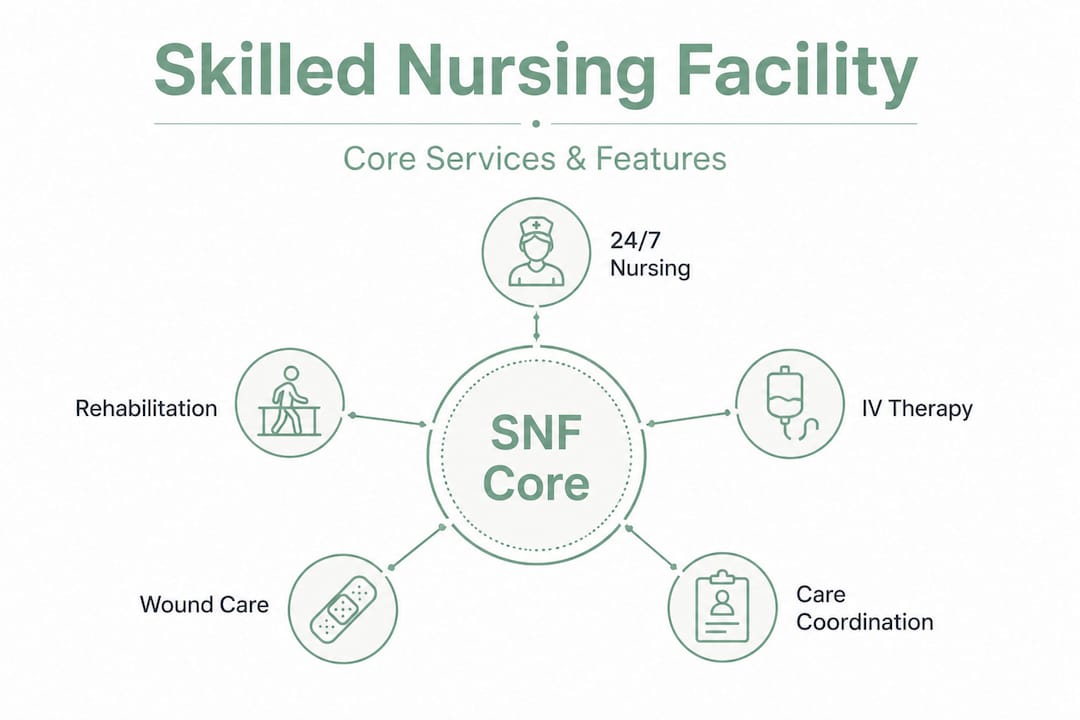
SNF care refers to skilled, not custodial, services that require qualified health professionals’ skills, such as therapy and certain nursing services. This is the regulatory line that separates covered care from out-of-pocket expense.
Required staff and services
To qualify as a Medicare-certified SNF, a facility must maintain a specific staffing profile. This includes:
- Registered nurses (RNs) available at minimum 8 consecutive hours per day, 7 days a week
- Licensed practical nurses (LPNs) or licensed vocational nurses (LVNs) providing around-the-clock coverage
- Physical, occupational, and speech-language therapists for post-acute rehabilitation
- A medical director who oversees clinical policies and physician services
- Social services and discharge planning staff to coordinate care transitions
Core skilled services provided in SNFs include wound care, intravenous (IV) antibiotic therapy, post-surgical rehabilitation, complex medication management, respiratory therapy, and monitoring of unstable medical conditions. These are services that require clinical judgment, licensed staff, and ongoing documentation of patient response.
Facility types
SNFs are not all structured the same way. Your team may encounter several configurations:
| Facility type | Description | Common use case |
|---|---|---|
| Stand-alone SNF | Independent facility dedicated to post-acute skilled care | Patients transitioning directly from hospital |
| Hospital-based SNF | Skilled unit physically within or attached to an acute care hospital | Complex cases needing close physician oversight |
| SNF unit within a nursing home | Designated skilled wing inside a long-term care facility | Patients who may transition to long-term custodial care |
| Swing-bed facility | Rural hospital beds used for both acute and SNF-level care | Limited rural access settings |
Understanding which type of facility you are referring to matters for logistics, staffing ratios, and coverage documentation. Proper documentation for SNF admissions is essential regardless of facility type, and your referral packet should reflect the specific setting.
Skilled vs. custodial care: Why the distinction matters
With a foundational definition in place, it is crucial to grasp the coverage and operational significance of skilled versus custodial care. This distinction is not just clinical. It determines whether Medicare pays, whether a referral is appropriate, and whether your patient ends up in the right setting.
What separates these two care types
Skilled care requires qualified health professionals and involves complex clinical interventions. Custodial care, by contrast, is supportive in nature and focuses on helping patients with activities of daily living (ADLs) such as bathing, dressing, eating, and toileting. Custodial care does not require a licensed clinician to perform or supervise.
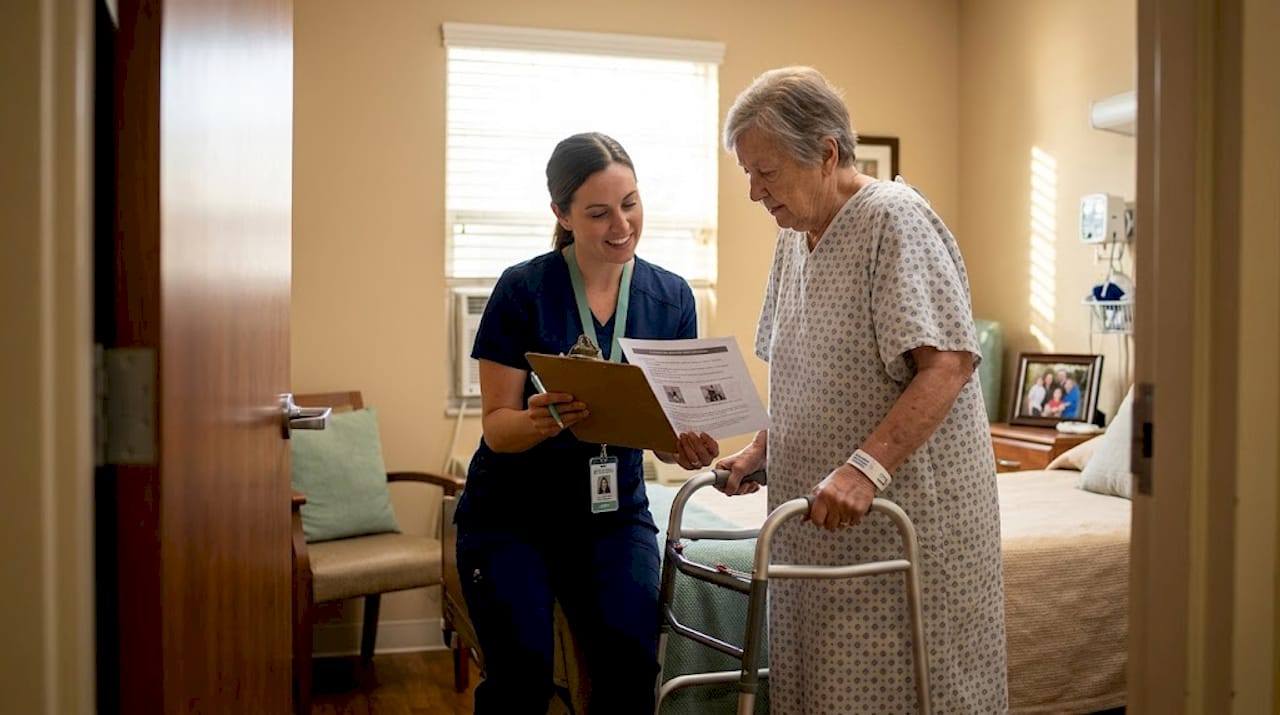
Here is a direct comparison:
| Care type | Examples | Who provides it | Medicare coverage |
|---|---|---|---|
| Skilled care | IV therapy, wound debridement, post-stroke speech therapy, complex medication titration | RN, LPN, PT, OT, SLP | Covered under Part A (with qualifying criteria) |
| Custodial care | Help with bathing, dressing, meal assistance, mobility support | Certified nursing assistants (CNAs), home health aides | Not covered by Medicare |
“Under Medicare, SNF coverage is time-limited and generally requires a qualifying inpatient hospital stay (typically at least 3 consecutive days) plus a physician order for daily skilled care.” Medicare Skilled Nursing Facility Care
The most common pitfall your team will encounter is assuming that a patient’s level of dependency or functional decline automatically qualifies them for SNF coverage. It does not. A patient who needs help with all ADLs but has no ongoing skilled clinical need does not meet Medicare’s SNF criteria.
Pro Tip: When evaluating a referral, ask one focused question: “Does this patient require a licensed clinician to safely deliver or supervise the needed service?” If the answer is no, the placement may be more appropriate for a custodial or assisted living setting.
Ensuring automated skilled nursing documentation is in place from the moment of referral helps your team capture the clinical rationale that justifies skilled placement before the claim is ever submitted. Facilities that also maintain HIPAA compliance for SNFs protect patient data throughout this process.
Medicare coverage and SNF admission criteria: What professionals must know
Knowing care types is important, but so is understanding the pathway to SNF admission and payment. Medicare’s rules are specific, and missing even one criterion can result in a full coverage denial.
The five core criteria for Medicare SNF coverage
- Medicare Part A enrollment. The patient must be enrolled in Medicare Part A, which covers inpatient hospital care and post-acute services including SNF stays.
- Qualifying inpatient hospital stay. The patient must have had a qualifying inpatient hospital stay of at least 3 consecutive days (not counting the day of discharge). Observation status does not count, even if the patient physically spent nights in the hospital.
- Physician order for skilled care. A physician or qualified practitioner must order daily skilled care. This order must be documented before or at the time of SNF admission.
- SNF admission within 30 days of hospital discharge. The patient must be admitted to a Medicare-certified SNF within 30 days of the qualifying hospital discharge, unless a medical exception applies.
- Ongoing medical necessity. The patient must continue to require skilled care on a daily basis. Coverage ends when skilled need is no longer present, even if the patient remains in the facility.
“A major practical edge case for SNF selection is that Medicare-covered SNF stays require skilled need (and documentation), not just need for assistance with activities of daily living.” Medicare Skilled Nursing Facility Care
Benefit period limits and cost-sharing
Medicare’s SNF benefit operates within a benefit period, which begins the day a patient enters a hospital or SNF and ends after the patient has not received inpatient hospital or SNF care for 60 consecutive days. Within each benefit period:
- Days 1 to 20: Medicare covers 100% of approved costs
- Days 21 to 100: Patient pays a daily coinsurance amount (updated annually by CMS)
- Day 101 and beyond: Medicare pays nothing; patient is responsible for all costs
Pro Tip: Proactively educate patients and families about the coinsurance period before Day 21 arrives. Unexpected cost-sharing is a leading source of patient and family complaints during SNF stays, and early communication prevents disputes later.
When coverage ends before Day 100, the facility must issue a Notice of Medicare Non-Coverage (NOMNC) at least two days before the last covered day. Your team should track benefit day usage and skilled need documentation closely to anticipate this and plan transitions accordingly. Streamlining optimizing intake for SNF admissions from the start reduces the risk of documentation gaps that trigger premature coverage termination.
Operational realities: Coordinating admissions and maximizing skilled coverage
After understanding admission criteria, putting it into practice can mean the difference between approval and denial. The gap between knowing the rules and executing them under real-world time pressure is where most coverage problems originate.
SNF care is intended for short-term, post-acute skilled needs, often after a qualifying hospital stay, and is not equivalent to long-term custodial care. Your referral and discharge planning workflows need to reflect that intent clearly.
Building a documentation-first workflow
Strong SNF admissions start with documentation that tells a complete clinical story. Every referral packet should include:
- Physician order for daily skilled care, specifying the type of skilled service and frequency
- Therapy evaluation and goals, including functional baselines and measurable short-term objectives
- Nursing assessment, documenting the specific skilled nursing needs that cannot be safely managed without licensed oversight
- Hospital discharge summary, confirming the qualifying inpatient stay and clinical rationale for SNF-level care
- Insurance verification, confirming Medicare Part A eligibility and benefit days remaining
SNF claims and coverage may be denied or ended via a Notice of Medicare Non-Coverage when services are no longer medically reasonable and necessary. This means documentation must be updated continuously, not just at admission.
Common causes of claim denial
Understanding why claims fail helps your team prevent them. The most frequent denial triggers include:
- Physician order missing or not specific enough about the skilled service required
- Therapy goals that are vague or not tied to measurable functional outcomes
- Nursing notes that describe custodial tasks rather than skilled clinical interventions
- Failure to document daily skilled service delivery (a single missed day can break coverage)
- Observation status hospital stay counted toward the 3-day qualifying stay requirement
Pro Tip: Review nursing and therapy notes weekly during a patient’s SNF stay to confirm they reflect skilled need, not routine care. A note that reads “patient assisted with ambulation” does not support skilled coverage. A note that reads “patient required skilled PT intervention to address post-surgical gait instability with fall risk” does.
Recognizing common admissions process pitfalls early allows your team to correct course before a denial is issued. Facilities that invest in automated documentation benefits report fewer gaps in clinical records and faster resolution of payer inquiries.
The realities no one tells you about skilled nursing facility admissions
Guidelines and regulatory definitions give your team a framework. What they do not capture is the operational pressure that makes following those guidelines genuinely difficult. Physicians are busy and orders are sometimes delayed. Discharge timelines are compressed. Families push for placements before documentation is complete. These are not edge cases. They are daily realities.
The most damaging documentation error is not an outright omission. It is under-documentation of skilled need. A patient may clearly require skilled care, but if the clinical record reads like a custodial care summary, the claim will be treated as one. Auditors and payer reviewers read what is written, not what was intended.
There is also a timing problem that teams underestimate. The window between hospital discharge and SNF admission is narrow, and the pressure to move patients quickly sometimes results in referral packets that are incomplete at the time of admission. Facilities that accept referrals without a verified physician order or confirmed qualifying stay are setting themselves up for retroactive denials.
What separates high-performing SNF admissions teams from reactive ones is process design. Teams that use structured intake checklists, automated eligibility verification, and real-time documentation review catch problems before they become denials. They do not wait for a NOMNC to review coverage status. They track benefit days, monitor clinical documentation quality, and communicate proactively with referring hospitals and physicians.
Technology is accelerating this shift. Platforms that integrate with EHR systems and insurance portals allow admissions staff to verify Medicare eligibility, confirm qualifying hospital stays, and flag documentation gaps in real time. This is not about replacing clinical judgment. It is about giving your team the information they need, at the moment they need it, to make better decisions. Investing in real-world intake optimization is one of the most practical steps a facility can take to protect revenue and reduce staff burnout simultaneously.
The facilities that struggle most with SNF admissions are those that treat documentation as an afterthought rather than a clinical priority. Shifting that mindset, supported by the right tools, is what makes the difference between consistent coverage and recurring denials.
Make SNF admissions faster and easier with the right tools
Your team now has a clear picture of what skilled nursing facilities are, how Medicare coverage works, and where admissions processes break down. The next step is putting that knowledge into a workflow that actually holds up under daily operational pressure.
Smart Admissions is built specifically for this challenge. The platform automates eligibility verification, flags documentation gaps before admission, and integrates with your existing EHR systems to keep clinical records complete and audit-ready. Teams using Smart Admissions report faster bed occupancy and fewer coverage denials because every referral moves through a structured, verified process. Explore the step-by-step workflow for SNF admissions to see how your team can standardize intake, and learn how automation for admissions efficiency reduces manual work across every stage of the process.
Frequently asked questions
What qualifies as skilled care in a skilled nursing facility?
Skilled care involves services like IV therapy, wound care, and rehabilitation provided by licensed nurses or therapists, not just daily living assistance. The key factor is that the service requires the clinical judgment and training of a licensed professional.
How long does Medicare cover a skilled nursing facility stay?
Medicare covers up to 100 days per benefit period in a skilled nursing facility if all other criteria are met. Full coverage applies for the first 20 days, with patient coinsurance required from Day 21 through Day 100.
What documentation is needed for SNF Medicare coverage?
You need a qualifying hospital stay record, a physician order for daily skilled care, and ongoing evidence of medical necessity. Medicare’s SNF coverage requires all three elements to be documented before and throughout the stay.
Does Medicare pay for long-term custodial care in SNFs?
No, Medicare’s SNF benefit does not cover custodial services alone. Coverage applies only when the patient has an ongoing, documented skilled care need.
Can SNF care be provided in a regular nursing home?
Yes, if the nursing home has the staff and equipment required for skilled care, SNF services can be delivered there. The facility must be Medicare-certified and meet all staffing and service requirements to bill for SNF-level care.