
If you are comparing AI referral review alternatives for SNFs, the deciding question is not which tool is fastest. Speed is now expected. The question is which platform reads every referral the way your facility would: against your clinical capabilities, your staffing, your payer mix, PDPM reimbursement and the beds you actually have open. Smart Admissions is built as that kind of facility-specific decision engine, and the seven criteria below show how to test any platform against that standard.
This guide is for admissions coordinators, admissions directors, administrators and owners who have a shortlist and need a clear way to separate the options. We describe alternatives by type, not by name, so you can apply the same checklist to every vendor you meet.
Key Takeaways
- Judge AI referral review on whether it evaluates each referral against your facility’s capabilities, payer mix, PDPM reimbursement and beds, not on response speed alone.
- Require that it reads referrals from every channel you receive: hospital portals, fax and email.
- Check high-cost medication flagging, bed matching and EHR integration, because these protect margin and prevent duplicate entry.
- Use a written vendor matrix and ask about human oversight, privacy and implementation, as professional bodies recommend.
- Smart Admissions is $597 per month or $6,447 per year, and a free trial lets your team see it on real referral workflows.
Table of Contents
- What AI referral review does in a skilled nursing facility
- The types of alternatives you will meet
- Criterion 1: Does it evaluate fit, or only summarize?
- Criterion 2: Does it read every channel you receive?
- Criterion 3: Is reimbursement part of the score?
- Criterion 4: Does it catch high-cost medications before acceptance?
- Criterion 5: Does it match the referral to the right bed?
- Criterion 6: Does it fit your EHR and avoid duplicate entry?
- Criterion 7: Can leadership see what is happening?
- Build a side-by-side vendor matrix
- Questions on oversight, privacy and implementation
- Our perspective
- What Smart Admissions costs and how to start
- How to run the comparison in two weeks
- FAQ
- Sources
What AI referral review does in a skilled nursing facility
AI referral review takes the packet a hospital sends, which is often a mix of faxed face sheets, portal documents and email attachments, and turns it into a structured summary and a recommendation your team can act on. Instead of an admissions director reading forty pages to find the diagnosis, the therapy needs, the medication list and the payer, the software pulls those facts out and scores the referral.
The decisions it supports are the ones your team already makes under time pressure:
- Can we clinically care for this patient with our current capabilities and staffing?
- Does the payer and expected PDPM reimbursement make the admission financially sound?
- Do we have a bed that suits this patient today?
- Are there costly medications that would erode margin once the patient is in the building?
The aim is a confident yes or a defensible no in minutes instead of hours. For the hospital case manager waiting on your answer, a fast, clear reply strengthens the relationship. For your team, it replaces paperwork with judgment. For a deeper look at the screening workflow, see our guide to AI referral screening for SNF admissions.
The types of alternatives you will meet
Most options on a shortlist fall into a few categories. Knowing the category tells you what it is likely to do well and where you will need to probe.
| Type of option | What it usually does well | What to confirm for your facility |
|---|---|---|
| Referral inbox and portal tools | Collect referrals in one place and track status | Whether they read and score the clinical content, not just log it |
| Documentation or EHR add-ons | Fit inside an existing clinical record | Whether they evaluate fit and reimbursement before acceptance |
| General-purpose AI assistants | Summarize text quickly | Whether they know your capabilities, payer mix, PDPM and beds |
| Facility-specific decision engines | Score each referral against your own rules | Configuration effort, integrations and reporting |
The last category is where Smart Admissions sits. It reads every incoming referral and evaluates it against each facility’s own clinical capabilities, staffing, payer mix, PDPM reimbursement and bed availability.
Criterion 1: Does it evaluate fit, or only summarize?
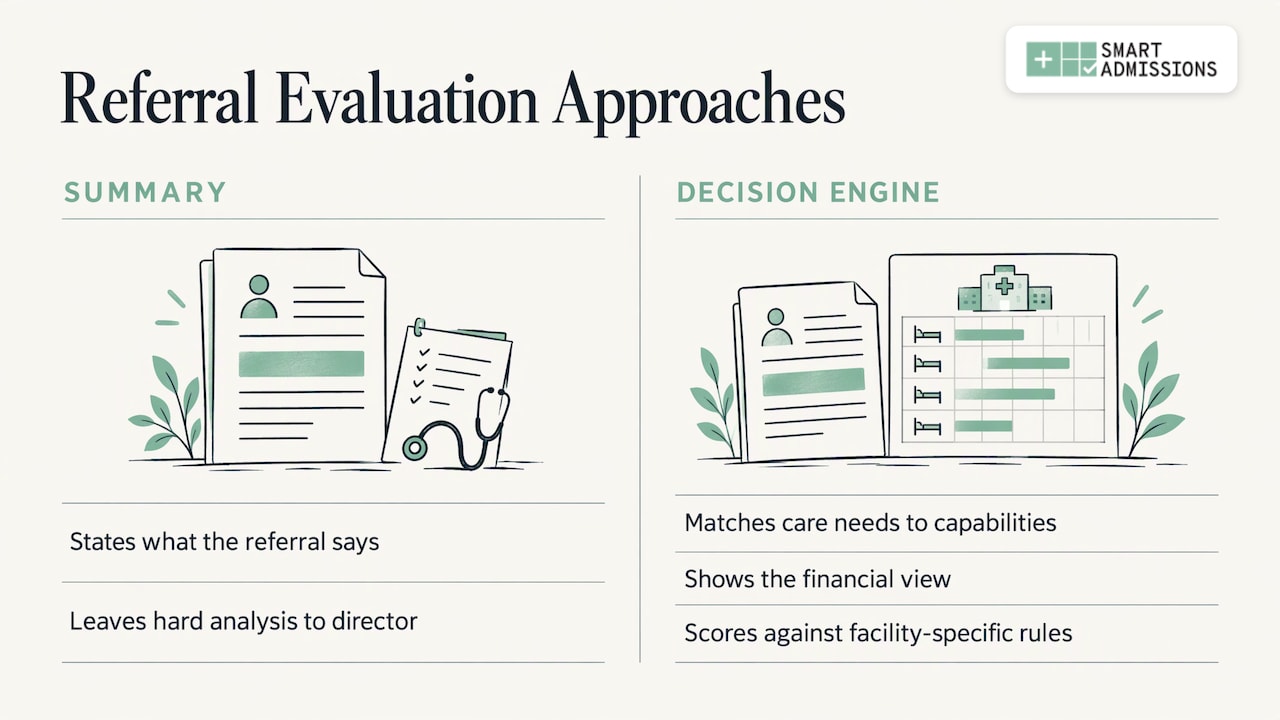
A summary tells you what the referral says. A decision engine tells you what the referral means for your building. The difference matters because the expensive mistakes in admissions are not slow replies. They are admissions your team cannot safely care for, or cannot afford to serve.
Ask every vendor to walk through one real referral and show you three things on the screen: the extracted clinical picture, the match against your capabilities, and the financial view. If the output stops at a summary, your director still does the hard analysis by hand.
Smart Admissions summarizes and scores each referral so your admissions director can answer quickly and defend the answer. Configuration matches each facility’s own rules, so a unit that cannot take certain care needs scores accordingly.
Criterion 2: Does it read every channel you receive?
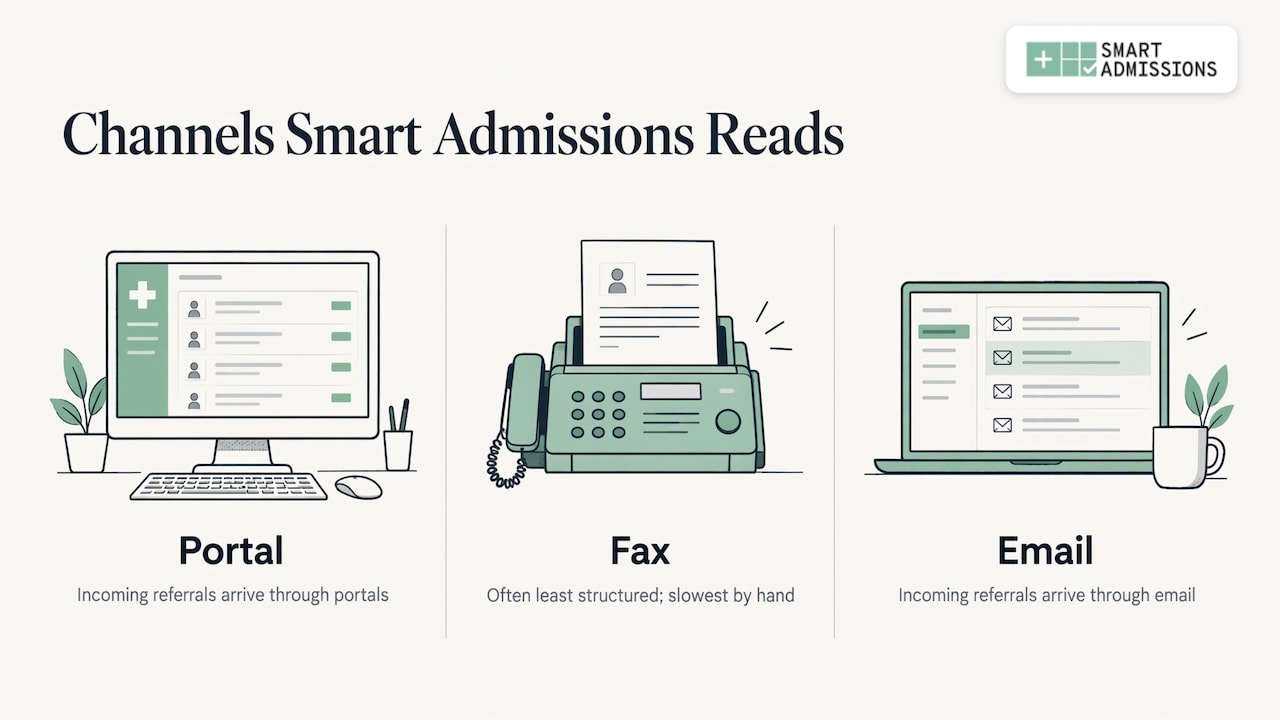
Referrals do not arrive politely through one door. Your hospital partners send them through portals, by fax and by email, and a tool that only handles one channel leaves the rest to manual work. Count how referrals reach you today, then require the platform to cover all of them.
Smart Admissions reads every incoming referral whether it arrives through a hospital portal, fax or email. This matters most for the faxed packets, which are often the least structured and the slowest to review by hand.
Criterion 3: Is reimbursement part of the score?
Under PDPM, the Patient Driven Payment Model that sets Medicare Part A payment for skilled nursing stays, the clinical details in a referral drive the payment you will receive. A referral that looks fine clinically can still be a poor fit financially, and you want to know before you accept, not after the first MDS.
PDPM-aware scoring shows the reimbursement story up front. Your admissions director sees expected reimbursement alongside payer mix, rather than discovering the gap at billing. If you want to build the habit around it, our 15 minute PDPM admission workflow and the PDPM preadmission checklist show how a team can protect day one revenue.
Criterion 4: Does it catch high-cost medications before acceptance?
A single expensive drug can turn a profitable admission into a loss, and the medication list is buried deep in most referral packets. Ask whether the platform flags high-cost medications at the review stage.
Smart Admissions includes med cost alerts that flag high-cost medications before acceptance, protecting margin on every admission. That puts the cost conversation at the moment you can still act on it, which is before the patient arrives.
Criterion 5: Does it match the referral to the right bed?
Accepting a referral is only half the job. The patient also needs the right bed, with the right roommate situation, unit and staffing. A tool that scores referrals but ignores bed availability pushes that puzzle back onto your team.
Referral-to-bed matching in Smart Admissions places the right patient in the right bed. For state veterans homes, the platform also supports DD214 review to speed eligibility decisions, which removes a common source of delay in veteran admissions. To see how bed matching connects to census, read about the referral-to-bed process and bed occupancy.
Criterion 6: Does it fit your EHR and avoid duplicate entry?
Integration is where many rollouts stall. Your staff should not retype an accepted referral into the clinical record. Ask which systems the platform connects to, and what happens to an accepted referral afterward.
Smart Admissions is EHR-independent and integrates with PointClickCare, so accepted referrals flow into existing workflows without duplicate entry. Being EHR-independent also means you are not locked into one record system to use it, which suits networks that run more than one.
Criterion 7: Can leadership see what is happening?
Administrators and owners need more than a faster inbox. They need to know where referrals come from, how quickly you respond, how many you accept and which opportunities you lose. Ask to see the reporting before you sign.
Smart Admissions gives leadership visibility into referral sources, response times, acceptance rates and lost opportunities, across one facility or an entire network. For ways to use that data, see how to analyze referral data for better bed occupancy.
Build a side-by-side vendor matrix
Putting the seven criteria on paper keeps the decision objective. LeadingAge Minnesota’s AI technology playbook recommends a side-by-side vendor matrix of features, capabilities and integrations, along with vendor-evaluation questions on AI integration, security and clinical oversight, budget guidance and an implementation plan with timelines and team responsibilities.
A simple version for your team:
| Criterion | Question to answer | Vendor A | Vendor B | Smart Admissions |
|---|---|---|---|---|
| Fit scoring | Scores against our capabilities and staffing? | Yes | ||
| Channels | Portal, fax and email? | Yes | ||
| PDPM | Reimbursement shown before acceptance? | Yes | ||
| Medication cost | High-cost drugs flagged? | Yes | ||
| Bed matching | Right patient, right bed? | Yes | ||
| Integration | Works with PointClickCare, no duplicate entry? | Yes | ||
| Reporting | Sources, response times, lost opportunities? | Yes |
Fill in the other columns from your demos. Score each cell from what you saw on the screen with your own referrals, not from a brochure.
Questions on oversight, privacy and implementation
AI in admissions touches patient information, so your evaluation should include governance questions. AHIMA’s guide to asking healthcare AI vendors smart questions advises asking whether humans oversee AI output, who is responsible for data privacy, what data the algorithms use and how potential errors are handled. It also offers a 16-item implementation checklist that covers timeline, resources, EHR integration, data migration, training, support, data quality and post-implementation monitoring, and advises confirming HIPAA compliance and encryption and authentication measures.
Turn that into a short list for every vendor call:
- Who on our team reviews and approves each recommendation before it becomes a decision?
- Who is responsible for protecting patient data, you or us?
- What is the implementation timeline and who owns each task?
- How is performance monitored after go-live?
- What training and support does your team get?
In Smart Admissions, the scoring supports your admissions director’s decision: it gives a clear summary and score so the person who knows your building makes the call. Our guide to the complete AI referral management implementation checklist for SNFs walks through the rollout step by step.
Our perspective
Admissions teams tell us the same thing: the pressure is not only to answer fast, it is to answer right. A quick yes to the wrong patient costs more than a slow reply ever did, and a quick no to a good referral is census you do not get back.
That is why we built Smart Admissions as a decision engine for one facility at a time, not a generic inbox. Your clinical capabilities, staffing, payer mix, PDPM reimbursement and open beds are the rules the referral is measured against. Med cost alerts, bed matching and PointClickCare integration follow from the same idea: do the review work before acceptance, so your director can spend time on hospital relationships instead of paperwork.
The people behind the platform have worked in admissions, MDS and reimbursement. When you compare options, ask each vendor whether they understand your daily decisions. We think the answer should show in the product.
Harry
What Smart Admissions costs and how to start
Smart Admissions is a subscription. The Monthly plan is $597 per month and the Annually plan is $6,447 per year, as published on the pricing page. Subscriptions can include a free trial period, so your team can run real referrals through the platform before committing.

If you want to see how intake, scoring and bed matching work together, how Smart Admissions works shows the flow, and you can start a free trial. Onboarding is fast and configuration matches each facility’s rules, with support from people who understand SNF operations.
How to run the comparison in two weeks
A short, structured evaluation beats an open-ended one. Here is a practical sequence:
- Week 1, define your rules. Write down the clinical needs you can and cannot meet, your target payer mix, and the medication cost threshold that worries you.
- Week 1, collect sample referrals. Pull a mix of recent portal, fax and email referrals, including a few you declined and a few that turned out costly.
- Week 2, run each vendor on the same samples. Compare the summaries, scores and reimbursement views side by side.
- Week 2, check integration and reporting. Confirm how accepted referrals reach your record system and what leadership can see.
- Week 2, review governance. Use the oversight, privacy and implementation questions above.
At the end, you will have an answer tied to your own referrals instead of marketing claims. For more comparison material, our overview of top AI referral management platforms covers the category.
FAQ
What should I look for in AI referral review for a skilled nursing facility?
Look for fit scoring against your own capabilities, staffing, payer mix, PDPM reimbursement and beds. Confirm it reads portal, fax and email referrals and connects to your record system. Reporting on response times and lost opportunities completes the picture.
Do I need to replace my EHR to use an AI referral platform?
No. Smart Admissions is EHR-independent and integrates with PointClickCare, so accepted referrals flow into existing workflows without duplicate entry. Your team keeps its current clinical record.
Does AI replace the admissions director’s decision?
No. The platform summarizes and scores each referral so your admissions director can respond with a confident yes or a defensible no. The decision stays with the person who knows your building, your staff and your hospital relationships.
How much does Smart Admissions cost?
The Monthly plan is $597 per month and the Annually plan is $6,447 per year. Subscriptions can include an optional free trial period, and current details are on the pricing page.
Can it help a state veterans home?
Yes. Along with referral scoring and bed matching, the platform supports DD214 review to speed eligibility decisions for veterans homes.
Sources
- AI Technology Solutions Playbook Preview, LeadingAge Minnesota
- 15 Smart Questions to Ask Healthcare Artificial Intelligence Vendors, AHIMA