
Every day your skilled nursing facility waits to fill an empty bed costs you money. Delayed response during referral review accounts for 35% of lost bed revenue due to extended vacancy periods. Most administrators blame insurance denials, but the real culprit is something entirely different. This article reveals the hidden bottlenecks in your referral-to-bed process and shows you how to optimize patient intake for better bed occupancy and stronger revenue.
Table of Contents
- Referral-to-Bed Workflow Fundamentals
- Role of Automation in Referral-to-Bed Process
- Insurance Verification and Eligibility Checks
- Clinical Assessments in Referral Processing
- Common Misconceptions about Referral-to-Bed Delays
- Conceptual Frameworks and Models
- Impact on Bed Occupancy and Revenue
- Optimize Your Referral-to-Bed Process with Smart Admissions
- Frequently Asked Questions About the Referral-to-Bed Process
Key Takeaways
| Point | Details |
|---|---|
| Five Core Steps | Referral-to-bed involves intake, clinical assessment, insurance verification, bed assignment, and admission scheduling. |
| Automation Impact | AI reduces referral processing time by 40% and boosts bed fill rates by 15%. |
| Clinical Assessment Value | Early clinical evaluations lower 30-day readmissions by 10%, improving patient outcomes. |
| Documentation Reality | Incomplete paperwork causes most delays, not insurance denials. |
| Occupancy Gains | Standardized processes increase bed occupancy by 12% within six months. |
Referral-to-Bed Workflow Fundamentals
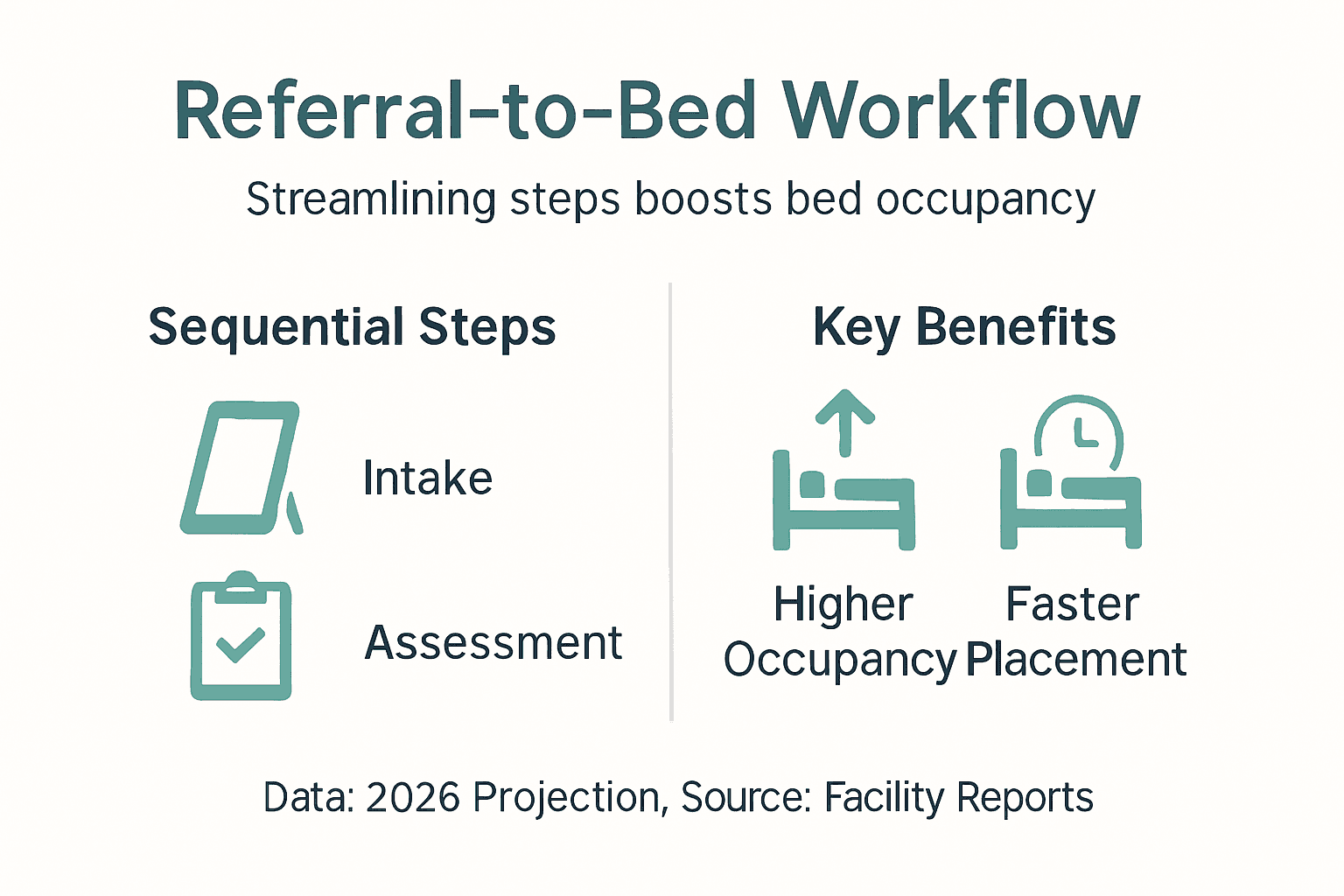
The referral-to-bed process involves systematic steps including referral intake, clinical assessment, eligibility verification, bed matching, and admission scheduling to ensure efficient patient placement. Understanding these stages helps you identify where delays occur and where improvements deliver the biggest impact.
Each step depends on coordination between your admissions coordinators and clinical staff. When these teams work in silos, handoffs slow down and information gets lost. Your admissions team receives the referral and gathers initial documentation. Clinical staff then review medical records to determine care needs and appropriate level of care. Meanwhile, administrative staff verify insurance eligibility and benefits. Once all checks clear, bed assignment happens and admission scheduling begins.
Typical Workflow Sequence:
- Referral intake and initial documentation gathering (1 to 2 days)
- Clinical assessment and care level determination (1 to 3 days)
- Insurance eligibility verification and prior authorization (2 to 4 days)
- Bed availability matching and assignment (1 day)
- Admission scheduling and patient transfer coordination (1 to 2 days)
The sequential nature of this traditional workflow means delays compound. If insurance verification takes an extra day, every subsequent step gets pushed back. This cascading effect extends vacancy periods and reduces your facility’s revenue potential. An AI referral management checklist can help you systematize these steps and reduce handoff delays.
Pro Tip: Map your current workflow with actual timestamps for each stage to identify your biggest bottlenecks before implementing changes.
Role of Automation in Referral-to-Bed Process
Automation transforms referral processing from a days-long marathon into a streamlined sprint. AI-powered systems reduce processing time by up to 40%, directly contributing to a 15% increase in bed fill rates. These aren’t theoretical numbers. Facilities implementing healthcare workflow automation see measurable improvements within weeks.
Modern referral management platforms handle tasks that previously consumed hours of staff time. Automatic document review extracts key clinical information from referral packets. Real-time eligibility checks connect directly with insurance portals to verify coverage instantly. Automated communication systems notify all stakeholders simultaneously when status changes occur.
Key Automation Features That Drive Results:
- Automatic extraction of clinical data from referral documents using optical character recognition
- Real-time insurance eligibility verification through direct payer portal integration
- Automated prior authorization tracking with alert systems for pending approvals
- Intelligent bed matching algorithms that consider clinical needs and current census
- Automated status updates to referring hospitals and case managers
Your staff shifts from manual data entry to strategic decision making. Instead of spending three hours reviewing a single referral packet, your team spends 20 minutes confirming AI-generated assessments and making final placement decisions. This efficiency gain means you can process more referrals with the same headcount, improving both capacity utilization and staff satisfaction.
Pro Tip: Start automation with your highest-volume referral sources to see the fastest return on investment and build staff confidence in the technology.
Insurance Verification and Eligibility Checks
Real-time insurance verification eliminates one of the most frustrating delays in patient placement. Traditional phone-based verification takes two to four days. Automated systems deliver results in minutes. This speed improvement reduces admission delays by approximately two days, getting patients into beds faster and generating revenue sooner.

Integrating verification directly with your EMR creates a seamless flow. When a referral arrives, the system automatically queries insurance databases and populates eligibility information into the patient record. Your team sees coverage details, benefit limits, and prior authorization requirements without leaving their workflow. This EMR integration for referral eligibility verification prevents information silos and reduces manual errors.
Critical Verification Components:
- Active coverage status and policy effective dates
- Skilled nursing facility benefit days remaining and coverage limits
- Prior authorization requirements and approval status
- Co-payment and deductible obligations
- Secondary insurance coordination when applicable
Prior authorization approvals accelerate when verification happens early. Instead of discovering authorization requirements three days into the referral process, your team identifies them immediately and submits requests right away. Payers receive complete information upfront, reducing back-and-forth requests for additional documentation.
Coordinating insurance workflow with referral intake prevents bottlenecks. When verification runs parallel to clinical assessment rather than sequentially after it, you compress the overall timeline. Some facilities cut total processing time by 30% through this simple workflow redesign.
Clinical Assessments in Referral Processing
Conducting clinical assessments early in the referral stage improves both placement accuracy and patient outcomes. Early clinical assessments reduce 30-day readmissions by 10% because they ensure patients match facility capabilities before admission. You avoid accepting referrals your facility can’t appropriately serve, which prevents costly transfers and readmissions.
Early clinical evaluation supports better patient-bed matching by identifying specialized care needs upfront. Your clinical team reviews medical history, current diagnoses, medication lists, and therapy requirements. This thorough review reveals whether the patient needs specialized wound care, behavioral health support, or ventilator management. Matching these needs to your facility’s strengths and current staffing creates successful placements.
Essential Clinical Documentation Requirements:
- Complete medical history including recent hospitalizations and diagnoses
- Current medication list with dosages and administration schedules
- Functional status assessment and therapy needs evaluation
- Infection control status including antibiotic-resistant organisms
- Behavioral health history and cognitive assessment results
Integrating clinical assessments with referral intake systems eliminates redundant data entry. Clinical staff access referral information directly in their assessment tools rather than re-entering data from paper faxes or scattered email attachments. This integration saves time and reduces transcription errors that can compromise patient safety.
Pro Tip: Schedule a daily coordination meeting between admissions and clinical teams to review pending referrals together, aligning administrative readiness with clinical capability in real time.
Common Misconceptions about Referral-to-Bed Delays
Many administrators believe insurance denials cause most referral delays, but delays often occur due to incomplete documentation rather than insurance denials. Missing physician orders, incomplete medication lists, and absent therapy assessments stall referrals far more frequently than coverage issues. Fixing documentation processes delivers faster results than negotiating with payers.
Referral-to-bed delays stem largely from administrative workflow issues, not clinical complexity. Your clinical team can assess complex patients quickly when they have complete information. Administrative bottlenecks, duplicate data entry, and manual communication create the real delays. Process redesign addressing these administrative inefficiencies yields bigger improvements than adding clinical staff.
Common Mistaken Assumptions:
- Insurance denials cause most delays (reality: incomplete documentation is the main culprit)
- Technology alone solves referral delays (reality: process redesign and staff training are equally critical)
- Clinical complexity drives long processing times (reality: administrative workflow inefficiencies create most delays)
- Adding more staff improves speed (reality: optimizing existing workflows often delivers better results)
“We thought our delay problem was clinical. We hired another nurse. Nothing improved. Then we mapped our actual workflow and discovered the real issue was three different people entering the same data into disconnected systems. We fixed that and cut our processing time in half.” – Director of Admissions, 250-bed skilled nursing facility
Communication breakdowns contribute significantly to referral lag time. When your admissions coordinator emails the clinical team, who then calls the insurance verification specialist, who leaves a voicemail for the bed assignment coordinator, information gets lost. Critical updates don’t reach decision makers. These common SNF admission inefficiencies compound delays and frustrate referring partners who expect timely responses.
Conceptual Frameworks and Models
Integrated workflow models illustrate how parallel processing shortens intake time dramatically. Traditional sequential workflows process one step at a time. Integrated models run eligibility verification, clinical assessment, and bed availability checks simultaneously. This parallel approach reduces total processing time by about 30% without requiring additional staff.
Coordinated team roles and IT integration support this compressed timeline. Your admissions coordinator triggers all three parallel processes when a referral arrives. Clinical staff access the referral in their assessment system. Insurance verification runs automatically in the background. Bed management staff see real-time census updates showing availability. Everyone works simultaneously on their piece rather than waiting in sequence.
| Workflow Aspect | Traditional Sequential Model | Integrated Parallel Model |
|---|---|---|
| Processing approach | Each step waits for previous step completion | Multiple steps run simultaneously |
| Average timeline | 7 to 10 days | 4 to 6 days |
| Staff coordination | Handoffs between isolated teams | Shared real-time information access |
| Technology role | Basic data storage | Active workflow orchestration |
| Bottleneck impact | Delays cascade through entire process | Parallel paths minimize compounding delays |
IT systems supporting real-time data flow enable this parallel processing. When all team members access a shared platform showing current status, they coordinate naturally without meetings or email chains. Updates appear instantly for everyone. Your clinical team sees that insurance verification completed while they work on assessment. Bed assignment staff know when both clinical and insurance approvals clear. This visibility prevents duplicate work and eliminates waiting periods. Optimizing your intake process requires both workflow redesign and technology that supports parallel operations.
Impact on Bed Occupancy and Revenue
Streamlined referral-to-bed processes produce measurable financial improvements. Facilities implementing standardized referral workflows see bed occupancy increase by 12% within six months. This occupancy gain translates directly to revenue growth. A 120-bed facility averaging 85% occupancy improves to 97% occupancy, adding 14 occupied beds daily.
Financial losses from delayed referrals reach staggering levels. Delayed response during referral review causes up to 35% of lost bed revenue through extended vacancy periods. Each day a bed sits empty while you process paperwork costs your facility the daily rate. Multiply that across multiple beds and weeks of unnecessary delays, and you see six-figure annual losses.
| Metric | Before Process Improvement | After Process Improvement | Change |
|---|---|---|---|
| Average referral processing time | 8 days | 5 days | 37% reduction |
| Bed occupancy rate | 85% | 97% | 12 percentage points |
| Average vacant days per bed annually | 55 days | 11 days | 80% reduction |
| Revenue per bed (annual) | $82,125 | $93,075 | $10,950 increase |
Quantifiable Benefits of Streamlined Processes:
- Reduced vacancy days increase annual revenue per bed by over $10,000
- Faster revenue cycles improve cash flow and reduce accounts receivable aging
- Better patient throughput increases annual admission volume by 15% to 20%
- Improved referring partner satisfaction generates more referral volume
- Enhanced staff efficiency reduces overtime costs and improves retention
These improvements compound over time. Higher occupancy improves your cost structure because fixed costs spread across more patient days. Better throughput means you can accept more referrals from preferred payer sources. Referring hospitals notice your quick response times and send more patients your way. Enhanced referral tracking helps you measure these gains and identify further optimization opportunities.
Optimize Your Referral-to-Bed Process with Smart Admissions
You’ve seen how automation, parallel processing, and integrated workflows transform referral management. Smart Admissions delivers these capabilities in a platform built specifically for skilled nursing facilities. Our AI-powered system automates document review, provides real-time insurance verification through direct payer integration, and coordinates clinical assessments with bed assignment in one seamless workflow.
Healthcare administrators using our platform reduce referral processing time by 40% within the first month. Real-time eligibility checks eliminate two-day waiting periods. Automated bed matching considers clinical needs and current census to suggest optimal placements instantly. Your team focuses on patient care while our technology handles repetitive administrative tasks. Explore our referral management solutions to see how we help facilities increase bed occupancy and revenue. Review referral management system examples showing real implementations, or dive deeper into our healthcare workflow automation tools designed specifically for post-acute care providers.
Frequently Asked Questions About the Referral-to-Bed Process
Why does the referral-to-bed process often cause delays despite insurance approvals?
Incomplete documentation creates most delays, not insurance issues. Missing physician orders, partial medication lists, and absent therapy assessments stall referrals even when coverage is confirmed. Administrative workflow bottlenecks and manual handoffs between disconnected systems compound these documentation problems.
What technology features most effectively speed up referral processing?
Automatic document extraction using AI, real-time insurance eligibility verification through direct payer integration, and intelligent bed matching algorithms deliver the biggest speed improvements. These features eliminate manual data entry and waiting periods. Shared platforms providing real-time status visibility to all team members prevent coordination delays.
How can early clinical assessments reduce hospital readmissions?
Early clinical assessments ensure patients match your facility’s capabilities before admission, reducing inappropriate placements that lead to readmissions. Thorough upfront review identifies specialized care needs like wound care or behavioral health support. This matching prevents accepting patients you can’t appropriately serve, avoiding transfers and readmissions within 30 days.
What are the best practices to integrate insurance verification with EMR systems?
Direct API connections between your EMR and insurance portals enable automatic eligibility queries when referrals arrive. Verification results populate directly into patient records without manual entry. Set up automated alerts for prior authorization requirements so staff submit requests immediately. Configure daily batch verification for pending admissions to catch coverage changes.
How quickly can improvements in the referral-to-bed process impact bed occupancy rates?
Facilities implementing standardized workflows with automation see measurable occupancy improvements within six months, with many noticing changes in the first 90 days. The speed of impact depends on your current baseline and implementation thoroughness. Quick wins like parallel processing of verification and assessment deliver immediate timeline compression. Sustained occupancy gains around 12% typically materialize within six months as workflow changes become routine.