
TL;DR:
- Automating referral triage and eligibility checks significantly reduces intake time and errors.
- Standardized documentation processes ensure compliance and prevent delays during admission.
- Continuous metric tracking and staff training are crucial for sustainable workflow improvements.
Every hour a referral sits unreviewed is an hour your beds stay empty and your revenue stalls. For skilled nursing facilities and rehabilitation centers, slow admissions workflows are not just an inconvenience; they are a measurable financial liability. AI and automation reduce manual referral processing from 45 minutes to just 5 minutes, cutting total intake time from 12 hours to under 2 hours and saving facilities roughly $700 per month. This guide walks your team through a practical, step-by-step approach to assessing your current process, applying the right automation tools, standardizing documentation, and tracking the metrics that prove your progress.
Table of Contents
- Assess your current admissions workflow
- Leverage automation and AI for faster, error-free intake
- Standardize documentation and compliance
- Monitor metrics and continuously improve
- The truth most admissions optimization guides miss
- Take your admissions workflow to the next level
- Frequently asked questions
Key Takeaways
| Point | Details |
|---|---|
| Map and benchmark workflows | Assess your current admissions process to identify delays and set measurable improvement targets. |
| Automate intake steps | Adopt AI and digital tools to slash processing times and reduce errors across referral management and onboarding. |
| Standardize documentation | Use checklists, templates, and e-forms for reliable, compliant documentation every time. |
| Track and improve metrics | Monitor KPIs like response time and occupancy to drive ongoing process refinement and measurable ROI. |
| Prioritize people and networks | Complement automation with robust staff training and inter-facility collaboration for best results. |
Assess your current admissions workflow
With the stakes clear, your first step is to get a sharp, unbiased view of your facility’s actual admissions processes. You cannot fix what you have not measured, and most facilities underestimate how many handoffs, format mismatches, and communication gaps slow their intake down.
Start by mapping your workflow from the moment a referral arrives to the day a patient moves in. Identify every step, every person involved, and every tool used. Then collect your baseline metrics so you have real numbers to improve against.
Key metrics to gather:
- Average referral response time (target: under 2 hours in competitive markets)
- Referral acceptance and rejection rates
- Bed days lost per month due to delayed admissions
- Documentation error rates and rework frequency
- Staff hours spent on manual data entry per week
Once you have those numbers, look for workflow evaluation tips to identify where delays cluster. Common bottlenecks include receiving referrals in multiple formats (fax, email, portal), manually verifying insurance eligibility, and chasing missing clinical documents across departments.
| Workflow area | Common tool | Staff role | Bottleneck risk |
|---|---|---|---|
| Referral receipt | Fax, email, EHR portal | Admissions coordinator | Format inconsistency, missed referrals |
| Eligibility verification | Phone, insurance portal | Billing specialist | Manual lookup delays, errors |
| Clinical assessment | Paper forms, EHR | DON, charge nurse | Incomplete data, slow turnaround |
| Agreement signing | Paper, PDF | Admissions director | Lost documents, compliance gaps |
| Move-in coordination | Phone, whiteboard | Charge nurse, social worker | Communication lags, last-minute changes |
Compare your results against industry benchmarks to understand where your facility stands relative to peers. Facilities that assess workflows to spot delays such as manual data entry errors and communication lags consistently find two to three major bottleneck areas that account for the majority of lost time.
Pro Tip: Before purchasing any technology, interview your front-line admissions staff. They see the real friction points daily and can tell you exactly where the process breaks down in ways that no flowchart will reveal.
Leverage automation and AI for faster, error-free intake
Once you see your weakest workflow links, you are ready to implement tools that directly eliminate them. Automation does not replace your team; it removes the repetitive, error-prone tasks that slow them down and cause burnout.
Here is a step-by-step sequence for applying automation to your intake process:
- Automate referral triage. Use AI-powered tools with optical character recognition (OCR) to read faxed and emailed referrals, extract patient data, and route them to the right staff member automatically.
- Automate eligibility verification. Integrate your admissions platform with insurance portals to run real-time benefit checks the moment a referral arrives, eliminating manual phone calls.
- Automate clinical data requests. Set up automatic document request triggers when a referral is incomplete, reducing back-and-forth with hospitals and discharge planners.
- Automate agreement delivery and e-signature. Send admission agreements digitally and collect signatures without printing, scanning, or chasing paper.
- Automate reminders and follow-ups. Schedule automated nudges for pending referrals, missing documents, and unsigned agreements so nothing falls through the cracks.
The impact of AI in admissions is well documented. Facilities using AI and automation reduce bottlenecks by 75% and achieve near-100% data accuracy, compared to the error rates common in manual entry workflows.

| Process step | Manual time | Automated time | Accuracy improvement |
|---|---|---|---|
| Referral processing | 45 minutes | 5 minutes | Significant error reduction |
| Eligibility verification | 20 minutes | 2 minutes | Near-100% accuracy |
| Document collection | 2 to 4 hours | 30 minutes | Fewer missing items |
| Agreement signing | 1 to 2 days | Same day | Full audit trail |
Reviewing a manual vs. automated comparison for your specific facility type helps you build a business case for leadership. Pair that with automation efficiency data to prioritize which steps to tackle first.
Pro Tip: Automate repetitive forms and follow-up reminders, but always keep a human in the loop for clinical edge cases, insurance disputes, and complex patient situations where judgment matters.
Standardize documentation and compliance
Automation speeds up intake, but standardizing your paperwork processes is what locks in long-term wins and compliance. Inconsistent documentation is one of the top reasons admissions get delayed, denied, or flagged during audits.
Every admission at your facility should trigger the same core document checklist, regardless of which staff member handles it. Here is how to build that consistency:
- Define your required document set. For every admit, specify the clinical documents (physician orders, medication reconciliation, functional assessment), financial documents (insurance authorization, payer source verification), and legal documents (advance directives, consent forms, HIPAA acknowledgment).
- Create standardized templates. Develop fillable digital templates for each document type so staff are never starting from a blank page. Templates reduce errors and speed up completion.
- Use dynamic forms. Configure your admissions platform to trigger the correct paperwork based on referral type, payer source, or clinical complexity. A Medicare patient and a private-pay patient need different document sets; dynamic forms handle that automatically.
- Centralize document storage. Store all admission documents in a single, searchable digital location linked to the patient record in your EHR system. This eliminates the risk of lost paperwork and simplifies audit preparation.
- Audit your documentation monthly. Review a sample of recent admissions for completeness and accuracy. Use findings to update templates and retrain staff where gaps appear.
Access a practical intake documentation guide to build your facility’s core document checklist from a proven framework.
“Intelligent Agreement Management, including eSign and dynamic forms, streamlines onboarding, reduces errors, and improves compliance for long-term care facilities.” This approach reduces the administrative burden on staff while creating a consistent, defensible record for every patient admitted.
Monitor metrics and continuously improve
System changes mean little without measurable impact. Here is how to stay on track and scale your progress over time.
Tracking the right key performance indicators (KPIs) gives your team a clear signal when the workflow is working and an early warning when something slips. Focus on these metrics:
- Referral response time: Are you consistently responding within 2 hours? In competitive markets, referral response under 2 hours is a decisive factor in winning admissions over competing facilities.
- Referral acceptance rate: A rising acceptance rate signals better referral-to-capacity matching and faster clinical review.
- Bed occupancy rate: Track empty bed days per month and set a reduction target. Facilities using optimized workflows report a 15 to 20% reduction in empty bed days within the first 90 days.
- Documentation error rate: Monitor how often admissions require rework due to missing or incorrect paperwork.
- Readmission rates: Every preventable readmission costs your facility over $2,000 in avoidable expenses. Tracking this metric helps you identify gaps in discharge planning and post-acute coordination.
Use your admissions platform’s workflow analytics dashboard to review these KPIs weekly, not just at month-end. Real-time visibility lets your team course-correct quickly rather than discovering problems after the damage is done.
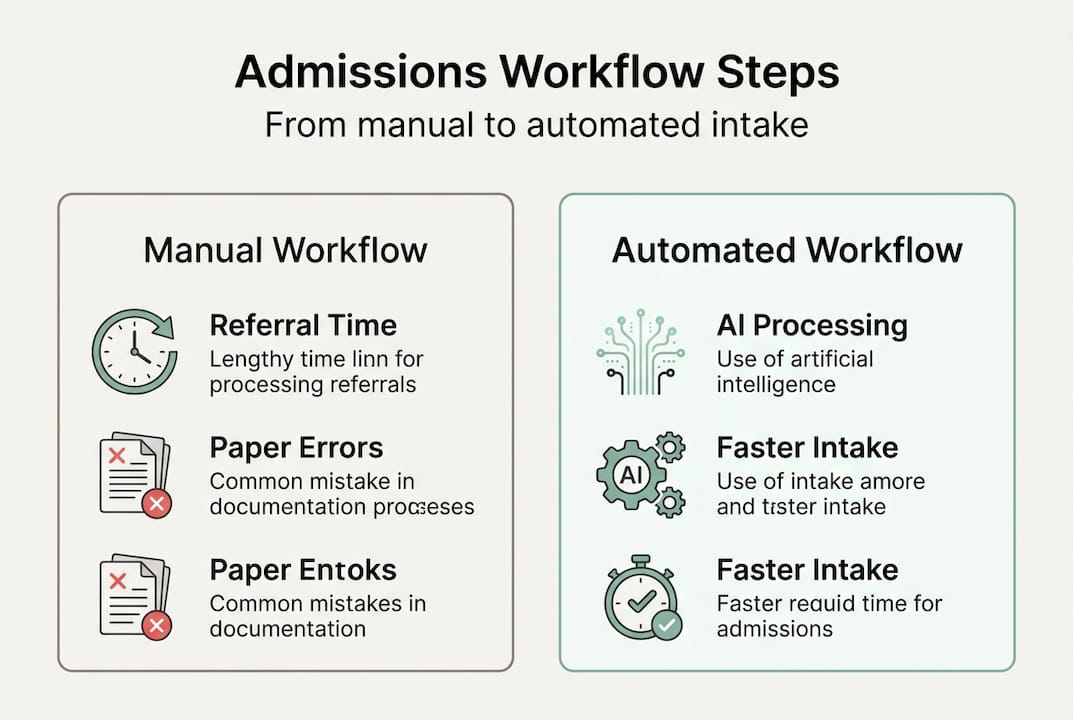
Applying analytics best practices from healthcare operations research shows that predictive insights, such as forecasting referral volume by day of week, help facilities staff appropriately and avoid bottlenecks before they form. Collect feedback from admissions staff and recently admitted patients quarterly to surface process friction that metrics alone may not capture.
The truth most admissions optimization guides miss
Most guides focus almost entirely on technology selection, as if choosing the right software guarantees better outcomes. It does not. The facilities that see the biggest, most sustained improvements are the ones that invest equally in staff adaptation and cross-organization collaboration.
Your admissions coordinator who has worked the same manual process for eight years will not automatically embrace a new platform on day one. Change management, structured training, and visible leadership support are what turn a software rollout into a real workflow transformation. Network participation outperforms isolated automation; real-world results require fiscal investment, staff buy-in, and collaboration across organizations, not just a software subscription.
Facilities that participate in referral networks and transitional care management (TCM) programs consistently outperform those relying on automation alone. Those relationships with hospital discharge planners, case managers, and ACO partners generate referral volume that no internal tool can replicate.
Phased implementation also matters more than most guides acknowledge. Rolling out automation in stages, starting with referral triage, then eligibility, then documentation, gives your team time to adapt and lets you maintain human oversight for exceptions throughout the transition.
Pro Tip: Budget as much time and resources for staff onboarding and training as you do for the technology itself. The platform is the tool; your team is what makes it work.
Take your admissions workflow to the next level
Your facility now has a clear roadmap: assess your current process, automate the right steps, standardize your documentation, and track the metrics that matter. The next move is putting those steps into practice with tools built specifically for skilled nursing and rehabilitation admissions.
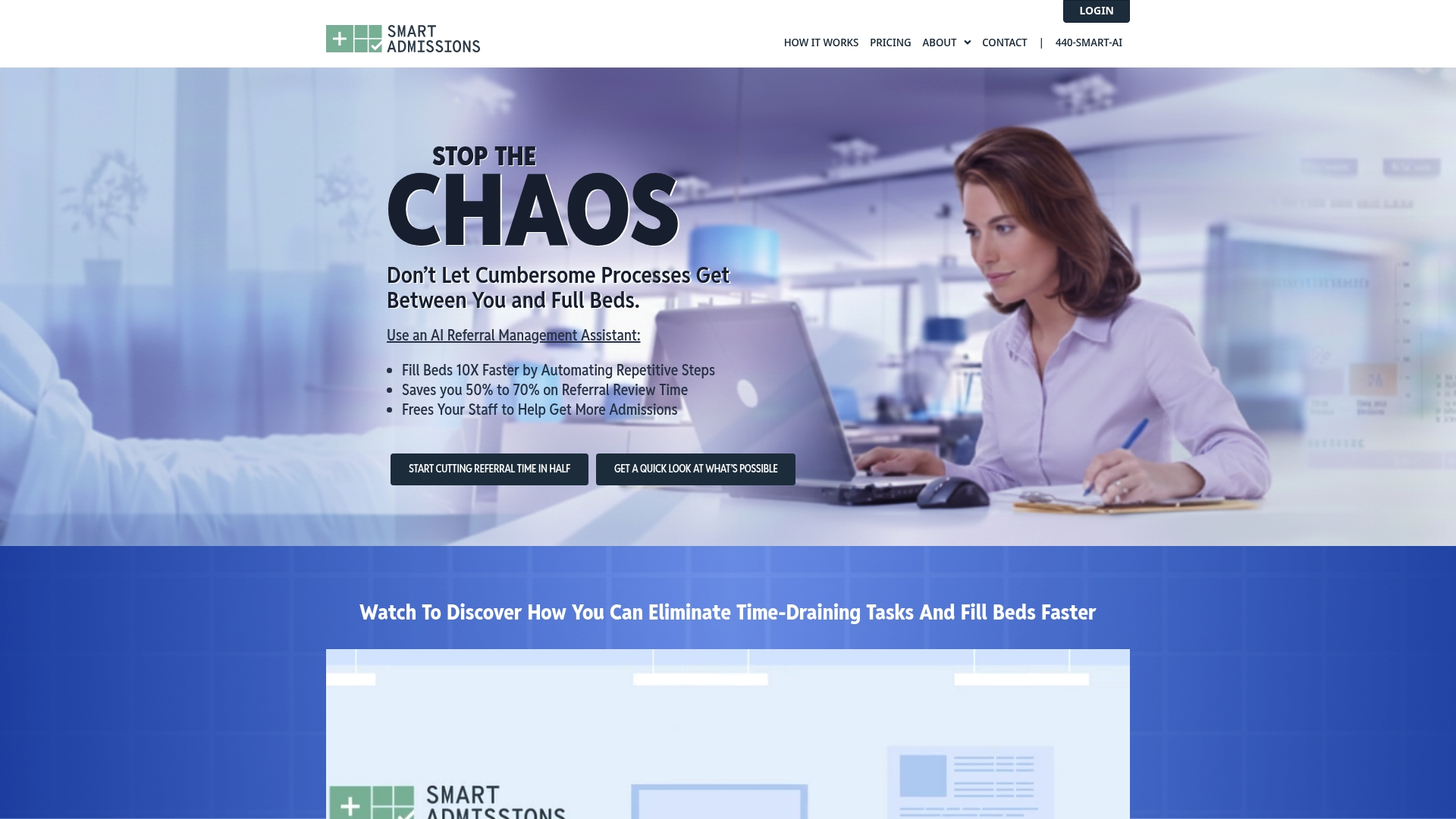
Smart Admissions gives your team AI-powered referral management, real-time eligibility verification, and automated documentation workflows in one platform designed for SNFs and rehab centers. Explore how faster bed occupancy is achievable with the right automation foundation. See real-world referral management examples from facilities like yours, and learn how intake automation can reduce your team’s manual workload starting on day one.
Frequently asked questions
What is the fastest way to eliminate admissions bottlenecks?
Automating referral triage and eligibility checks with AI tools is the most impactful first step. These two areas account for the largest share of manual time, and AI reduces processing time by over 90%.
How does automation impact regulatory compliance in SNFs?
Automation, especially with e-signature and dynamic forms, reduces documentation errors and strengthens your audit trail. eSign and dynamic forms streamline onboarding and directly improve compliance with long-term care standards.
What KPIs should admissions directors track for workflow improvement?
Focus on referral response time, acceptance rate, bed occupancy, documentation error rate, and readmission rates. Real-time tracking of referral and occupancy metrics is essential for continuous optimization in competitive markets.
Do SNFs need both tech upgrades and staff training?
Absolutely. Technology alone does not deliver results without staff buy-in and structured training. Human oversight remains necessary for exceptions even when 90% of routine tasks are automated.