
TL;DR:
- Most SNF admissions teams treat eligibility as a simple insurance check, but it involves comprehensive operational verification.
- Implementing structured, multi-stage workflows for verifying both insurance coverage and clinical criteria reduces errors, denials, and compliance risks.
Most admissions teams treat patient eligibility as a quick insurance check before a patient walks through the door. That assumption is costing your facility denied claims, compliance gaps, and delayed bed fills. Eligibility is actually a multi-layered operational process that governs who qualifies for your services, what coverage applies, and whether your documentation will hold up under audit. This guide breaks down every dimension of eligibility verification relevant to skilled nursing facilities (SNFs) and rehabilitation centers, and shows your team exactly how to operationalize it at each stage of intake.
Table of Contents
- Understanding patient eligibility: More than insurance coverage
- Eligibility verification workflow: Key touchpoints and best practices
- Payer-based rules: Medicare Part A and SNF eligibility criteria
- Eligibility, compliance, and documentation: Preventing downstream risks
- A new approach: Operationalizing eligibility for speed and accuracy
- Connect eligibility processes with smarter admissions solutions
- Frequently asked questions
Key Takeaways
| Point | Details |
|---|---|
| Beyond insurance | Patient eligibility includes both coverage and program-specific intake criteria. |
| Repeat verification is vital | Eligibility checks must occur at multiple touchpoints to avoid errors and denials. |
| Payer rules vary | Medicare and other payers have distinct eligibility conditions you must know. |
| Compliance starts at intake | Accurate eligibility upfront reduces compliance risks and costly rework. |
| Structured and automated workflows | Operationalizing and automating eligibility checks boosts speed and accuracy. |
Understanding patient eligibility: More than insurance coverage
When admissions staff hear “eligibility,” most think about calling an insurance company to confirm active coverage. That is part of it, but only a small part. Eligibility verification in post-acute care also includes confirming whether a patient meets the clinical and program-specific criteria required for admission.
As Hospital at Home guidance makes clear, eligibility verification is distinct from insurance status alone and includes operational criteria such as inclusion and exclusion requirements for specific care programs. For your SNF or rehab center, this means your team must evaluate both financial coverage and clinical appropriateness before confirming a bed.
“Eligibility is the gatekeeper to service access. Without accurate verification across both insurance and program criteria, your facility risks admitting patients it cannot legally or financially serve.”
Common eligibility checks your team should run at intake include:
- Insurance status: Active coverage, plan type (Medicare Part A, Medicaid, commercial), and benefit period status
- Program requirements: Qualifying hospital stays, clinical diagnoses, and care level justifications
- Benefit limits: Days remaining in a benefit period, prior authorization status, and co-pay obligations
- Exclusion criteria: Managed care carve-outs, geographic restrictions, or payer-specific service exclusions
Facilities that also verify employee benefits utilization patterns in their payer contracts report fewer mid-stay surprises when coverage limits are reached unexpectedly.
Pro Tip: Build a dual-column eligibility checklist for every admission. One column addresses insurance verification, and the other covers program-specific criteria. This ensures your team never skips a required check because they assumed coverage equaled eligibility.
Operationalizing this broader view of eligibility requires structured screening protocols. That means documented workflows, defined roles for who runs each check, and a clear escalation path when eligibility data is incomplete or conflicting.
Eligibility verification workflow: Key touchpoints and best practices
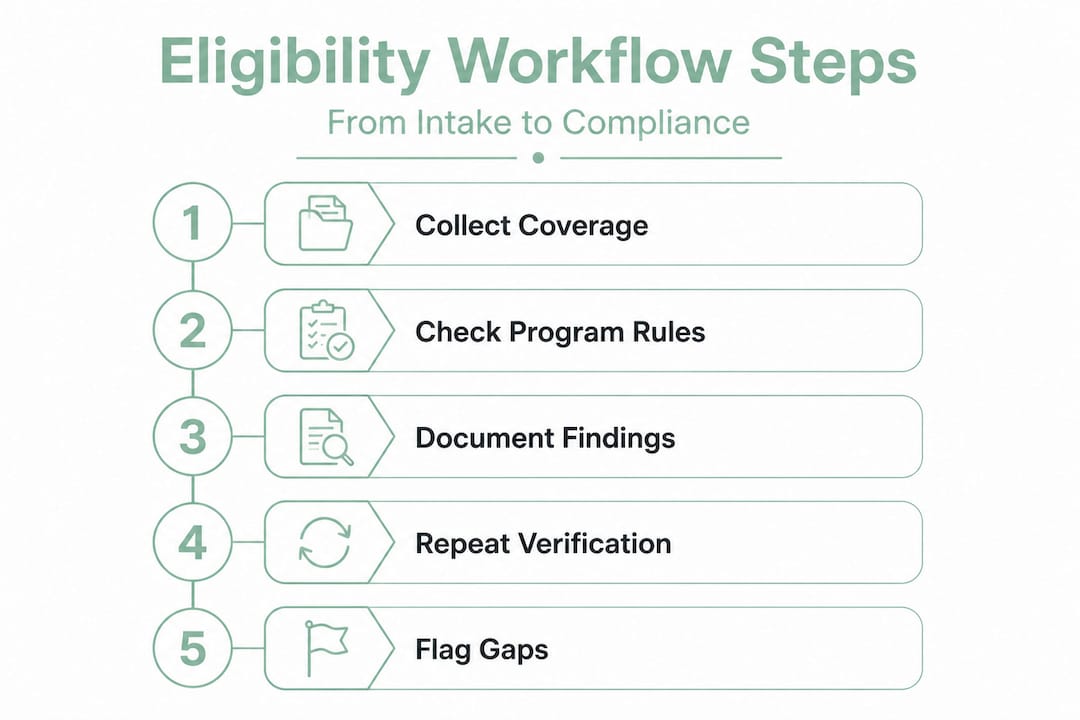
Your eligibility verification process should not happen once and then get filed away. Eligibility checks must be repeated at multiple points during scheduling, pre-admission, and before the service date to ensure data remains current. Coverage details change. Benefit periods reset or expire. Patients change plans without notifying your facility.
Here is the standard sequential workflow your admissions team should follow:
- Scheduling: Run an initial insurance eligibility check as soon as a referral arrives. Confirm that the payer is active and that the patient has days remaining in the benefit period.
- Pre-admission review: Conduct a deeper clinical and program eligibility review. Confirm the qualifying hospital stay, diagnosis codes, and care level requirements.
- Registration: Verify coverage a second time at registration to catch any changes that occurred between the referral and admission date.
- Service date confirmation: Run a final eligibility check on or just before the service date. This step catches last-minute plan changes or benefit exhaustion.
Reviewing your step-by-step intake process against these touchpoints helps your team identify gaps in current verification practices.
| Stage | Purpose | Tools used |
|---|---|---|
| Scheduling | Confirm active coverage and benefit period | Insurance portals, eligibility APIs |
| Pre-admission | Verify clinical and program criteria | EMR review, clinical screening tools |
| Registration | Update and re-confirm insurance data | Clearinghouses, payer portals |
| Service date | Final coverage and benefit validation | Real-time eligibility checks |
Streamlining administrative tasks in this workflow reduces manual errors and the time your team spends chasing down outdated information. Facilities that streamline digital claims alongside eligibility verification report faster reimbursement cycles.

Pro Tip: Automate eligibility checks at the scheduling and service date stages using real-time verification tools. Manual lookups at these points are the most common source of outdated data errors that lead to claim denials.
When your team treats eligibility verification as a repeatable, structured process rather than a one-time task, you dramatically reduce the risk of admitting patients whose coverage has lapsed or whose program criteria were never fully confirmed.
Payer-based rules: Medicare Part A and SNF eligibility criteria
Medicare Part A is the most common payer for SNF admissions, and its eligibility criteria are among the most specific. Understanding these rules prevents costly denials and ensures your team identifies qualified patients quickly.
According to Medicare SNF criteria, coverage requires all of the following:
- The patient must have had an inpatient hospital stay of at least 3 consecutive days (not counting the discharge date)
- The patient must be admitted to the SNF within 30 days of leaving the hospital
- The patient must require skilled nursing or therapy services
- Days must remain in the patient’s current benefit period
These rules mean a patient discharged after an observation stay, rather than a full inpatient admission, would not meet Medicare Part A criteria regardless of their clinical needs. Your admissions team must verify the admission type before assuming Medicare will cover the stay.
Eligibility rules vary significantly by payer type. Here is a comparison of the key differences your team should know:
| Feature | Medicare Part A | Medicaid | Commercial payer |
|---|---|---|---|
| Qualifying stay required | Yes (3-day inpatient) | Varies by state | Rarely required |
| Prior authorization | Not for initial admission | Often required | Usually required |
| Benefit limits | 100 days per benefit period | Varies; often no day limit | Plan-specific |
| Care level documentation | Skilled care required | Often broader criteria | Plan-dependent |
| Copay structure | Days 1-20 fully covered; days 21-100 copay applies | Minimal or no copay | Variable |
Beyond Medicare and Medicaid, your team should be aware of program-specific rules that affect other payer types:
- Managed care plans may carve out SNF services or require network-specific facilities
- Veterans Administration (VA) payers follow separate clinical and eligibility standards; verifying veteran eligibility requires additional documentation steps your team must be trained to handle
- Dual-eligible patients (Medicare and Medicaid) require coordination of benefits verification to determine which payer is primary and what cost-sharing applies
- Commercial plans for post-acute care often include detailed pre-authorization requirements and specific clinical criteria for SNF admission approval
Studies indicate that a significant share of SNF claim denials trace directly back to eligibility oversights at intake, including missed qualifying stay requirements, expired benefit periods, and incorrect payer primary assignments. Even a small reduction in these errors translates to measurable revenue recovery for your facility.
Eligibility, compliance, and documentation: Preventing downstream risks
The discipline your team applies at the front end of admissions has a direct impact on your facility’s compliance posture and revenue cycle performance. Eligibility errors made at intake become documentation problems that surface during audits, Minimum Data Set (MDS) validations, and claims reviews months later.
As CMS SNF validation program FAQs confirm, eligibility and documentation discipline at intake reduce later rework and compliance risk. CMS reviews SNF data accuracy as part of its validation program, which means your admissions records must support every clinical and financial claim your facility makes.
“CMS SNF validation reviews treat intake documentation as the foundation for compliance. Eligibility errors at admission create a chain of downstream data inaccuracies that are difficult and costly to correct after the fact.”
Common compliance pitfalls that start with eligibility failures include:
- Missed MDS data: When eligibility criteria are not confirmed at intake, MDS assessments may reference incorrect admission dates, wrong payer categories, or unsupported care levels
- Denied claims: Incomplete eligibility verification leads to claims submitted under the wrong benefit period or without required qualifying stay documentation
- Billing errors: Incorrect payer assignment at intake results in claims sent to secondary payers before primary coverage is confirmed, triggering coordination of benefits disputes
- Audit exposure: Facilities with inconsistent eligibility records at admission are more likely to receive additional documentation requests during CMS audits and third-party reviews
- Revenue cycle delays: Eligibility errors identified post-discharge require retroactive verification, appeals preparation, and resubmission, all of which consume staff time and delay reimbursement
Solid SNF documentation management practices, when paired with thorough eligibility verification at every intake touchpoint, give your facility a defensible record from day one. Your team’s goal should be to ensure that every clinical note, MDS entry, and billing record connects back to confirmed eligibility data captured at admission.
The financial case for this discipline is straightforward. Every denied claim requires staff time to appeal and resubmit. Every audit finding requires documentation responses. These costs are avoidable when eligibility is treated as a structured, verified process rather than a formality.
A new approach: Operationalizing eligibility for speed and accuracy
Most SNF and rehab admissions teams understand that eligibility matters. The problem is execution. Manual eligibility checks depend on individual staff knowledge, portal access, and the time available between referral calls and admission deadlines. This creates inconsistency, and inconsistency creates risk.
The hard truth is that manual eligibility processes do not fail because your team lacks competence. They fail because the volume of checks required across multiple payers, multiple intake stages, and multiple documentation requirements is too high for manual methods to handle reliably at scale.
What most admissions teams overlook when trying to improve their eligibility process includes:
- Re-verification gaps: Teams verify at scheduling but skip the pre-service check, missing coverage changes that occurred in the interim
- Data-sharing gaps between referral sources: Referring hospitals often provide incomplete insurance data, and teams accept it at face value rather than independently verifying
- Audit trail deficiencies: Teams run eligibility checks verbally or through portal screens without documenting the result, leaving no record to support a denied claim appeal
- Single-payer tunnel vision: Teams focus on the primary payer and miss secondary coverage or coordination of benefits issues that affect final reimbursement
The solution is not to hire more staff. It is to restructure eligibility into a documented, automated workflow with clear accountability at each intake touchpoint. Structured checklists reduce variation. Automation reduces the time each check takes. Healthcare workflow automation applied specifically to eligibility verification creates a repeatable, audit-ready process that does not depend on any one person’s institutional knowledge.
Pro Tip: Integrate eligibility verification into every defined intake touchpoint in your admissions workflow, not just the first call. Assign ownership for each verification stage and document the result in your EMR or admissions platform with a timestamp. This creates an audit trail that protects your facility and accelerates appeals when denials occur.
Facilities that operationalize eligibility this way report faster admission decisions, fewer surprise denials, and stronger audit performance. The shift from ad hoc verification to structured, automated eligibility management is one of the highest-return operational improvements available to SNF and rehab admissions teams today.
Connect eligibility processes with smarter admissions solutions
Your team now has a clear picture of what thorough eligibility verification requires, from multi-stage workflows and payer-specific rules to compliance documentation and automation strategies. The next step is applying that knowledge through tools designed specifically for skilled nursing and post-acute care admissions.
Smart Admissions gives your team a purpose-built platform that integrates eligibility verification directly into your intake workflow. Real-time eligibility checks, EMR integration, and automated documentation reduce the manual work that slows your admissions team down. Facilities using automated admissions see 20% faster bed occupancy and fewer eligibility-related denials. Use our intake documentation guide to align your documentation practices with your verification workflow, and explore referral management systems that keep your pipeline moving without the bottlenecks.
Frequently asked questions
How does patient eligibility verification differ from prior authorization?
Eligibility verification and prior authorization are distinct processes: eligibility confirms that a patient has active coverage and available benefits, while prior authorization is a separate request to the payer for approval of a specific service before care is delivered.
What are Medicare Part A eligibility criteria for SNF care?
Patients must have a qualifying inpatient hospital stay of at least 3 days, days remaining in their benefit period, and must be admitted to the SNF within 30 days of their hospital discharge.
Why are eligibility checks repeated during the patient intake process?
Coverage details and benefit limits can change between the referral date and the service date, so repeating eligibility checks at each intake stage ensures your facility works from current, accurate information and reduces the risk of claim denials.
How does eligibility verification impact compliance in skilled nursing facilities?
Accurate front-end eligibility checks create the documentation foundation required for MDS accuracy, audit readiness, and correct billing, and eligibility discipline at intake directly reduces downstream compliance risk and the costly rework that follows denied or flagged claims.