
TL;DR:
- Automation can significantly reduce referral review time and improve bed occupancy.
- Key workflow stages include referral aggregation, AI scoring, eligibility checks, and EHR synchronization.
- Successful implementation requires staff training, system integration, and ongoing performance monitoring.
Every delayed referral response is a missed admission. For skilled nursing facilities and rehabilitation centers, admissions bottlenecks translate directly into lower census numbers, lost reimbursement, and staff stretched thin across repetitive manual tasks. When your team spends 60 to 90 minutes reviewing a single referral by hand, the cost compounds fast. This guide walks you through every stage of a modern admissions reporting workflow, from referral receipt to care handoff, and shows how SaaS automation tools can compress timelines, reduce errors, and drive measurable gains in bed occupancy and operational efficiency.
Table of Contents
- Understanding the admissions reporting workflow
- Essential tools and requirements for workflow optimization
- Step-by-step: Building an automated admissions reporting workflow
- Common pitfalls and best practices for verification and success
- Perspective: Why admissions workflow success is about people, not just software
- Explore solutions to accelerate your admissions reporting workflow
- Frequently asked questions
Key Takeaways
| Point | Details |
|---|---|
| Automate key workflow steps | Modern SaaS tools can reduce admissions time by 30+ minutes and increase census efficiency. |
| Choose tools with compliance in mind | HIPAA and SOC2 requirements are essential when selecting admissions automation platforms. |
| People drive technology adoption | Staff engagement and ongoing training are often more important than the software itself. |
| Track ROI continuously | Measure benchmarks like referral acceptance rate, bed occupancy, and manual review time to secure lasting gains. |
Understanding the admissions reporting workflow
Before your team can improve the process, you need a clear picture of what it actually involves. The admissions reporting workflow includes referral aggregation, AI-powered data extraction and scoring, eligibility verification, prioritization, clinical review, and documentation sync with your EHR. Each stage has a direct impact on census, reimbursement speed, and patient outcomes.
Here is how each stage maps to common challenges and where automation adds value:
| Workflow stage | Common challenge | AI-powered enhancement |
|---|---|---|
| Referral receipt | Fragmented sources, fax delays | Centralized aggregation portal |
| Data extraction | Manual entry errors | Automated clinical and financial scoring |
| Eligibility verification | Slow payer checks | Real-time insurance portal integration |
| Prioritization | Subjective ranking | AI-driven flags and scoring rules |
| Clinical review | Incomplete documentation | Pre-populated clinical summaries |
| Acceptance/documentation | Redundant data entry | Auto-sync with EHR and bed board |
| Care handoff | Communication gaps | Structured transition checklists |
At the referral receipt stage, delays often stem from relying on fax or phone, which creates fragmented data and forces staff to manually compile patient information. This is where intake process optimization delivers immediate value by centralizing all incoming referrals into a single, searchable queue.
Data extraction and scoring is where most manual workflows break down. Staff must read through dense clinical packets, identify key diagnoses, and assess financial viability, all under time pressure. Errors at this stage ripple forward, affecting prioritization and clinical decisions.
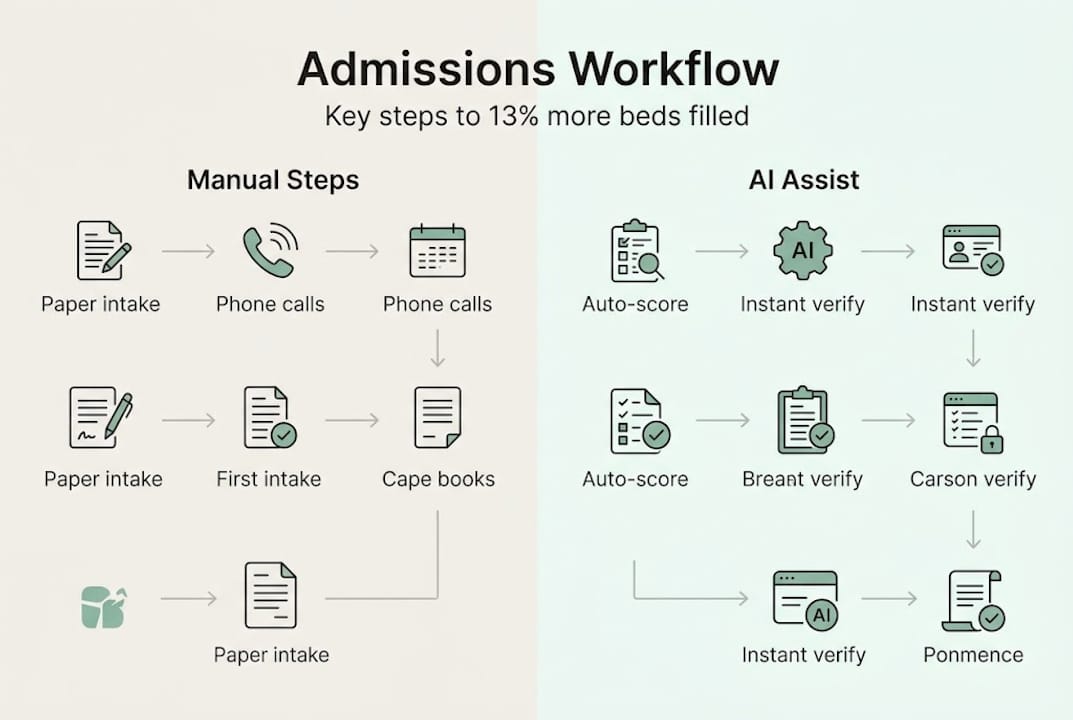
Eligibility verification is another high-risk step. Incorrect payer information or outdated coverage data leads to claim denials and delayed revenue. Automating this step with real-time insurance portal connections removes a major source of downstream billing problems.
Understanding AI in healthcare admissions helps your team see why each stage matters, not just as an administrative task, but as a direct driver of financial and clinical outcomes. When your workflow is tight and well-structured, your facility captures more appropriate referrals, fills beds faster, and reduces the administrative burden that leads to staff burnout.
Essential tools and requirements for workflow optimization
Now that we have mapped out the workflow stages, let us pinpoint the technology and tools that make seamless automation possible. Your facility needs a specific set of SaaS capabilities to move from a manual, reactive process to a proactive, data-driven one.
Core tools your admissions team needs:
- Referral aggregation portal that consolidates fax, EMR, and digital referral sources
- EHR integration using FHIR and HL7 standards for bidirectional data sync
- AI scoring engine for clinical complexity and financial risk assessment
- Automated insurance eligibility verification connected to payer portals
- Audit-ready documentation pipeline with version control and access logs
- Bed board integration for real-time occupancy visibility
- Analytics dashboard for tracking referral volume, conversion rates, and response times
Platforms like WellSky and Aidin are widely used in post-acute care settings and offer strong referral management capabilities. When evaluating any vendor, look for metrics such as average referral-to-decision time, integration depth with your existing EHR, and the availability of real-time eligibility checks. SaaS solutions like WellSky, Aidin, ExaCare AI, and skyAdmissions reduce manual review and automate referral processing, saving 30 or more minutes per admission.
Here is how manual and SaaS-automated approaches compare:
| Feature | Manual process | SaaS-automated process |
|---|---|---|
| Referral intake | Phone/fax, fragmented | Centralized digital portal |
| Data entry | Staff-driven, error-prone | AI extraction, auto-populated |
| Insurance check | Manual calls, 24-48 hour lag | Real-time payer portal query |
| Prioritization | Subjective, inconsistent | Rules-based AI scoring |
| Documentation | Redundant entry across systems | Single-entry EHR sync |
| Audit readiness | Manual file assembly | Automated audit trail |
The AI benefits for admissions extend beyond speed. Automation reduces the cognitive load on your admissions coordinators, which directly impacts staff retention and job satisfaction.

When evaluating AI-powered assistants for your facility, prioritize vendors who can demonstrate live integrations with your current EHR and payer systems.
Pro Tip: Before onboarding any SaaS tool, verify HIPAA compliance documentation and confirm SOC 2 Type II certification. These are non-negotiable requirements for handling protected health information in a post-acute care environment.
Step-by-step: Building an automated admissions reporting workflow
Armed with the right toolset, here is exactly how to automate your admissions reporting workflow step by step.
- Aggregate all referrals into a single digital portal. Connect fax, EMR referral feeds, and hospital discharge platforms to eliminate fragmented intake.
- Enable AI data extraction and scoring. Configure your scoring engine to flag clinical complexity, diagnoses relevant to your care specialties, and payer mix risk.
- Integrate real-time eligibility and insurance checks. Connect directly to payer portals so your team gets instant coverage confirmation without manual phone calls.
- Set up prioritization rules and flags. Define criteria for high-priority referrals, such as short discharge windows or high-value payers, so your team always works the right cases first.
- Design clinical review workflows. Route pre-scored referrals to the appropriate clinical reviewer with pre-populated summaries and flagged gaps in documentation.
- Automate accept and decline communications. Use templated responses with customizable fields so referral sources receive timely, professional responses without adding to staff workload.
- Connect your bed board and EHR. Ensure accepted referrals trigger automatic bed assignments and pre-admission documentation creation.
- Sync all documentation. Confirm that every step generates a timestamped audit record that feeds into your compliance and billing pipelines.
Your team should target a 2-minute referral acknowledgment, a 15-minute initial review, and a 30-minute final decision as performance benchmarks. Manual review can take 60 to 90 minutes per admission, while AI tools reduce this time by 50% or more. Facilities that have fully adopted automation report up to 13% higher bed occupancy and 30% less staff burnout, making the case for optimizing the intake process clear and measurable.
For teams using AI admission tools for the first time, the transition is most successful when it is phased and supported with hands-on training.
Pro Tip: Start your implementation with the two highest-impact stages: AI scoring and automated insurance verification. These deliver the fastest ROI and build staff confidence before you tackle full EHR sync.
Common pitfalls and best practices for verification and success
With your workflow live, the final challenge is ensuring ongoing results and avoiding hidden pitfalls.
Common mistakes to avoid:
- Over-relying on automation without maintaining human review checkpoints
- Rushing staff onboarding without structured training and role-specific guidance
- Ignoring system integration gaps that create data silos between your referral platform and EHR
- Underestimating the time and resources needed to meet HIPAA and SOC 2 compliance requirements
- Skipping a pilot phase and rolling out facility-wide before validating performance
While SaaS solutions promise major gains, real-world challenges include staff training, integration costs, and data privacy compliance. These are not reasons to avoid automation, but they are factors your team must plan for deliberately.
“It is vital to balance automation with human oversight. No system is error-proof. Vigilant review prevents costly mistakes.”
Best practices for sustained workflow performance include investing in change management from day one, running a structured pilot with a defined success metric before scaling, and monitoring key performance indicators such as referral-to-decision time, acceptance rate, and denial rate weekly. Update your workflow rules based on real feedback from admissions coordinators, not just system data.
For an honest look at what AI tools can and cannot do, the truth about AI admissions software is worth reviewing before you finalize your vendor selection.
Ongoing verification checklist:
- [ ] Weekly review of referral response time metrics
- [ ] Monthly audit of insurance eligibility accuracy
- [ ] Quarterly staff feedback sessions on workflow friction points
- [ ] Bi-annual review of integration performance and EHR sync accuracy
- [ ] Annual compliance review against HIPAA and SOC 2 requirements
Research on SNF performance assessment confirms that facilities with structured review cycles consistently outperform those that treat automation as a set-and-forget solution.
Perspective: Why admissions workflow success is about people, not just software
Here is something vendor sales decks rarely tell you: the technology is the easy part. The harder work is getting your admissions team to trust it, use it consistently, and adapt when it does not perform as expected.
In real SNF rollouts, the facilities that see lasting gains are not the ones with the most sophisticated platforms. They are the ones that invested in transparent communication with staff before go-live, ran honest pilots, and treated early friction as useful feedback rather than failure.
The myth of instant ROI is one of the most damaging expectations in healthcare technology adoption. Culture and user training set the actual pace of return. When coordinators feel like the system was built with them, not imposed on them, adoption accelerates and outcomes follow.
The best admissions reporting workflow is not the most automated one. It is the one your team uses correctly, every day, with clear accountability at each stage. Effective change management is not a soft skill add-on. It is a core implementation requirement. Build it into your project plan from the start, and your technology investment will deliver what it promises.
Explore solutions to accelerate your admissions reporting workflow
If your facility is ready to move beyond manual processes, Smart Admissions offers a practical path forward. The platform is purpose-built for SNFs and rehabilitation centers, with AI-powered referral management, real-time eligibility verification, and EHR integration designed to reduce review time and increase bed fill rates.
Explore the automated admissions advantages that facilities like yours are already using to achieve 20% faster bed occupancy. Review referral management examples to see how peer facilities have structured their workflows. Or use the admissions automation guide to map your current process against proven benchmarks. Book a guided walkthrough or pilot assessment to see exactly where your workflow can improve.
Frequently asked questions
What is the standard admissions reporting workflow in skilled nursing facilities?
The standard workflow steps run from referral aggregation through scoring, eligibility verification, prioritization, clinical review, acceptance, and documentation sync with your EHR. Each stage connects directly to census performance and reimbursement speed.
How much time can automation really save in SNF admissions?
AI platforms save 30 or more minutes per admission and can cut documentation time by up to 50%, freeing your coordinators to focus on higher-value clinical and relationship tasks.
What are the biggest barriers to adopting admissions automation?
The primary barriers include staff training requirements, integration costs, and meeting HIPAA and SOC 2 compliance standards. Planning for these from the start reduces delays and budget overruns significantly.
Does a higher CMS star rating guarantee better admissions workflow efficiency?
CMS ratings measure care quality outcomes, not workflow speed or automation level. Many high-rated SNFs still operate with largely manual admissions processes, meaning star rating and operational efficiency are separate performance dimensions.