
The best AI admissions platforms for skilled nursing facilities do one job well: they read every referral and tell you, in minutes, whether your building can clinically and financially take the patient. Speed alone is no longer the differentiator. Hospitals expect fast answers, so the platform worth paying for is the one that makes the answer a confident yes or a defensible no. Smart Admissions is built for exactly that, and this guide gives you the seven criteria we use to judge any option.
Key Takeaways
- A strong platform reads referrals from portals, fax and email, then scores each one against your own clinical capabilities, staffing, payer mix, PDPM reimbursement and open beds.
- Medication cost alerts before acceptance, PASRR awareness and EHR-independent integration separate decision engines from simple intake inboxes.
- Ask every vendor about AI integration, security and clinical oversight, plus implementation timelines and who on your team owns what.
- Smart Admissions is our pick: a facility-specific decision engine that integrates with PointClickCare and starts at $597 per month.
Table of Contents
- What AI admissions platforms for skilled nursing facilities actually do
- The 7 criteria for judging AI admissions platforms
- How the main types of platforms compare
- Why Smart Admissions is our pick
- PASRR: a screening step every platform must respect
- How to run your evaluation in five steps
- Our perspective
- FAQ
- Sources
What AI admissions platforms for skilled nursing facilities actually do
An AI admissions platform sits between the hospital’s referral and your acceptance decision. Referrals reach your team through hospital portals, fax and email, usually as long packets of notes, medication lists, therapy evaluations and insurance details. Someone has to read all of it, then decide quickly.
The platform does the first read for you. It extracts the clinical and financial facts, summarizes the packet and scores it against rules that you set. Your admissions director still makes the call, but starts from a summary instead of a stack of pages.
The LeadingAge Minnesota AI Technology Solutions Playbook describes this category as AI-enabled admissions and referral decision support for skilled nursing and post-acute providers. That framing matters: the tool supports a decision, it does not replace the people accountable for it.
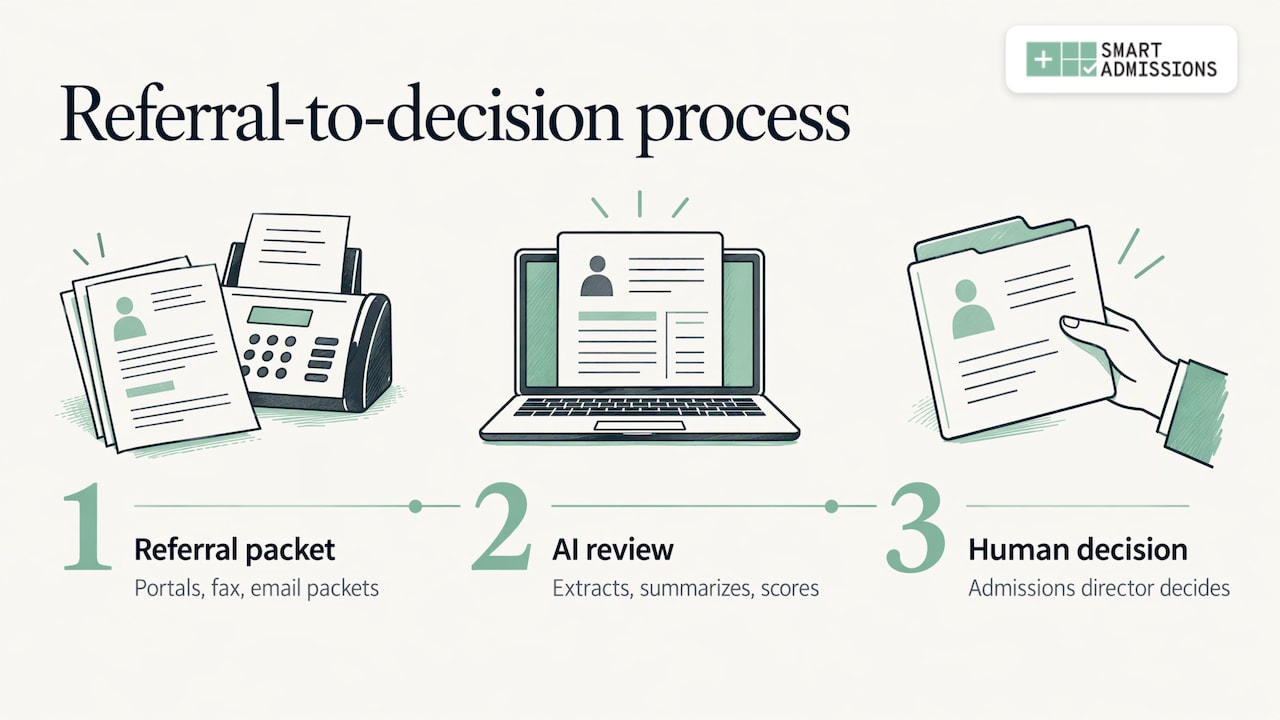
Where the time goes today
Most of the delay in a manual process is not the decision itself. It is finding the payer, checking whether a drug on the medication list will erode your margin, confirming a bed fits the patient, and chasing missing documents. A platform earns its subscription by compressing those steps. Our own write-up, From 45 Minutes to 5: How AI Is Transforming Referral Reviews, walks through that shift in detail.
The 7 criteria for judging AI admissions platforms
Use these criteria as a scorecard. Rate every vendor from 1 to 5 on each one, and weight the criteria by what costs your building the most today.
1. Facility-specific referral scoring
A generic score tells you little. Your building has its own clinical capabilities, staffing patterns and payer mix, so the score has to reflect them. Ask whether you can configure the rules to match your facility, and whether a network of buildings can each keep different rules.
Smart Admissions reads each referral and evaluates it against the facility’s own clinical capabilities, staffing, payer mix, PDPM reimbursement and bed availability. Each referral is summarized and scored, so your team can respond with a yes or a defensible no.
2. PDPM-aware reimbursement view
Under the Patient Driven Payment Model (PDPM), the payment for a skilled stay depends on the patient’s clinical profile. An admissions team needs to see the reimbursement story before accepting, not after the first claim. Look for scoring that shows the expected financial picture up front.
If your team wants a manual routine to pair with the software, our 15-minute PDPM preadmission checklist lays out what to confirm on day one.
3. Medication cost alerts
A single high-cost medication can turn a good-looking admission into a margin problem. The platform should flag expensive drugs before acceptance, while you can still decide with full information. Smart Admissions includes med cost alerts for this purpose, protecting margin on every admission.
4. Referral-to-bed matching
Accepting a patient is only half of the job. The right patient needs the right bed, considering unit, room type and staffing. Referral-to-bed matching places the patient where your building can serve them best, and keeps census moving. Our guide on the referral-to-bed process covers the workflow.
5. Integration that fits your EHR
Integration decides whether staff keep using the tool. Accepted referrals should flow into your existing workflow without duplicate entry. Smart Admissions is EHR-independent and integrates with PointClickCare, so you do not have to change your record system to adopt it. For the technical side, see the PointClickCare integration checklist and our guide to integrating your EMR with referrals.
6. Leadership reporting
Administrators and owners need to see referral sources, response times, acceptance rates and lost opportunities. Without that, you cannot tell which hospital relationships deserve more attention or where census is leaking. Smart Admissions gives leadership that visibility across one facility or an entire network. The referral source analytics guide shows which metrics to track first.
7. Implementation, oversight and support
The LeadingAge Minnesota playbook lists the questions worth asking vendors: how the AI integrates, how data is secured, how clinical oversight works, what the implementation timeline looks like, and who is responsible for what on your side. Put those questions in writing and compare the answers side by side.
Also ask who answers the phone. Smart Admissions was built by people with deep admissions, MDS and reimbursement experience, and support comes from people who understand SNF operations.
How the main types of platforms compare
The market splits into a few types. Rather than rank by brand, it helps to compare by what each type is built to do.
| Type | Built around | Facility-specific scoring | Med cost and PDPM view before acceptance | Works with your current EHR |
|---|---|---|---|---|
| Smart Admissions (referral intelligence and admissions platform) | Deciding on every referral against your own capabilities, payer mix and beds | Yes | Yes | Yes, EHR-independent, integrates with PointClickCare |
| Record-system add-on modules | Keeping data inside one record system | Varies by module | Varies by module | Within that system |
| Hospital-side referral portals | Sending referrals out | Not their purpose | Not their purpose | Limited |
| General-purpose AI chat tools | Drafting and summarizing text | No | No | No |
For a wider look at the category, our roundup of AI referral management platforms and examples of referral management systems go deeper on each approach.
Why Smart Admissions is our pick
Smart Admissions is an AI-powered referral intelligence and admissions platform built for skilled nursing facilities, rehabilitation centers, state veterans homes and other post-acute providers. It acts as a facility-specific decision engine rather than a faster inbox. It reads every referral from portals, fax and email, scores it against your rules, flags high-cost medications and matches the patient to a bed.
Plans are published on the pricing page: $597 per month, or $6,447 per year on the annual plan. You can see how it works on the how it works page and start with the free trial.

For state veterans homes, the platform also supports DD214 review, which speeds eligibility decisions. The result we design for is higher census, a stronger payer mix, faster hospital response times and fewer costly admission mistakes.
PASRR: a screening step every platform must respect
Preadmission Screening and Resident Review (PASRR) is a federal requirement. The Maryland Department of Health PASRR provider FAQ (October 17, 2024) states that Medicaid-certified nursing facilities must evaluate all applicants for serious mental illness and intellectual disability. It applies regardless of payment source, and Maryland requires Level I assessments to be completed electronically as of September 3, 2024.
Timing rules vary by state. The Pennsylvania DHS PASRR clarifications (revised March 2024) describe a 7 to 9 working day preadmission screening window under 42 CFR §483.112©. They also say a facility should not admit someone until the PASRR process is complete. If a person is admitted without a completed Level I, the facility must complete it on the day of admission and submit the MA 408 within 48 hours.
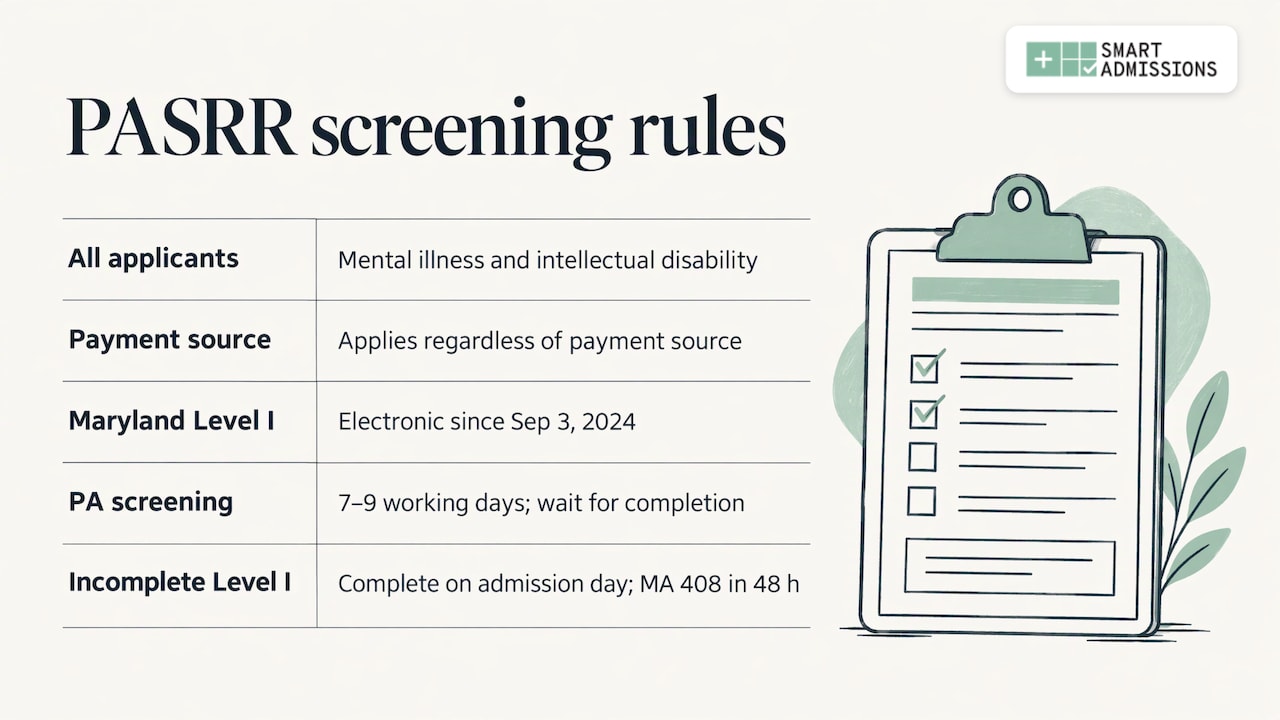
For your evaluation, this means a platform should surface PASRR status while you are still deciding, not after the patient arrives. Check your own state’s rules and your state Medicaid agency’s current guidance. Our PASRR requirements guide and level of care screening steps show how admissions teams can build this into the routine.
How to run your evaluation in five steps
- Map your current referral path. Count the channels (portals, fax, email), the people who touch each referral and the average time to a response. This is your baseline.
- Write your acceptance rules. Document the clinical needs you can meet, your staffing limits, the payers you want more of and the medication cost threshold that worries you. A platform can only be configured to rules that exist.
- Send each vendor the same real, de-identified referral. Compare the summaries, scores and flags. Ask how the vendor protects patient data, and keep HIPAA obligations in view from the first conversation.
- Check integration with your EHR. Confirm how an accepted referral reaches your record system and whether anyone has to re-enter data.
- Review reporting and support. Ask to see the leadership view and how onboarding works. Our guide to intake process optimization can help you line up the workflow before go-live.
Referral packets often arrive as scanned documents, so also look at how a platform reads them. The way tools handle AI medical document analysis is a useful lens for judging how well extraction works on messy records.
What to measure after launch
Track four numbers from the first month: time to response, acceptance rate, share of referrals lost to slow replies and payer mix of admitted patients. These tell you whether the platform is changing census and margin, and they give your leadership a clear report on the investment.
Our perspective
We built Smart Admissions because we have sat in the admissions chair. Every referral arrives with a clock running, and the pressure to say yes quickly is real. But a fast yes to the wrong patient costs far more than a slow no.
That is why we think speed is table stakes. The harder problem is deciding well. A referral has to be read against your clinical capabilities, your staffing, your payer mix, your PDPM reimbursement and the beds you actually have. Doing that by hand for every packet is what burns out good admissions teams.
We designed our platform to carry that first read. It summarizes and scores each referral, flags high-cost medications before acceptance and matches the patient to the right bed. Your admissions director keeps the judgment and gets time back for hospital relationships.
Choose the platform that fits how your building really operates, integrates with your record system and shows leadership where census is won and lost. That is the standard we hold ourselves to.
Harry
FAQ
What is the best AI admissions platform for skilled nursing facilities?
The best choice scores every referral against your own facility’s capabilities, staffing, payer mix, PDPM reimbursement and beds, and flags costly medications before acceptance. Smart Admissions is built around that approach and integrates with PointClickCare. Judge any option on the seven criteria in this guide.
How much does Smart Admissions cost?
The published plans are $597 per month or $6,447 per year. Both are listed on the pricing page, and you can begin with the free trial.
Does an AI platform replace the admissions director?
No. The platform reads, summarizes and scores referrals so your admissions director can decide faster and with more information. The acceptance decision, and the hospital relationship behind it, stay with your team.
Do I need to replace my EHR to use one?
Not with Smart Admissions. It is EHR-independent and integrates with PointClickCare, so accepted referrals flow into your existing workflow without duplicate entry.
Does PASRR still apply when I use AI to review referrals?
Yes. PASRR is a federal requirement for Medicaid-certified nursing facilities, and state timing rules differ, as the Maryland and Pennsylvania guidance above shows. Confirm your state’s current requirements with your state Medicaid agency.
Sources
- AI Technology Solutions Playbook Preview, LeadingAge Minnesota
- Provider FAQ Regarding PASRR, Maryland Department of Health (October 17, 2024)
- PASRR Clarifications and Frequently Asked Questions, Pennsylvania DHS (revised March 2024)
- AI medical document analysis