
Managing patient referrals in skilled nursing homes involves juggling clinical data, insurance verification, bed availability, and reimbursement considerations simultaneously. Studies show that 66.7% concordance rates between AI and physician diagnosis reveal significant room for improvement in referral accuracy. Decision support tools powered by artificial intelligence offer a practical solution by automating data aggregation, scoring referral fit, and flagging high-risk cases before they reach your admissions team. This guide explores how these tools work, what challenges you might face during implementation, and actionable steps to optimize your referral management workflow for faster bed occupancy and better patient outcomes.
Table of Contents
- Key takeaways
- Understanding decision support tools in healthcare referrals
- Navigating challenges and limitations of AI decision support
- Comparing decision support tool options and features for skilled nursing
- Applying decision support tools to optimize your referral management workflow
- Explore AI-powered referral management solutions
- Frequently asked questions
Key Takeaways
| Point | Details |
|---|---|
| Referral accuracy boost | AI powered decision support automates data aggregation, referral scoring, and risk flagging to improve accuracy. |
| Reduces manual workload | Automation lessens manual data entry and allows staff to focus on complex cases. |
| Real time insurance verification | Direct integration with major payer portals verifies coverage in real time, eliminating multiple portal checks. |
| Implementation challenges | Algorithmic bias, data privacy concerns, and integration hurdles demand strong governance, ongoing training, and ethical oversight. |
Understanding decision support tools in healthcare referrals
Decision support tools aggregate referral data from faxes, emails, hospital portals, and direct submissions into a unified system. They apply rule-based systems and machine learning for predictive modeling to evaluate each referral against your facility’s capacity and expertise. The system scores referrals across multiple dimensions: clinical fit based on diagnoses and care needs, reimbursement potential tied to payer mix, projected length of stay, and risk factors that might complicate care delivery.
These tools pull patient demographics, medical history, current medications, and insurance details automatically. Advanced platforms integrate with post-acute care AI applications to verify coverage in real time, eliminating the need for staff to manually check multiple insurance portals. This automation allows your admissions team to focus on complex cases requiring human judgment rather than routine data entry.
The scoring algorithms weigh factors differently based on your facility’s priorities. A rehabilitation center might prioritize patients with strong therapy potential and favorable Medicare coverage, while a skilled nursing home might emphasize stable chronic conditions with predictable care pathways. Machine learning models improve over time by analyzing which accepted referrals resulted in successful admissions versus those that led to early discharges or payment denials.
Pro Tip: Ensure your system supports multi-channel data aggregation to cover all referral inputs, including legacy fax systems that many hospitals still use for patient transfers.
Core components of effective decision support systems
- Clinical assessment modules that map diagnoses to your facility’s service capabilities
- Real-time insurance verification connecting to major payer portals
- Predictive analytics for length of stay and readmission risk
- Automated documentation extraction from unstructured referral documents
- Integration hooks for existing EMR and admissions workflows
| Scoring Dimension | Data Sources | Decision Impact |
|---|---|---|
| Clinical Fit | Diagnosis codes, care requirements, therapy needs | Determines if facility can provide appropriate care level |
| Reimbursement Potential | Insurance type, coverage limits, prior authorization status | Affects revenue and payment timeline |
| Length of Stay Risk | Historical data, diagnosis patterns, patient demographics | Influences bed turnover planning and census management |
| Payer Mix Balance | Current census composition, contract rates | Optimizes facility financial performance |
By implementing tools that enhance decision making in healthcare admissions, facilities gain visibility into referral patterns and can adjust acceptance criteria based on actual outcomes rather than intuition alone.

Navigating challenges and limitations of AI decision support
While AI tools offer significant advantages, they introduce new complexities that require careful management. Algorithmic bias, data privacy concerns, and staff resistance represent the most common implementation barriers. Training data quality directly impacts model accuracy, and if historical acceptance decisions reflected unconscious biases, the AI will perpetuate those patterns unless actively corrected.
HIPAA compliance becomes more complex when patient data flows through AI systems. You need clear data governance policies covering how referral information is stored, processed, and shared. Many facilities discover their existing security protocols don’t adequately address machine learning model training or cloud-based processing requirements. Staff often resist adopting new tools, especially when they perceive AI as threatening job security or questioning their clinical expertise.
Integration with existing EHR systems frequently proves unreliable. Nursing homes face AI adoption challenges including incompatible data formats, limited API access from legacy systems, and workflow disruptions during implementation. Even when technical integration succeeds, the AI’s recommendations might not align with your facility’s operational realities like current staffing levels or specialized equipment availability.
Ethical dilemmas emerge in complex clinical scenarios, particularly around palliative and end-of-life care decisions. AI models trained on outcome optimization might systematically deprioritize patients with terminal diagnoses, even when your facility specializes in hospice care. Human oversight remains essential to catch these misalignments and ensure decisions reflect your organization’s values and mission.
“Over-reliance on AI can reduce critical human judgment essential in complex cases.”
Common implementation obstacles
- Data quality issues from incomplete or inconsistent referral documentation
- Resistance from clinical staff who distrust automated recommendations
- Budget constraints limiting access to premium AI platforms
- Vendor lock-in concerns with proprietary systems
- Ongoing maintenance costs for model updates and system refinements
Understanding the benefits of AI in healthcare administration requires balancing automation gains against these real-world constraints. Successful implementations acknowledge limitations upfront and build processes to mitigate risks rather than assuming technology alone solves referral management challenges.
Comparing decision support tool options and features for skilled nursing
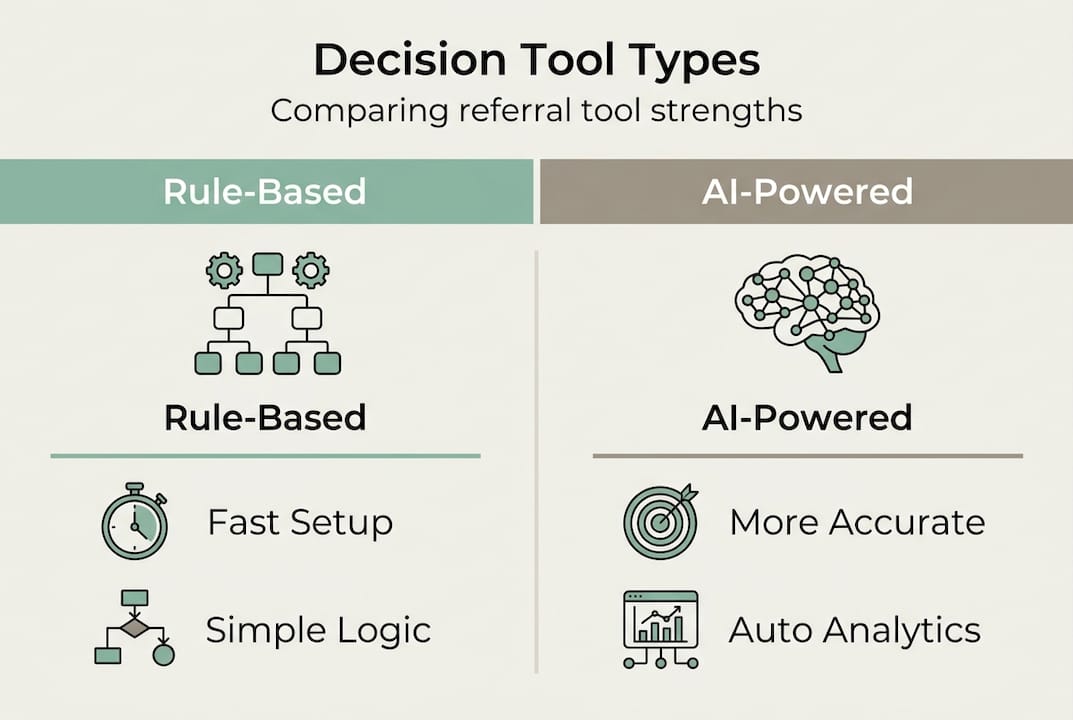
Three primary approaches dominate the market: rule-based systems, pure machine learning models, and hybrid platforms combining both methodologies. Rule-based tools apply predetermined criteria consistently but lack adaptability to unusual cases. Machine learning models excel at pattern recognition but require substantial training data and ongoing refinement. Hybrid systems offer the best of both worlds, using rules for standard cases while deploying AI for complex scenarios requiring nuanced evaluation.
| Tool Type | Strengths | Limitations | Best For |
|---|---|---|---|
| Rule-Based Systems | Consistent application, transparent logic, easy to audit | Cannot adapt to new patterns, requires manual updates | Facilities with stable referral criteria and straightforward case mix |
| Machine Learning Models | Learns from outcomes, handles complexity, improves over time | Black box decisions, requires large datasets, prone to bias | Large facilities with diverse case types and robust data infrastructure |
| Hybrid AI Extraction | Balances consistency with adaptability, explainable recommendations | Higher cost, more complex implementation | Multi-site organizations needing standardization with flexibility |
Research shows AI-powered extraction reduces review time by 40% compared to manual processing. The time savings compound when you consider reduced back-and-forth communication with referring hospitals to clarify missing information. Advanced systems use natural language processing to extract key data points from narrative physician notes, eliminating the need for staff to read through pages of medical records.
Pro Tip: Prioritize tools with seamless EMR integration to maximize workflow efficiency and minimize duplicate data entry that frustrates staff and introduces errors.
Essential features for skilled nursing referral management
- Clinical fit scoring based on your facility’s service capabilities and current census
- Automated insurance verification with real-time eligibility checks
- Length of stay prediction using diagnosis patterns and patient demographics
- Risk flagging for patients likely to require hospital readmission
- Customizable acceptance criteria reflecting your operational priorities
- Analytics dashboards tracking referral sources, acceptance rates, and revenue impact
When evaluating referral management systems for efficiency, consider how easily you can integrate EMR with referrals without disrupting existing workflows. Platforms like SkyAdmissions demonstrate how cloud-based solutions can connect disparate data sources while maintaining HIPAA compliance through encryption and access controls.
Key selection considerations
- HIPAA compliance certification and data security protocols
- Staff training requirements and vendor support availability
- Scalability to accommodate census growth and service line expansion
- Pricing models aligned with your budget and expected ROI timeline
- Vendor reputation and customer references from similar facilities
Applying decision support tools to optimize your referral management workflow
Successful implementation follows a structured approach that addresses technical, operational, and cultural dimensions. Rushing deployment without adequate preparation leads to poor adoption and wasted investment. Follow these steps to maximize your chances of achieving meaningful improvements in referral management efficiency and patient outcomes.
- Assess your current referral workflow by documenting how referrals arrive, who reviews them, what criteria guide decisions, and where bottlenecks occur. Measure baseline metrics like average review time, acceptance rates by referral source, and bed occupancy patterns.
- Select a tool aligned with your needs by evaluating options against your budget, technical infrastructure, and staff capabilities. Request demos focused on your specific use cases rather than generic presentations. Verify that vendors can support your EMR system and insurance payer mix.
- Train staff comprehensively before go-live, emphasizing how the tool augments rather than replaces their expertise. Address concerns openly and involve clinical leaders as champions who can model effective tool usage. Provide ongoing support through the learning curve.
- Integrate systems methodically by starting with a pilot program on a subset of referrals before full deployment. Monitor data accuracy closely and adjust mapping rules as needed. Ensure backup processes remain available if the AI system experiences downtime.
- Monitor outcomes continuously using built-in analytics to track acceptance rates, bed occupancy improvements, and staff time savings. Compare AI recommendations against actual admission outcomes to identify where the model needs refinement. Solicit regular feedback from admissions staff about tool usability and accuracy.
Research demonstrates that automation boosts bed occupancy by 20% when implemented properly with adequate change management support. The gains come from faster referral processing, reduced missed opportunities from delayed responses, and more accurate matching between patient needs and facility capabilities. However, these benefits only materialize when staff trust and consistently use the system.
Pro Tip: Use built-in analytics within tools to assess impact on census and efficiency regularly, adjusting acceptance criteria based on what actually drives successful admissions rather than assumptions.
Involving clinical staff from the beginning reduces resistance and surfaces practical concerns that might derail implementation. Nurses and therapists often identify workflow issues that administrators miss, and their buy-in proves essential for sustained adoption. Create feedback loops where frontline users can suggest improvements and see their input reflected in system updates.
Ongoing monitoring must address both performance metrics and ethical considerations. Watch for patterns suggesting algorithmic bias, such as systematically lower scores for certain demographic groups or diagnosis categories. Regular audits comparing AI recommendations to human decisions help identify drift and maintain alignment with your facility’s values and regulatory requirements.
Understanding what referral management entails helps contextualize where AI fits within the broader admissions process. Tools work best when they complement existing strengths rather than attempting to replace human judgment entirely. The goal is faster, more consistent initial screening so your team can focus on complex cases requiring nuanced evaluation.
Explore resources on automating admissions for faster bed occupancy and review intake documentation guides to understand how decision support tools fit within comprehensive workflow optimization. Many facilities find that addressing documentation standardization and communication protocols amplifies AI benefits by ensuring higher quality input data.
Explore AI-powered referral management solutions
Smart Admissions specializes in helping skilled nursing homes and rehabilitation centers transform their referral management processes through intelligent automation. Our platform combines the decision support capabilities discussed throughout this article with practical tools designed for busy admissions teams facing constant time pressure and complex case evaluations.
Discover comprehensive resources explaining what referral management involves and explore examples of referral management systems that demonstrate real-world applications. Learn practical strategies for integrating EMR with referrals to eliminate duplicate data entry and maintain information accuracy across systems. Our approach emphasizes seamless implementation that respects your existing workflows while delivering measurable improvements in efficiency and census growth.
Frequently asked questions
What are decision support tools in healthcare?
Decision support tools leverage data integration and artificial intelligence to assist healthcare professionals in making faster, more accurate referral and care decisions. They automatically aggregate patient information from multiple sources, apply scoring algorithms based on clinical fit and reimbursement factors, and flag cases requiring additional review. These systems improve consistency while reducing the manual workload on admissions staff.
How do AI-powered tools improve referral accuracy?
AI uses machine learning algorithms to analyze clinical fit, reimbursement potential, and risk factors automatically across hundreds of data points that would take humans hours to evaluate manually. This reduces errors from fatigue or oversight and accelerates approval workflows by immediately identifying ideal candidates. The systems learn from historical outcomes to continuously refine scoring criteria, and AI in healthcare admissions demonstrates measurable improvements in patient-facility matching over time.
What challenges should be expected when adopting decision support tools?
Algorithmic bias and HIPAA compliance represent critical concerns requiring ongoing monitoring and governance policies. Staff training needs and EHR integration issues often slow initial adoption, with resistance emerging when teams feel the technology questions their expertise. Continuous oversight balancing AI recommendations with human judgment remains essential, and understanding the benefits of AI in healthcare administration helps set realistic expectations about both capabilities and limitations.
How can skilled nursing facilities implement these tools effectively?
Start by assessing your current workflow and measuring baseline performance metrics like review time and acceptance rates. Select tools matching your technical infrastructure and budget, then train staff comprehensively while addressing concerns about job security openly. Integrate systems through pilot programs before full deployment, and monitor outcomes continuously to identify where adjustments improve accuracy. Resources on automating admissions provide additional implementation guidance for maximizing return on investment.