
Admissions triage automation means letting software sort, verify and score incoming referrals so your team spends its time on the clinical and financial decisions only people should make. For a skilled nursing facility (SNF), that usually means every referral is logged on arrival, eligibility is checked against payer data, clinical fit is summarized, and the admissions coordinator sees a ranked queue instead of an inbox. This guide gives you seven steps to get there, what to ask vendors, and which rules are changing in 2026.
TL;DR
- Admissions triage automation handles the repetitive steps of referral intake: logging, eligibility checks, document collection and scoring. Your team keeps the final admit or decline decision.
- Map and fix your workflow first. Automating a slow, unclear process only makes the confusion faster.
- Published quality improvement work shows structured triage can cut the time from request to admission, for example from 3.3 days to 2.3 days in one Veterans Affairs facility.
- Look for EMR integration, real-time eligibility checks, audit logs and transparency about how any algorithm scores a referral.
- Smart Admissions is priced at $597 per month or $6,447 per year, and onboarding is designed to take under an hour.
Table of Contents
- What admissions triage automation does in a skilled nursing facility
- Why admissions triage automation matters now
- What the evidence says about faster triage
- 7 steps to put admissions triage automation in place
- Manual triage versus automated triage
- What to ask before you choose a triage tool
- Our perspective: triage is a decision problem, not a typing problem
- Pricing and how to try it
- Common mistakes to avoid
- FAQ
- Sources
What admissions triage automation does in a skilled nursing facility
Triage in an SNF is the first pass on a referral: can we clinically care for this person, will a payer cover the stay, do we have the right bed, and how urgent is the request? In many buildings that pass still happens by phone, fax, portal screenshots and sticky notes. One coordinator may open six systems to answer a single hospital case manager.
Admissions triage automation replaces the clerical part of that pass. A well-built system does five things:
- Captures every referral from every source in one queue, including those you later decline.
- Pulls patient demographics and clinical documents into a structured record.
- Checks insurance eligibility against payer portals.
- Compares the clinical profile with your facility’s capabilities and admission criteria.
- Ranks the queue so the most urgent and best-fit referrals are reviewed first.
The human stays in charge. Experts in health interoperability describe the direction of travel as agentic AI with human-in-the-loop oversight, where software queries standard APIs for eligibility and documentation, suggests matches, and a person makes the final clinical or financial call. That is the model worth buying.
Why admissions triage automation matters now
Three pressures are converging on admissions teams.
Speed decides who gets the referral. Hospital discharge planners send a request to several facilities and usually go with the first that responds with a clear yes. We cover the revenue side of this in our piece on why improving referral response times matters in skilled nursing.
Manual intake distorts your own data. A retrospective study of admission decisions in skilled nursing facilities found that facilities relying on burdensome manual entry often stop recording denied or lost referrals. That gives leadership a biased picture of true referral volume and missed revenue. Automation logs every referral by default, so your census strategy rests on complete numbers.
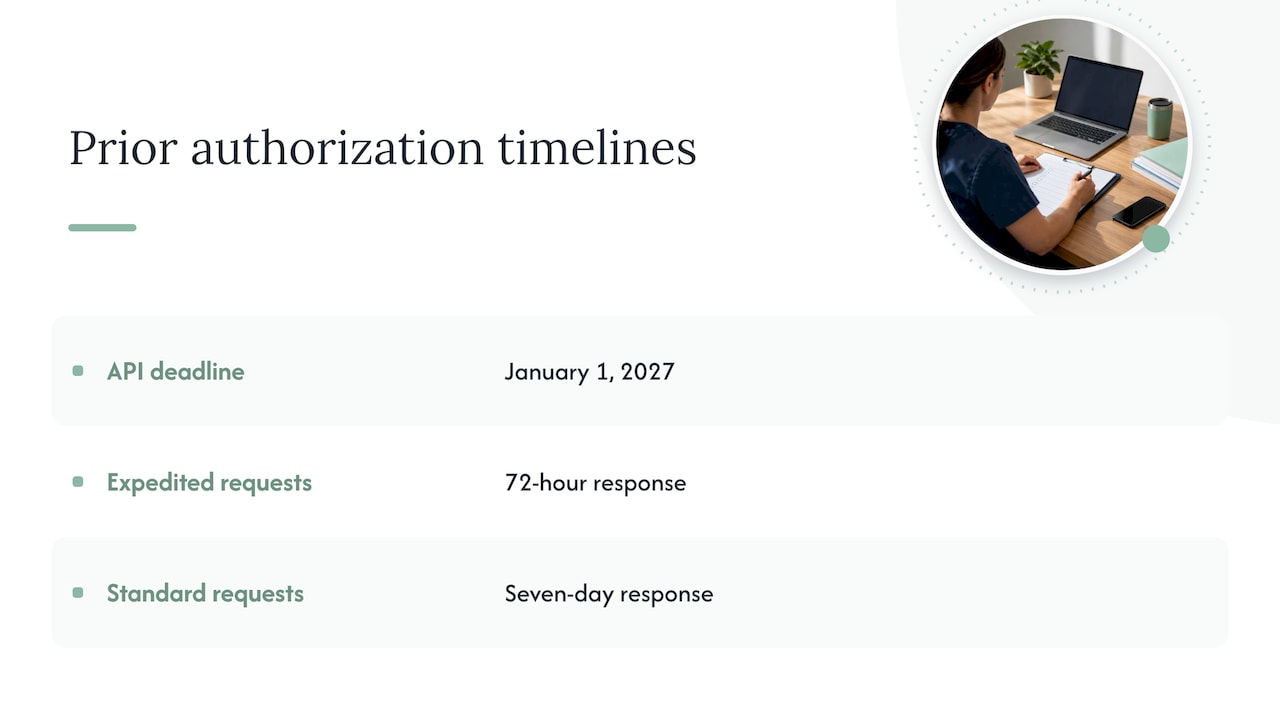
Payer rules are moving toward electronic exchange. Under the CMS Interoperability and Prior Authorization final rule, impacted payers must implement Prior Authorization APIs by January 1, 2027. The rule sets a 72-hour response for expedited requests and seven days for standard ones. Facilities already working in structured, electronic workflows will be better placed to use those responses than teams still tracking requests on paper.
What the evidence says about faster triage
It is worth being precise about what published studies show and what they do not.
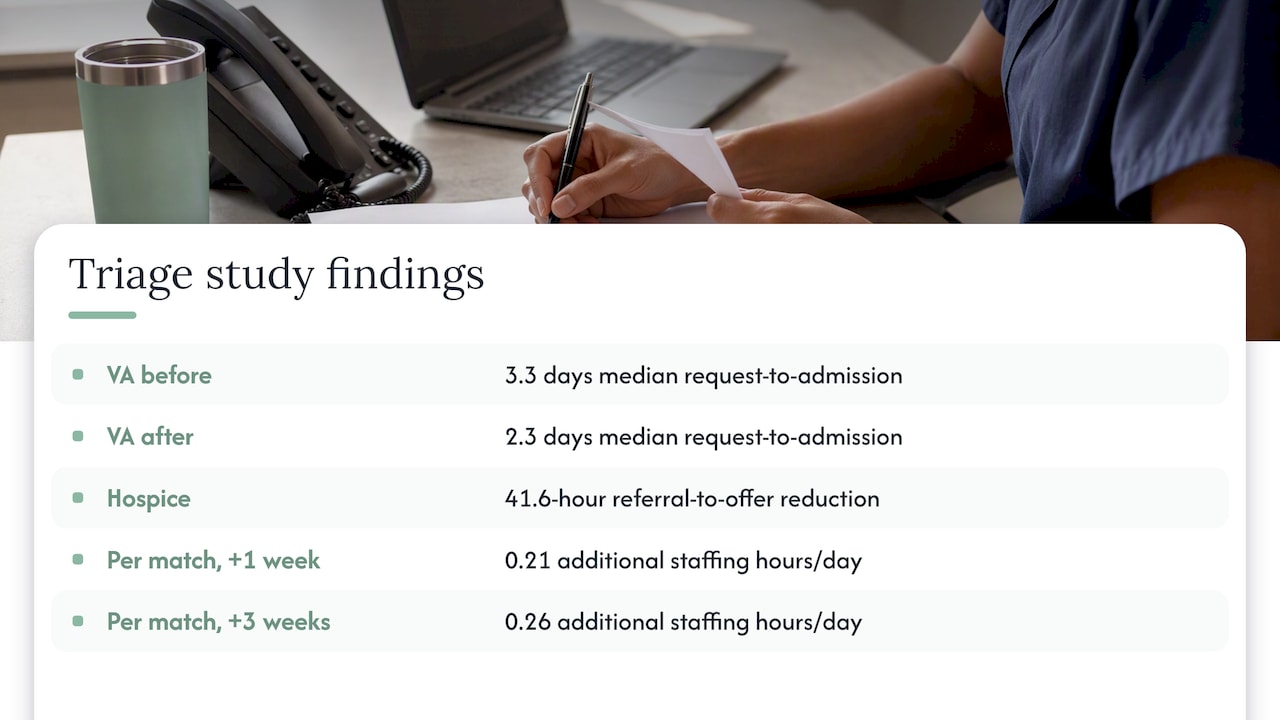
A quality improvement project that redesigned the admission process in a Veterans Affairs skilled nursing facility reduced the median time from request to admission from 3.3 days to 2.3 days. A separate hospice project reported that referral-to-offer time fell by 41.6 hours in a post-intervention cycle, according to the Thames Hospice admissions process project. Both were process redesigns in specific settings, not guarantees for your building, and they involved more than software.
That is the key lesson. Staffing research points the same way: a study of centralized matching in Massachusetts nursing homes associated each suggested match in a week with 0.21 additional staffing hours per day the following week in a 100-resident home, and 0.26 three weeks later. Matching and triage are operational levers, and they work best when the underlying process is sound.
7 steps to put admissions triage automation in place
Step 1: Map the referral path as it runs today
Sit with your admissions coordinator for a day and write down every touch on one referral, from the moment it arrives to the moment you send an answer. Note each system opened, each person who handles it, and each wait.
The VA project above used multidisciplinary improvement work, with nurses, social workers and administrators in the room, to find redundant handoffs and unclear documentation criteria. Bring the same group together. Without this preparation you risk automating an inefficient process and limiting your return on the software.
Step 2: Write down your admission criteria
Triage software can only apply rules you can state. Document the following in plain language:
- Clinical services you can and cannot support, such as IV therapy, wound care levels, bariatric needs, ventilator care or behavioral health limits.
- Payer mix targets and the payers you accept.
- Hard stops, such as missing documentation or lack of coverage for a skilled stay.
- Soft factors, such as expected length of stay or therapy intensity.
Turn the list into a scoring approach. Our guide to admissions queue prioritization with scoring shows how a ranked queue helps your team fill beds faster.
Step 3: Centralize intake into one queue
Referrals arrive by fax, secure email, hospital portals and phone. Decide on one place where all of them land, and require that every referral, including those you will decline, gets a record. This is the foundation for the complete data described earlier. See our overview of intake process optimization for the practical details.
Step 4: Automate eligibility verification
Eligibility is the check most likely to stall a referral. Manually logging into payer portals takes minutes per patient and gets repeated when a referral is revisited. Real-time verification during triage tells you at the start whether a stay is likely to be covered. Use our patient eligibility verification checklist to confirm what to verify for each payer, and read about the 48 to 72 hour rule for real-time eligibility checks if your team works against that window.
Step 5: Connect your EMR
Double entry is where automation projects lose their value. If your coordinators still retype demographics into the EMR after triage, you have moved the work rather than removed it. Ask whether the vendor integrates with your existing system and how. Our explainer on what EMR integration is and its benefits and the walkthrough on how to integrate your EMR with referrals cover what to expect.
The industry has a reason to care. The Post-Acute and Long-Term Care Medical Association has said that EHR fragmentation between hospitals and SNFs is a primary frustration for clinicians, and that better data sharing matters for safety during transitions of care.
Step 6: Define the human review points
Decide in advance where a person must look. A sensible baseline:
- Every decline decision is reviewed by a coordinator or director.
- Clinical flags, such as complex medications, go to the director of nursing.
- Financial exceptions, such as pending Medicaid, go to the business office or administrator.
- The software never sends an admit or decline on its own.
Write these rules down and train to them. This keeps accountability with licensed staff and keeps hospital partners dealing with a person when the case is complicated.
Step 7: Measure, review and adjust
Pick four numbers and review them weekly for the first 90 days:
| Metric | Why it matters |
|---|---|
| Time from referral received to first response | Predicts whether hospitals keep sending you cases |
| Referral-to-admission conversion rate | Shows whether faster triage turns into occupied beds |
| Share of referrals with complete eligibility data at first review | Shows how much rework remains |
| Decline reasons by category | Reveals gaps in services, staffing or payer mix |
Use a plan-do-study-act cycle: change one thing, watch the numbers for two weeks, keep or revert it. For broader occupancy tactics, see our guide to optimizing bed occupancy in skilled nursing.
Manual triage versus automated triage
| Task | Manual process | With admissions triage automation |
|---|---|---|
| Logging referrals | Entered by hand, often skipped for declines | Every referral recorded on arrival |
| Eligibility check | Portal logins, phone calls | Verified during intake |
| Document handling | Fax review, re-keying | Structured and attached to the record |
| Prioritization | First in, first out or gut feel | Ranked by your own criteria |
| Reporting | Spreadsheets, partial data | Dashboards from complete data |
For a fuller comparison, read manual vs. automated admissions: 5 key differences.
What to ask before you choose a triage tool
Use these questions in every vendor conversation. They apply to any type of solution, from standalone referral tools to broader workflow platforms.
- Does it work with our EMR and our payer portals? Ask for the specific method, not a general yes.
- Which standards does it support? Modern interoperability relies on a FHIR-forward architecture with OAuth 2.0 and OpenID Connect for security, and audit-logged handoffs between staff and automated agents.
- How transparent is the scoring? The ONC HTI-1 final rule requires that predictive algorithms in certified health IT provide baseline information about fairness, appropriateness, validity and safety. Even if your vendor is not covered, ask for that level of explanation.
- Is there an audit trail? You should be able to see who or what made each recommendation and when.
- How long does onboarding take, and who supports us? A tool that needs months of IT work defeats the purpose.
- What happens if it does not work? Look for a clear guarantee in writing.
For a type-by-type overview, see examples of referral management systems.
Our perspective: triage is a decision problem, not a typing problem
We built Smart Admissions for skilled nursing, rehabilitation and post-acute teams because we saw the same pattern: capable coordinators spending their day copying information between systems while a referral sat unanswered. The clinical judgment was never the slow part. The chasing was.
Our view is that automation should take over the chasing and leave the judgment alone. That is why our platform integrates with the EMR and insurance portals you already use, verifies eligibility in real time, and gives your team a ranked queue to act on. It is also why we are cautious about promises of full autonomy. A person who knows your building, your staff and your referral partners should make the final call.
We also think the order matters. Fix the workflow, write down the criteria, then automate. Teams that skip the first two steps tend to be disappointed with any software. Teams that do them find the third step surprisingly quick: our onboarding is designed to take under an hour, and we back the product with a guarantee that it pays for itself within 30 days.
— Harry
Pricing and how to try it
If you are ready to see the workflow on your own referrals, Smart Admissions is available as a subscription at $597 per month or $6,447 per year. Both plans are built for administrators and admissions directors who want faster referral review without a heavy IT project. You can also start from the Smart Admissions home page to see how the platform fits a skilled nursing or rehabilitation facility.
Common mistakes to avoid
- Automating before fixing. A broken handoff stays broken, only faster.
- Ignoring declines. If you log only accepted referrals you cannot see lost revenue or fix its causes.
- No human checkpoints. Clinical and ethical accountability cannot be delegated to a score.
- Skipping staff training. Coordinators need to know why the queue is ordered as it is, so they trust it and can override it.
- Measuring nothing. Without a baseline, you cannot show the administrator or owner what changed.
To see how automation fits into a wider program, read our overview of healthcare workflow automation for admissions and the referral management overview.
FAQ
Does admissions triage automation replace admissions coordinators?
No. It removes repetitive tasks such as logging, eligibility lookups and document sorting. Coordinators still evaluate clinical fit, talk with hospital case managers and make the final decision. The model described by interoperability experts keeps a human in the loop for the clinical and financial call.
How long does it take to see results?
That depends on your starting point and how clean your process is. Published projects measured gains over improvement cycles rather than overnight, so plan to track results for at least 90 days. Smart Admissions is designed for onboarding in under an hour, which shortens the setup phase.
Is automated triage compliant with HIPAA?
Compliance depends on the vendor and your configuration. Ask for a business associate agreement, audit logging and details on how data is secured and exchanged. Your compliance officer or counsel should review the arrangement before go-live.
What should we automate first?
Start with centralized intake and eligibility verification. These two steps cause most delays and are easy to measure. Once they run reliably, add scoring and reporting, then review your numbers weekly.
Sources
- Improving Access to Care by Admission Process Redesign in a Veterans Affairs Skilled Nursing Facility
- Thames Hospice Admissions Process Project
- Factors Influencing Admission Decisions in Skilled Nursing Facilities
- Impact of using a centralized matching process on nursing home staffing
- CMS Interoperability and Prior Authorization Final Rule (CMS-0057-F)
- Appendix VI: AI for Interoperability, Interoperability Standards Platform
- ONC HTI-1 Final Rule
- PALTmed on EHR interoperability for post-acute and long-term care