
Traditional intake processes can consume up to 12 hours per admission, creating bottlenecks that delay patient care and leave revenue-generating beds empty. Healthcare administrators at skilled nursing facilities and rehabilitation centers now face mounting pressure to accelerate admissions while maintaining accuracy and compliance. Streamlining intake workflows reduces processing time from hours to under 2 minutes, transforming how facilities manage referrals and bed occupancy. This guide explores evidence-based strategies to optimize your intake operations, backed by real-world benchmarks and practical implementation steps.
Table of Contents
- Key takeaways
- Why streamlining intake workflows matters in skilled nursing and rehab centers
- Core methodologies to streamline and automate intake workflows effectively
- Challenges, nuances, and comparing manual versus automated intake workflows
- Applying streamlined intake workflows: practical tips and benchmarks for healthcare admins
- Explore Smart Admissions solutions to streamline your intake
- Frequently asked questions
Key Takeaways
| Point | Details |
|---|---|
| Speed gains | Streamlining intake reduces processing from hours to under two minutes, enabling rapid bed decisions and fewer admission backlogs. |
| Error reduction | AI data extraction and automated workflows cut manual data entry and errors, improving data accuracy and reducing claim denials. |
| Revenue impact | Reducing empty bed days by 15 to 20 percent saves about $700 per bed per month, boosting facility revenue. |
| Real time checks | Real time insurance eligibility verification helps speed decisions and prevents delays caused by missing coverage information. |
| Standardized workflows | Standardized digital workflows minimize variability and ensure compliance across teams during admissions. |
Why streamlining intake workflows matters in skilled nursing and rehab centers
Your admissions team spends countless hours manually reviewing referral packets, verifying insurance eligibility, and entering patient data into multiple systems. This labor-intensive approach creates delays that ripple through your entire operation. Manual intake can take up to 12 hours, forcing patients to wait and beds to remain empty while staff struggle through paperwork mountains.
Digital workflows flip this equation completely. Automated systems process the same referral in 2 minutes or less, enabling your team to make admission decisions almost instantly. This speed translates directly to improved bed utilization rates. When you can review and approve admissions faster, you fill beds that would otherwise sit empty, capturing revenue that traditional workflows leave on the table.
The financial impact proves substantial. Reducing empty bed days by 15-20% saves facilities approximately $700 monthly per bed, with each empty day costing around $450 in lost revenue. For a 100-bed facility, this optimization can generate tens of thousands in additional monthly income. Beyond dollars, faster admissions improve patient outcomes by reducing wait times for critical post-acute care.
Key benefits include:
- Speed gains: Processing drops from hours to minutes, eliminating admission backlogs
- Revenue protection: Higher bed occupancy captures income from previously empty days
- Staff efficiency: Automation frees clinical teams for patient care instead of paperwork
- Error reduction: Standardized digital workflows minimize data entry mistakes and claim denials
Facilities that implement intake workflow optimization report dramatic improvements in both operational efficiency and staff satisfaction, as teams spend less time on repetitive tasks and more time on meaningful patient interactions.
The competitive advantage becomes clear. Facilities with streamlined intake can accept referrals others must decline due to processing limitations. This agility positions your center as the preferred choice for hospital discharge planners and case managers who need rapid placement decisions.
Core methodologies to streamline and automate intake workflows effectively
Successful workflow optimization relies on proven technologies and systematic approaches that address common bottlenecks in the admission process. Understanding these methodologies helps you select solutions that match your facility’s specific needs and referral volumes.
AI-powered data extraction represents the foundation of modern intake automation. These systems read referral packets, medical records, and insurance documents, automatically extracting relevant patient information and populating your admission forms. This eliminates manual data entry, which accounts for most intake errors and time consumption. Advanced natural language processing identifies clinical details, medication lists, and care requirements without human intervention.

Parallel processing techniques allow your team to handle multiple referrals simultaneously rather than sequentially. Traditional workflows force staff to complete one admission before starting the next, creating queues during high-volume periods. Modern platforms enable concurrent processing, where different team members work on separate admissions while automated systems handle routine verification tasks in the background.
Real-time eligibility verification checks insurance coverage instantly by connecting directly to payer portals and databases. This immediate confirmation prevents the costly discovery of coverage issues after admission, reducing claim denials and revenue cycle delays. Automated eligibility checks also identify authorization requirements upfront, allowing staff to secure approvals before patients arrive.
Standardized workflows create consistency across your admissions team. E-referral platforms guide staff through predetermined steps, ensuring no critical tasks get overlooked. These systems enforce quality controls, flagging incomplete information and prompting follow-up actions. Standardization also simplifies training, as new team members follow clear, documented processes rather than learning through observation.
Continuous improvement methodologies like PDSA cycles (Plan-Do-Study-Act) help facilities refine their intake operations over time. Analytics dashboards track key performance indicators, revealing bottlenecks and opportunities for enhancement. Regular review sessions allow teams to adjust workflows based on real-world performance data.
Pro Tip: Map your current intake workflow before implementing automation. Document every step, identify time-consuming manual tasks, and measure baseline metrics. This assessment reveals which processes will benefit most from automation and provides benchmarks for measuring improvement.
Implementation follows a structured approach:
- Assess current workflows: Document existing processes, measure processing times, and identify pain points
- Integrate AI tools: Deploy AI in healthcare patient intake systems that connect with your EHR and payer portals
- Train staff thoroughly: Provide hands-on training and ongoing support to ensure adoption and proficiency
- Monitor KPIs continuously: Track metrics like processing time, error rates, and bed occupancy to validate improvements
- Iterate and optimize: Use performance data to refine workflows and address emerging challenges
Kanban boards help manage high-volume referral streams by visualizing the admission pipeline. Each referral moves through columns representing workflow stages (received, under review, approved, scheduled), giving teams clear visibility into workload distribution and potential bottlenecks. This transparency enables proactive resource allocation during peak periods.
Challenges, nuances, and comparing manual versus automated intake workflows
Implementing streamlined workflows involves navigating technical, organizational, and practical obstacles that can derail even well-planned initiatives. Understanding these challenges upfront allows you to develop mitigation strategies and set realistic expectations.
Legacy EHR integration presents the most common technical hurdle. Many skilled nursing facilities operate electronic health record systems built decades ago, lacking modern APIs or standardized data formats. Connecting automation tools with legacy EHRs requires custom development work, middleware solutions, or manual data bridges that reduce efficiency gains. Budget additional IT resources and extended timelines when dealing with older systems.
Staff resistance emerges predictably during workflow changes. Admissions coordinators who have performed manual intake for years may view automation as threatening their expertise or job security. Leadership buy-in becomes critical. Administrators must communicate that automation handles repetitive tasks, freeing staff for higher-value activities like relationship building with referral sources and complex case management. Robust training programs that emphasize support rather than replacement help overcome this resistance.
Facility size and referral volume significantly impact return on investment. Centers processing fewer than 10 to 15 admissions monthly may struggle to justify automation costs, as the time savings and error reduction provide less financial benefit. Smaller facilities might achieve better results through workflow standardization and staff training rather than full automation. Conversely, high-volume centers with 50-plus monthly admissions see dramatic ROI from even partial automation.
Manual workflows offer distinct advantages in specific scenarios. Complex cases involving unusual insurance arrangements, specialized care needs, or regulatory exceptions benefit from human judgment and flexibility. Experienced admissions staff can navigate ambiguous situations, make contextual decisions, and provide personalized communication that automated systems cannot replicate. This human touch proves valuable when building relationships with referral sources who appreciate responsive, knowledgeable contacts.
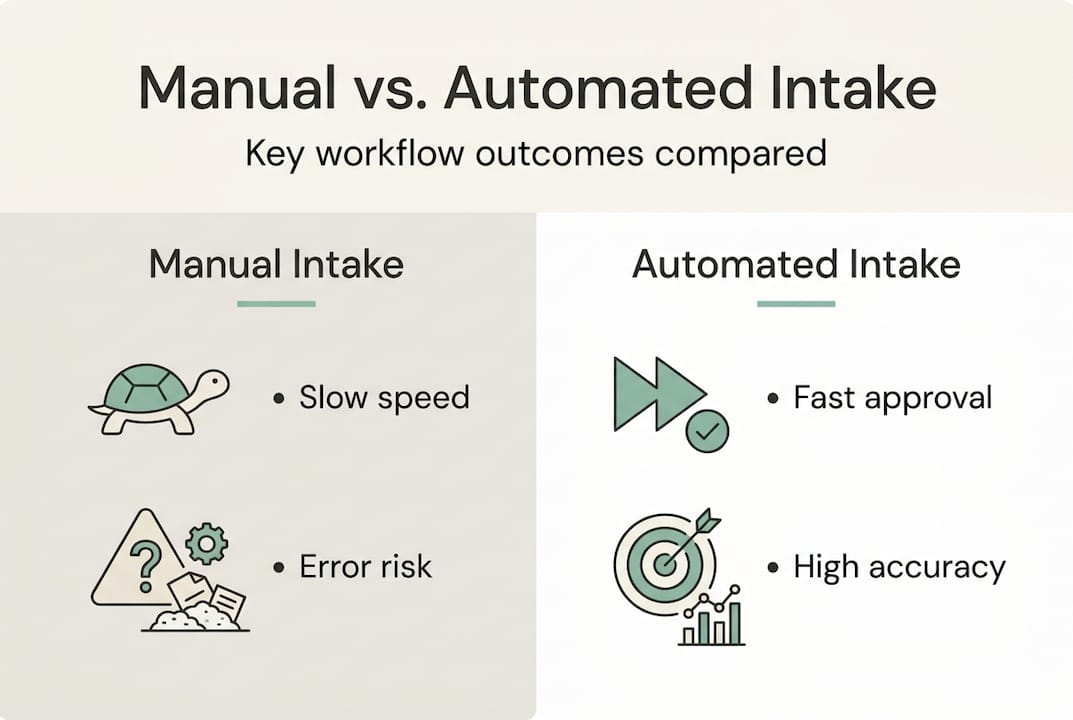
However, manual processes increase error risk substantially. Data entry mistakes, missed documentation requirements, and inconsistent eligibility verification plague manual workflows. These errors lead to claim denials, delayed reimbursements, and compliance issues that cost facilities thousands monthly. Manual intake also scales poorly. As referral volumes grow, facilities must hire additional staff rather than leveraging technology multipliers.
Automation delivers consistent accuracy, typically achieving 98% data correctness through structured validation rules and automated cross-checks. Systems never forget steps, always verify required fields, and maintain audit trails automatically. This reliability reduces claim denials and accelerates revenue cycle performance. Automation also scales efficiently. The same platform handles 20 or 200 monthly admissions without proportional staff increases.
Pro Tip: Implement a hybrid model initially, using automation for routine referrals while maintaining manual processes for complex cases. This balanced approach captures efficiency gains without sacrificing the flexibility needed for exceptional situations.
| Factor | Manual Workflow | Automated Workflow |
|---|---|---|
| Processing speed | 2 to 12 hours per admission | Under 2 minutes per admission |
| Data accuracy | 85 to 90% (human error prone) | 98% (consistent validation) |
| Flexibility | High (handles unusual cases well) | Moderate (requires configuration) |
| Initial cost | Low (existing staff) | Moderate to high (software, integration) |
| Staff impact | High workload, repetitive tasks | Reduced burden, focus on exceptions |
| Scalability | Poor (requires proportional hiring) | Excellent (handles volume increases) |
Compliance considerations require careful attention regardless of approach. Automated systems must maintain HIPAA protections, audit trails, and data security standards. Manual workflows face similar requirements but rely on staff training and policy adherence rather than technical controls. Understanding AI admission tools benefits includes evaluating how platforms address regulatory requirements and support compliance reporting.
Applying streamlined intake workflows: practical tips and benchmarks for healthcare admins
Transforming intake operations requires more than technology deployment. Successful administrators combine strategic planning, measurable goals, and ongoing optimization to maximize results and sustain improvements over time.
Set realistic benchmarks aligned with industry performance data. Aim to increase admission medication reconciliation completion from baseline levels around 13% to 80% or higher through automated prompts and workflow enforcement. Target 90% reductions in referral review times, bringing multi-hour processes down to minutes. These specific, measurable goals provide clear targets and enable progress tracking.
Track comprehensive KPIs beyond simple processing time. Monitor claim denial rates to ensure automation improves rather than complicates billing accuracy. Measure bed occupancy rates weekly to validate that faster intake translates to improved census. Track staff overtime hours and reported workload satisfaction to confirm that efficiency gains benefit your team. Dashboard tools that visualize these metrics help identify trends and emerging issues before they become problems.
Prioritize staff training as a success factor equal to technology selection. Comprehensive onboarding should cover not just system operation but the reasoning behind workflow changes. When staff understand how automation helps them and patients, adoption accelerates. Provide ongoing support through super-users, readily available help resources, and regular check-ins to address questions and concerns.
Leverage AI-powered assistants to handle routine inquiries and data gathering tasks that consume staff time. These tools can automatically request missing documentation from referral sources, send status updates to families, and flag urgent cases requiring immediate attention. By offloading these repetitive communications, AI-powered assistants for admissions free your team to focus on decision-making and relationship management.
Implement regular workflow reviews using PDSA cycles. Monthly or quarterly sessions where the admissions team examines performance data, discusses challenges, and proposes adjustments create a culture of continuous improvement. These reviews surface practical insights that analytics alone might miss, such as confusing interface elements or workarounds staff have developed.
Key improvement areas to monitor:
- Referral source satisfaction: Survey discharge planners and case managers about response times and communication quality
- Documentation completeness: Track percentage of admissions with all required paperwork at intake
- Time to bed assignment: Measure hours from referral receipt to patient arrival
- Staff utilization: Analyze how team members allocate time across tasks
| Metric | Before Streamlining | After Streamlining | Improvement |
|---|---|---|---|
| Med rec completion rate | 13% | 87% | +74 percentage points |
| Average review time | 12 hours | 72 minutes | 90% faster |
| Administrative error rate | 15% | 6% | 60% reduction |
| Staff time per admission | 45 minutes | 15 minutes | 67% workload decrease |
| Bed fill rate | 82% | 94% | +12 percentage points |
Pro Tip: Begin with pilot projects focused on your highest-volume referral streams. Targeting the busiest pathways delivers faster impact and generates compelling data to support broader rollout. Success with high-volume sources builds momentum and staff confidence.
Address integration challenges proactively by involving IT teams early in planning. Automated workflow benefits in healthcare admissions depend heavily on seamless data exchange between systems. Allocate time for testing, troubleshooting, and refinement before full deployment. Phased rollouts reduce risk and allow course corrections based on real-world performance.
Celebrate wins and communicate results broadly. When your team achieves measurable improvements in processing time, accuracy, or bed occupancy, share these successes with leadership, staff, and referral sources. Recognition reinforces positive behaviors and demonstrates the value of workflow changes to stakeholders who may have been skeptical initially.
Explore Smart Admissions solutions to streamline your intake
Transforming your intake operations requires tools purpose-built for skilled nursing and rehabilitation environments. Smart Admissions delivers AI-powered referral management that integrates seamlessly with your existing systems, reducing processing time while improving accuracy and compliance. Our platform automates routine tasks like data extraction, eligibility verification, and documentation management, freeing your team to focus on patient care and relationship building.
Facilities using Smart Admissions report dramatic efficiency gains and revenue improvements. Built-in automation handles the repetitive work that consumes staff hours, while intelligent workflows ensure nothing falls through the cracks. Real-time dashboards provide visibility into your admission pipeline, enabling proactive management of referral volumes and bed availability.
Explore examples of referral management systems to understand how modern platforms streamline operations across different facility types and sizes. Learn why intake automation in healthcare admissions has become essential for competitive facilities seeking to maximize census and revenue. Discover the specific benefits of automated admissions, including up to 20% faster bed occupancy rates that directly impact your bottom line.
Pro Tip: Contact Smart Admissions for a personalized demo showing how automation can transform your specific intake workflow. Our team will assess your current processes and demonstrate exactly how our platform addresses your unique challenges and goals.
“Smart Admissions reduced our referral review time by 85%, allowing us to accept more patients and improve relationships with hospital discharge planners who value our rapid response.”
Frequently asked questions
How can automation reduce claim denials in intake workflows?
Automation increases data accuracy by performing real-time eligibility verification and validating documentation completeness before admission. Systems automatically cross-check insurance information against payer databases, flag missing authorizations, and ensure all required fields contain accurate data. This proactive validation catches issues that would otherwise result in claim denials weeks after admission, when corrections prove more difficult and costly. Facilities typically see 40% to 60% reductions in denial rates after implementing automated intake workflows.
What are the main challenges when integrating intake automation with legacy EHR systems?
Legacy EHRs often lack modern APIs or use proprietary data formats that complicate integration with newer automation platforms. This technical mismatch requires custom development, middleware solutions, or manual data bridges that reduce efficiency gains and increase implementation costs. Staff also need adequate training to adapt established workflows and troubleshoot initial system bugs or data synchronization issues. Budget additional time and IT resources when working with older EHR systems, and consider phased rollouts that allow for testing and refinement before full deployment.
Is manual intake workflow ever better than automation for certain cases?
Manual intake allows personalized handling of complex or unusual cases that fall outside standard parameters. Experienced admissions coordinators can apply judgment to ambiguous insurance situations, negotiate special arrangements, and provide responsive communication that builds referral source relationships. This flexibility proves valuable for high-acuity patients, unique payer arrangements, or situations requiring creative problem solving. However, manual processes come at the cost of increased errors, longer processing times, and poor scalability as referral volumes grow.
How can healthcare administrators measure success after streamlining intake workflows?
Key metrics include processing time per admission, claim denial rates, bed occupancy percentages, and staff workload indicators like overtime hours. Track these KPIs weekly or monthly using dashboard tools that visualize trends and highlight areas needing attention. Compare performance against baseline measurements taken before workflow changes to quantify improvements. Regular analysis ensures continuous optimization and validates return on investment for automation initiatives. Survey referral sources periodically to assess their satisfaction with your response times and communication quality, as these relationships directly impact referral volumes.